







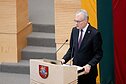




Lithuania’s Andrius Kubilius has been assigned the post of EU Commissioner for Defence and Space, which is new and shrouded in uncertainty. How influential will this post be? It is difficult to say yet, but experts note that Kubilius has the unique opportunity to define the importance of his portfolio himself.
Last week, European Commission President Ursula von der Leyen officially announced the new commissioners and their portfolios. This confirmed the rumours already mentioned in the political circles that Lithuania will get the defence portfolio.
“When we think of a defence commissioner, the equivalent of a defence minister is the first thing that comes to mind, and this can cause misunderstanding because this portfolio is not it,” Stefano Braghiroli, a lecturer at the Johan Skytte Institute of Political Studies at the University of Tartu, told LRT.lt.
“Countries have armed forces, and the European Union does not. The member states are the first to decide on their own defence policy, not the European Commission,” he added.
Nevertheless, defence policy has recently become much more important in the EU, especially after Russia’s large-scale invasion of Ukraine, while the bloc is also investing billions of euros in space technology.
New portfolio
This is the first time the Defence and Space portfolio has been created in the European Commission. Introducing Kubilius, von der Leyen stressed that “he will work to develop the European Defence Union and to increase our defence capabilities”.
The European Defence Union is defined in the Lisbon Treaty, which states that the EU must move towards a common defence policy. EU High Representative for Foreign Affairs and Security Policy Josep Borrell and EU Internal Market Commissioner Thierry Breton oversaw this area during the last EC mandate.

According to Steven Blockmans, a senior research fellow at the International Centre for Defence and Security (ICDS), Kubilius’ new portfolio takes parts of the previously existing posts. His main task now is to create a “public procurement union” for defence purchases, thus filling not only the European coffers but also those of aid to Ukraine.
“I believe that developing the defence industry’s capabilities will be the most important task of the new EC member,” Blockmans told LRT.lt.
However, the undefined budget for this portfolio may pose a challenge. Funding is expected to come from different areas related to industrial promotion. Kubilius himself mentioned controversial financing options including Eurobonds and the Recovery and Resilience Facility (RRF).
“This is a new priority area that needs resources. Ursula von der Leyen herself says that an additional 500 billion euros needs to be invested over the next 10 years. She also says that the best investment in Europe’s security is an investment in Ukraine’s security. These priorities need to be turned into reality,” Kubilius told LRT journalists in Brussels.
Defence companies remain cautious about committing to a large-scale increase in the production of weapons and other defence products without explicit financial support from the EU or national governments. For Kubilius, different opinions and approaches to defence among EU countries may also pose challenges. For example, it has already been announced that Germany and the Netherlands are opposed to borrowing at the EU level, even when it comes to the defence industry.

In the area of defence, the Lithuanian commissioner will have to help countries plan their resources and procurement and perhaps even achieve NATO’s objectives more effectively. As the post of Defence Commissioner is new, experts say that Kubilius could use this as an opportunity to broaden the scope of his work.
“However, the commissioner will have to coordinate to ensure that EU countries have enough resources and perhaps get more production for a lower price than before,” Braghiroli said.
Opportunities in space
Alongside the defence portfolio, Kubilius will also be responsible for space in the EC. According to experts, this is an area that is very well-funded and increasingly linked not only to research and civilian projects but also to military strategies.
One of the most expensive projects that the Space Commissioner will have to take care of is Galileo. This is the EU satellite navigation system, developed through the European Space Agency. The EU commissioned the system to have its own satellite navigation system, which is also suitable for military use, as it is independent of the US GPS and Russia’s GLONASS. The project cost around 10 billion euros.
In 2024, 25 satellites have already been launched, but they are expected to be replaced after 2026 by more sophisticated satellites. According to scientists, the European navigation system is already more accurate than the American GPS, with an error of less than one metre.
Another important programme coordinated and managed by the European Commission is Copernicus. This is an Earth observation programme that collects data on the planet and provides it in real time.
“These instruments clearly have a dual purpose and can be used for military purposes. I believe that this area is expected to continue to develop in an innovative and strong way, which is why the space portfolio is included in defence,” said Blockmans of ICDS.

However, this is also where Kubilius will need diplomatic skills, as the European Space Agency is not directly linked to the European Union. However, joint projects are foreseen in the near future and funding is already in place. As is the case for defence, the commissioner will have to coordinate member states’ spending on the space industry.
“If the EU wants to develop the ideas of military and strategic autonomy, it is absolutely essential that defence and space are brought together in a single portfolio,” stressed Braghiroli.
Baltic victory
The European Parliament can still reject the EU commissioners proposed by von der Leyen, but observers believe that Kubilius will not be one of them. The Lithuanian politician is expected to be approved because he belongs to the European People’s Party (EPP), which has the majority in the EP.
“He will have a strong voice in the EP, and I don’t think he faces any major risks during the hearings,” Braghiroli told LRT.lt.
Kubilius will also have to work closely with former Estonian Prime Minister Kaja Kallas, who will serve as High Representative for Foreign Affairs and Security Policy, and Finland’s Henna Virkkunen, who is proposed as Vice-President for Tech Sovereignty, Security and Democracy.
When discussing the proposed composition of the EC, Politico identified the Baltic states and Finland as the winners with important and visible posts. At the same time, these appointments reveal the EU’s position on Ukraine and Russia.
“I think these appointments symbolise a kind of middle finger to Russia” said Blockmans, a fierce critic of Russia, assessing the appointments of Kallas and Kubilius to security and defence posts in the EC.
At the same time, it signals that the EU sees Russia as the biggest security threat to Europe. According to Blockmans, it shows that von der Leyen needs politicians who understand the regional context and at the same time are not opposed to providing support to Ukraine.

Newsletter
Every Friday morning.