









Yitskhok Rudashevski is the Anne Frank of Vilnius – a Jewish teenager who left a diary describing his life in a ghetto during the Holocaust. Six years ago, it was translated from Yiddish into Lithuanian and is now a subject of an online exhibition.
“I am ashamed to appear on the street, not because I am Jewish, but because I am ashamed of my powerlessness. The yellow patches are sewn on our clothes, but not on our consciousness. We are not ashamed of the patches! Let those who put them on us be ashamed of them,” writes Yitskhok Rudashevski from Vilnius in his diary on July 8, 1941.
The YIVO Bruce and Francesca Cernia Slovin Online Museum is now open to visitors from all over the world for its second exhibition, Yitskhok Rudashevski: A Teenager’s Account of Life and Death in the Vilna Ghetto.
Based on the diary of Rudashevski, the exhibition tells the story of the Holocaust from the beginning of the Nazi invasion in June 1941 to the runup of the ghetto liquidation in 1943.
Mindaugas Kvietkauskas, one of the curators of the exhibition and translator of Rudashevski’s diary into Lithuanian, says that he learned about the diary when he was translating the work of Abraham Sutzkever into Lithuanian. The well-known Jewish poet from Vilnius was the first publisher of the diary after the war, and the book was published in Israel.
“The first time I read the diary of Yitskhok Rudashevski was when a memorial stone was installed for him on the pavement of the former gymnasium on Rūdninkų Street in Vilnius in 2016. This was the first memorial marker in Vilnius dedicated to Rudashevski,” recalls Kvietkauskas.

Encouraged by the Chair of the Lithuanian Jewish Community, Faina Kukliansky, Kvietkauskas translated the diary, which was published in Vilnius in 2018 in a bilingual Lithuanian-Yiddish edition.
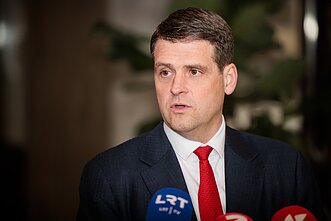
Kvietkauskas, who has done extensive research about Rudashevski, his family and their life in Vilnius, talks about his findings in an interview with LRT.lt.
The diary of Rudashevski is an extraordinary piece of remembrance, but the story of how it was discovered is itself extraordinary.
The diary was found almost by miraculous coincidence. Unfortunately, the entire Rudashevski family was murdered in Paneriai after their hiding place was found by the Nazis following the liquidation of the ghetto in September 1943.
And the only person who managed to escape from among the people who were in that hiding place was Sore Voloshin, a cousin of Rudashevski. According to her, she managed to escape from the Gestapo, which is incredible. When the Nazis discovered the hiding place, the whole family was taken to the Gestapo and interrogated before they were taken to Paneriai to be executed. Sore was a teenager at the time, and her mother, seeing the cell door open, pushed her out into the Gestapo corridor.
And then she just walked, as if blindly, she managed to go unnoticed into the Gestapo courtyard, to see a truck leaving the courtyard, and then to follow the truck out through the open gates without being seen. It is just a story of incredible coincidences. Voloshin was the only one who survived.
After that, she managed to reach a group of Jewish partisans in the woods. In July 1944, when the Soviet army occupied Vilnius, in the very first days, she returned to her family’s former hiding place to look for any remaining objects and documents. And in the attic of a house on Dysnos Street in Vilnius, on the floor, amidst the dust and sand, she saw a notebook which she immediately recognised as her cousin’s diary.
Sore then passed the diary on to the poet Abraham Sutzkever, who had also been back in Vilnius and was trying to set up a Jewish museum in the former ghetto. Later, Sutzkever took the diary to Israel and published the first version in Yiddish there.

I was fortunate to hear this story of discovery and rescue from Voloshin herself, whom I met in Jerusalem back in 2018. Although she was already in very poor health, she told me this whole story very vividly. Sadly, she is no longer with us.
What was Rudashevski’s world like before the Holocaust?
The Rudashevskis were a highly educated and intelligent family. Rudashevski’s father, Elijah Rudashevski, came from Molėtai, and later he was educated as a printer and typographer. He was a printer for one of the largest newspapers and probably the largest Yiddish daily newspaper Vilner Tog. The daily was published between the wars and was really very important. It ran a lot of writing about culture, literature, and was important for the whole life of the community.
And Rudashevsk’s uncle, his mother’s brother, Aaron Voloshin, was the administrator of the newspaper. This was a family connected with the world of the Jewish press, literature and politics. The Jewish Real Gymnasium in Vilnius, located on Rūdninkų Street, was also of great importance to Rudashevski. The Yiddish gymnasium educated the Jewish youth to be patriots of Vilnius and the Litvak community.
The milieu of the Rudashevski family and the gymnasium was secular. They were no longer religious Jews of that traditional lifestyle. Their views were secular, liberal or leftist. In general, left-wing views were really close to Rudashevski’s heart, and this is also very clear from his diary.
In preparing the exhibition, together with our colleagues from the YIVO Institute, lead curator Karolina Ziulkoski, director Jonathan Brent and Alexandra Zapruder, one of the most prominent researchers of children’s diaries of the Holocaust in the United States, we have tried to convey the whole historical environment of Vilnius, to tell it in an attractive, but also complex way. We tried to talk not only about Jewish life, but also about Jewish relations with Lithuanians, with Poles, about different political views, and especially about the tragic collisions that befell the Litvaks, Vilnius, and the whole of Lithuania. First during the Soviet occupation, then during the Nazi occupation, and later during the second Soviet occupation.

The preparation of the exhibition was also very interesting for me because of the internal discussions that took place between us, the organisers of the exhibition. We were discussing how to prepare a narrative that would be effective and acceptable to audiences in different parts of the world. The exhibition is dedicated to international Holocaust education around the world.
The best-known child testimony about the Holocaust is the diary of Anne Frank. Rudashevski’s diary is not as well-known. How would you compare their diaries, their memories, their perspectives on history and their environment?
Anne Frank’s diary has been considered a classic Holocaust diary for decades. It is a very thoroughly researched work that has been published many times. Her story has also been told in Hollywood films, in various museums and exhibitions in Amsterdam and elsewhere, wherever there are museums dedicated to the history of the Holocaust.
Meanwhile, the story of the teenage author of the Vilnius Ghetto diary has certainly remained in the shadows. One of the aims of this exhibition was to bring Rudashevski’s text back to an international audience, a text that is distinctive and certainly different from Anne Frank’s diary.
In the Vilnius ghetto and in Lithuania and Central Eastern Europe in general, the situation of the Holocaust and the war was different from what Anne Frank and her family faced in Amsterdam. In Western Europe, the Holocaust was much more brutal and that reality was different in many ways.
Another very big difference is that Rudashevski sees himself as part of a larger Jewish community that speaks Yiddish and promotes Yiddish culture. Vilnius was the capital of Yiddish culture. In a community that had very clearly retained its language, its separate identity, the aim was to expand that cultural activity. Rudashevski feels part of the cultural life of the community. The ghetto library, of which he was a truly avid user, was extremely important to him, as was the ghetto theatre, on whose stage he appeared.

Rudashevski was extremely important to the Ghetto Gymnasium and the literary evenings he attended, and he also organised youth literary evenings. In this diary we also have stories about the unarmed cultural resistance of the Vilnius Ghetto. Compared to other ghettos in European cities, the Vilnius Ghetto is particularly notable for the intensity of its unarmed cultural resistance.
It is extremely important to make this information available to an international audience, so that Rudashevski’s name is truly known alongside Anne Frank and other authors of diaries for children and teenagers. This is a unique text.
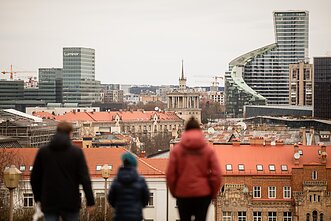
It is about Vilnius, the space of Vilnius, the places and, of course, through it, one can discover one’s own relationship to the tragic history of the Holocaust in Vilnius, to the history of the city, to the memory. It is important that not only international readers, visitors to the city, but also Lithuanian readers, Lithuanian youth can discover it.
I would like to emphasise that the Lithuanian translation of Rudashevski’s book, which was published in 2018, has also received a great deal of attention as a visually well-designed book, with a lot of new archival material and photographs. The book was designed by artist Sigutė Chlebinskaitė.

The diary’s impact is confirmed by the fact that, back in 2017, excerpts from it were included in the Lithuanian literature curriculum in our secondary schools. The Rudashevki’s diary and its history appeared in the textbooks of the 8th grade programme. The diary has become part of our education, alongside the traditionally read diary of Anne Frank.
Thanks to the Goodwill Foundation and the Ministry of Education, Science and Sport, the 2021–2022 edition of Rudashevski’s diary has been donated to libraries in several hundred Lithuanian schools.
Rudashevski’s writing is truly powerful, with sayings such as “words on paper burn with blood”. Is this typical of a fifteen-year-old? What would his future have been, had he not perished in Paneriai?
Rudashevski was a very thoughtful and ambitious young man. He undoubtedly had literary talent. His literary talents stood out, and they appeared very early. He thought of himself as a future writer or historian. He was also very interested in historical research and had begun to research the history of the ghetto, collecting stories from people in the streets where he was imprisoned.
He was very much encouraged by his school, by his teachers, and then in the ghetto gymnasium. Reading the diary, we also see the phenomenon of sudden maturity, when, especially in an extreme situation, a child, a teenager, grows up incredibly quickly and begins to think very independently and very critically.
Rudashevski’s diary contains a wide variety of very pertinent insights and sharp observations about the life of the ghetto itself, the ghetto council and the activities of the so-called Judenrat. He appears as a very politically motivated, critical teenager, condemning the forms of coping with the Nazi authorities, condemning humility, waiting for an armed resistance from the ghetto underground. In his writings, he was very keen to defend his Jewish and, at the same time, his Vilna identity against the humiliation that was oppressing him.

You have been researching Judaica for many years, you have read many memoirs and translated many works. What struck you most about translating Rudashevski’s diary?
There are a lot of tragic, authentic scenes told by a child, and they sound very real and unadulterated. You can feel the fear, the despair and the faith in the text.
One of the scenes that struck me the most is the situation described by Rudashevski at the gates of the Vilnius Ghetto, when his whole family was going through the “selection”. They were very lucky, they were let through the ghetto gates, but they were stopped by their grandmother, whom he loved very much. The guards did not let her pass, they separated her from the family and they realised that she was going to be taken to Paneriai to be shot. The moment when they are forced to leave her alone is described in an extremely shocking, extremely painful way, and he writes how he cannot sleep, how he sees the eyes of his grandmother being left to die in front of him.
Another scene is when he is hiding in a storeroom during a ghetto manhunt by a group of Lithuanian collaborators. He stands trembling in the storeroom, hiding behind a wooden wall. And he can feel the trappers walking around, shining torches, trying to see where the Jews are hiding. A woman with a baby is also hiding among the people. Suddenly the baby starts crying. The people are so frightened that they start shouting at the mother to strangle her baby because it will betray them all.
When I was reading these scenes, translating them, I really could not sleep sometimes afterwards.
Did Rudashevski have any hope that this testimony would survive?
He believes in the word, he believes in writing, he believes in the book itself, and it turns out that his premonition that what he writes will make sense, will survive, in spite of everything, comes true. His faith proved correct. His face, his narrative were supposed to be completely gone, but his story does not end with his death in Paneriai.
Perhaps the most hopeful thing in reading [Rudashevski’s diary] is the faith it gives in writing, in creative endeavour, in the work of resistance, in resistance within without collapsing.

Rudashevski’s little book endures, survives many decades and comes to new generations. This is the greatest hope and perhaps the lesson that his diary teaches now, how not to break down, how to survive in extreme situations.
What is the place of Rudashevski’s diary in the context of global memory?
I can say that it is a truly unique source of Holocaust history, one of the world’s most important child diaries about the Holocaust. A diary that until now has been very little known. The aim of the organisers of the exhibition was to highlight its importance, so that the diary of Rudashevski could be seen as a classical source of history.
How many more stories are there still undiscovered or untranslated?
You never know how much hasn’t yet been discovered. There are certainly many more Lithuanian Holocaust sources. I think Berl Kagan’s diary, A Jew in the Forest, in which he describes his hiding with a Lithuanian family and his relationship with his Lithuanian rescuers, should be translated. Kagan was a prominent journalist in Kaunas between the wars, and he and his wife were hidden by a very ordinary Lithuanian family of farmers.
This diary is extremely interesting because it tells the story of the relationship between Jews and their rescuers, and the entire rescue network. I think it is very important to understand the human relationships that very often determined the rescuers’ decisions.
Do you see a growing interest in Judaica, Jewish heritage in this country, openness to talk about the Holocaust?
I think that this is the result of an intensive process of discovering and making sense of the Jewish heritage that has been going on for more than a decade. It is very important that not only state institutions be involved, but also many people who volunteer, who read the names of the Holocaust victims in various Lithuanian cities and towns, where they are discovering the local Jewish history.
It is a very varied and intensive process. Jewish memory is becoming part of our own social memory. It is very important for us to realise that the tragedy of the Holocaust is a tragedy of the Lithuanian citizens. It is not only the tragedy of the Jews, but also the tragedy of Lithuania. And it is our loss.

Newsletter
Every Friday morning.