













As Ukraine receives its first batch of F-16s, the American-made jets have been patrolling the Baltic airspace since 2004.
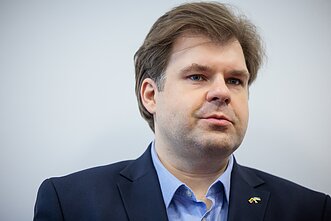
LRT.lt sat down with Lieutenant Colonel José Diaz-Kimba, the lead pilot of the Portuguese rotation of the NATO air policing mission, to speak about his career, the job of guarding the airspace above Lithuania, as well as the famous F-16 jet.
How long have you been a pilot and why did you choose this career?
I joined the Air Force in 1998. At the Portuguese Air Force Academy, the course lasts four years, after which cadets join a flying school in a training squadron to learn how to become a pilot. Of those who complete pilot training, some go on to fly fighter planes, some transport aircraft and others fly helicopters.
When I started flying fighter aircraft and taking part in missions, there was a rush of adrenaline because this kind of machine, whether we want it or not, gives us an adrenaline rush inside.
As I got older, I realised that there was a greater motivation for all of this – that by doing this work we are making a legitimate contribution to peace in Europe, in our own and other countries where we operate. For me, that is the motivation. I feel driven to do something that creates a better future for my children, someone else’s children, and all of us.

How long have Portuguese troops been in Lithuania?
We were first deployed here in late 2007. Since then, we have been deployed here, in Šiauliai [airbase], seven times.
What is working in Lithuania like? What has changed since 2007?
I sense there have been important changes in Lithuania since 2007. I think the country has changed on all levels. In the beginning, everything was new and we were new, Lithuania was new to us, and the relationship was new. I was here in 2007 and I remember well the support of Lithuania and how much you worked at that time to meet our requests. Being here now, in 2024, I can see that things have only improved.
The people at the Šiauliai Air Base are working hard, doing everything they can to support us. Every time we come here, we are welcomed with open arms because it is a friendly place, the faces are familiar, and we know the base. Being in Šiauliai is always a good experience.
What is the process if you want to become a fighter pilot?
Specifically for the Portuguese Air Force, we accept young cadets after a selection process. The selection process starts with a medical screening – they need to be physically strong. Before that, there is a psychological screening, which is psychological tests
After the medical screening, there is a test for physical fitness. The last stage involves a couple of flights in a simple aircraft to confirm that the cadets have at least the minimum coordination to become pilots.
From all those who pass these four stages, it is possible to choose who will join the Air Force Academy.
Depending on grades and performance, we choose [...] the best of the best and then the four-year process at the academy begins.
You mentioned the adrenaline rush of flying. I guess those are the words you would use to describe the feeling of piloting a fighter jet.
What we do with the F-16 is demanding, from the physical level to the brain. It requires a lot of attention, we don't have a lot of space to think about things. It's strange to say, but when we're piloting an F-16, there's not much time to think about feelings because we're very focused on the mission, on what we need to do right.
I don't feel much when I'm piloting an F-16, but when I can, it's the adrenaline rush and the exhilaration of what I'm experiencing: the supersonic speed, the high G-forces, the curvature of the Earth, because the higher you go, the rounder the horizon gets. [...] When we have time to think, that's what we feel, it's magical. I would say it's also a bit humbling because when we are up there and we look down, we see how small we are. We see that Klaipėda [by the Baltic Sea] is so close to Šiauliai [in northern Lithuania].

How long does it take you to fly 150 kilometres from Šiauliai to Klaipėda?
It depends on how fast we're getting up to speed, but if we're in a hurry, we can fly in 3-4 minutes. Under normal conditions, it would take 10 minutes.
Have you ever encountered a non-NATO fighter jet and escorted it away?
Yes. It happens to the Portuguese Air Force here in the Baltics and quite often. But it has also happened in Portugal when we have similar air policing missions. There are non-NATO aircraft flying over international waters that need to be escorted.
What does that escort process look like for a non-NATO aircraft?
It depends on who we are escorting, but generally speaking, there is no communication via radio. This is the reason why NATO launches fighters to escort non-NATO fighters – because we do not talk to them.
Is it a non-verbal indication that the aircraft is not in its territory?
Yes and no. It is a non-verbal indication that NATO is here. But they are in international waters and, under international law, they have a right to be there. However, certain procedures have to be followed and, when those procedures are not followed, NATO can decide whether or not to release the aircraft to escort them. The real objective, of course, is security, because we do not know what these aircraft are doing, regardless of their country of origin.
When it comes to the F-16 fighter jet, it is said to be indispensable in air combat. What makes this fighter so special?
Well, I am a little biased because that is what I pilot. I think that the F-16 is a very important combat aircraft, and there are a couple of arguments to support that.
First of all, the numbers. The number of F-16s is high, which means that their interoperability is also better because a battle involving two fighters is different from a battle involving 20 fighters. If you need to go into combat or carry out a mission with 20 jets, there is an advantage. Even in terms of logistics and maintenance, it is easier to have more fighters because they need more parts. There is also an advantage in functionality.

The fighter is highly manoeuvrable and capable and, in terms of combat, whoever manoeuvres best will have the advantage.
The other advantage that I see, although it is a bit of a paradox, is the age of the fighter – we know how it works, and there are no surprises. We are improving it and adding new capabilities all the time: new sensors, new weapons, new ways to communicate. Even though it is an old aircraft that we know very well, it is still a new fighter in terms of capability.
Even if the F-16 is not a fifth-generation fighter, [it] can interoperate with fifth-generation fighters simply because the F-16 is evolving. I see this as a major advantage – the F-16 has been modernised to the extent that it practically looks like a fifth-generation fighter. I realise that I am exaggerating a little because fifth-generation fighters have much more capability than the F-16, but it can carry a large number and variety of weapons, it has a wide range of sensors, and it is easy to operate and maintain. That is what makes it a valuable tool for the Air Force.

Newsletter
Every Friday morning.