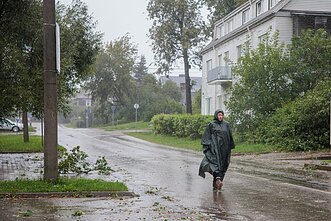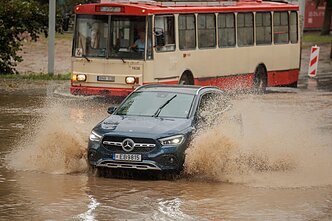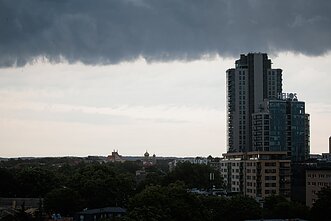















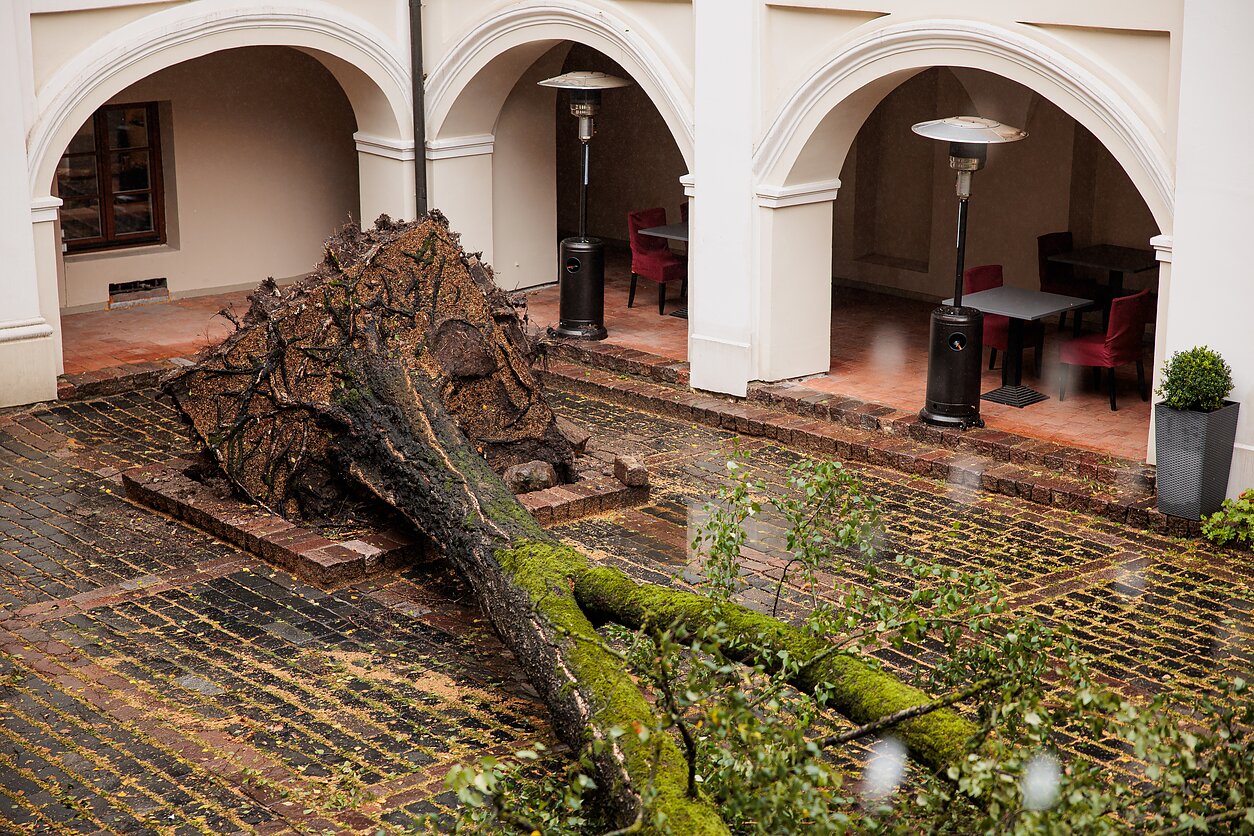
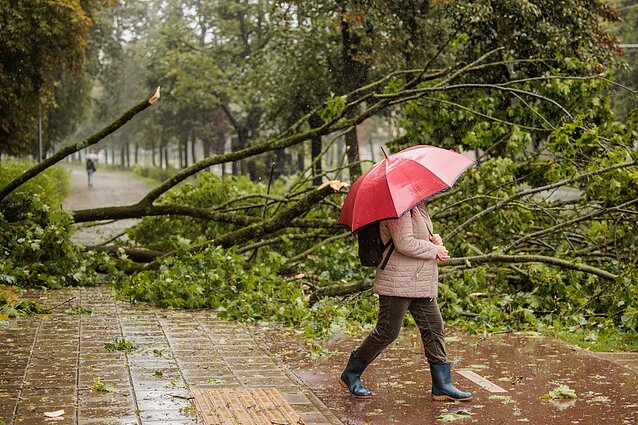
A powerful storm swept through Lithuania on Sunday and Monday, uprooting trees, leaving thousands of households without electricity, and even killing one person. According to meteorologists, this was an atypical phenomenon for this time of year.
“It is more typical of late autumn or winter, both in terms of wind speed and cyclone intensity,” said Gintautas Stankūnavičius, an associate professor at the Department of Hydrology and Climatology of Vilnius University (VU).
The Lithuanian Hydrometeorological Service has reported that in parts of Lithuania (Telšiai, Šiauliai, Laukuva, Mažeikiai, and Kelmė District), more than a month’s worth of rain fell in 24 hours, while strong winds were also reported.
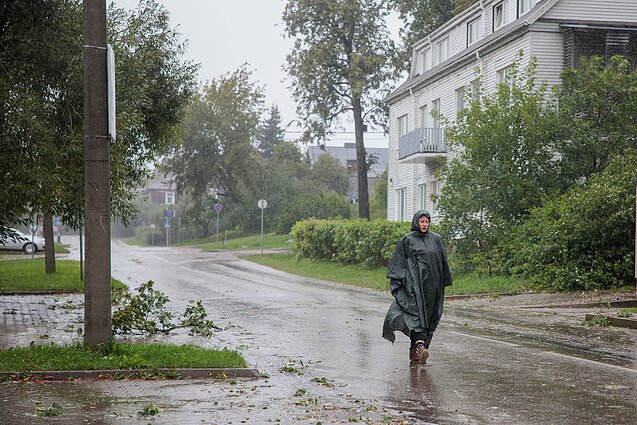
According to meteorologist Gytis Valaika, although such storms occur in Lithuania every few years, there has not been such a precipitation event for a long time.
“The last time we had a similar storm, with weaker winds and less rain, was in August 2021, if I remember correctly. But it was definitely weaker. It is very rare that so much precipitation falls,” the meteorologist told LRT.lt.
Came from France
According to Stankūnavičius, an associate professor at Vilnius University, the cyclone that caused the storm started to form in France and then travelled to Lithuania.
“The cyclone was very weak at first, but it quickly began to develop in the southern part of the Baltic Sea region, reaching its maximum at the Lithuanian-Latvian border,” he said.

One of the main components that are important for the formation of such a storm is a large temperature contrast, the meteorologist said.
“Cyclones develop very often off the coast of America because there is a thermal contrast – the warm Gulf Stream and the cold Labrador Current meet very close to the continent. Here, we have a polar air mass in western Europe and a near-tropical air mass in south-eastern and eastern Europe,” Stankūnavičius explained.
More dangerous phenomena
Stankūnavičius said he doubted that climate change could have caused the powerful storm.
“That would be a very bold statement,” he noted.
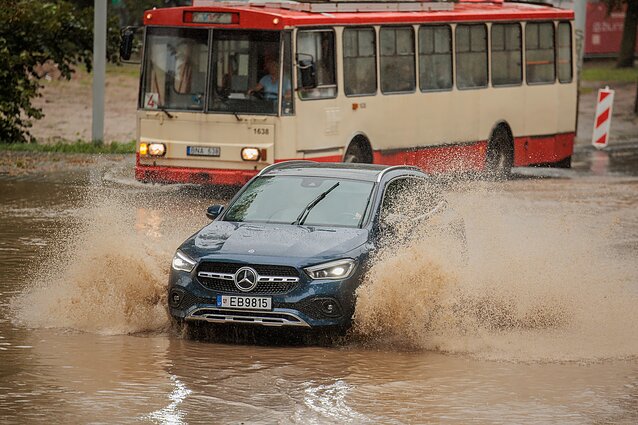
According to meteorologist Valaika, more detailed research is needed to answer this question, but there may be some assumptions about the connection between these phenomena.
“Perhaps there was some impact because the atmosphere is getting warmer, and for several months now the atmosphere around the world has been record warm. And the more heat, the more water vapour can be accommodated, and the more water vapour there is, the more storms occur because water vapour is like fuel for storms,” he said.
Valaika also noted that the general trend is not positive when looking at all the weather phenomena in Lithuania.
“The frequency of dangerous natural phenomena is increasing, especially those related to rain. In the face of climate change, Lithuania is mainly affected by heavy rainfall,” the meteorologist said.
Stankūnavičius, an associate professor at Vilnius University, also added that the most noticeable effect of climate change is that warmer air masses are increasingly arriving in Lithuania in summer and staying longer.
Further reading

Newsletter
Every Friday morning.