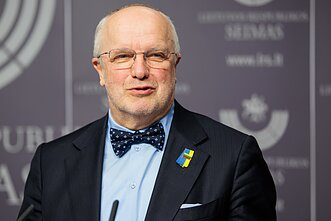








Lithuania will start building permanent border fortification at two locations in September and the first counter-mobility park will be opened at the end of August, Defence Minister Laurynas Kasčiūnas has said.
“On August 22, we will invite you all to the opening of one of the counter-mobility parks, the engineering park in Pabradė, and there will be a total of 27 such parks, and they will start to be established on a weekly basis,” Kasčiūnas told a press conference at the government headquarters on Monday.
“By the end of the year, we have to fill all 27 counter-mobility parks with all the main four types of equipment – dragon’s teeth, the well-known blocking tool, prefabricated ‘hedgehogs’, Spanish riders, and roadblocks,” he said.
The counter-mobility parks will be located near the border, Kasčiūnas noted.
“When the intelligence services light up an indicator, it will be possible to move all this to the arteries [main roads],” the minister said.
According to him, permanent fortifications will be set up in two locations.

“We won’t be very specific about what these places are, some are near Kaliningrad, some are near Belarus. At the beginning of September, we will start permanent fortification processes in two places,” Kasčiūnas said.
“This will include the installation of fortifications on the banks to prevent the enemy from crossing the shoals and the fortification of some bridges,” he added.
The Defence Ministry launched a tender for the counter-mobility equipment in May and contracts were awarded in June.
“The production is already in place, we have pictures of all that equipment, now the question is how to get it to these counter-mobility parks more quickly,” the minister said.
According to Kasčiūnas, the national defence system sees a need for 600 million euros for the acquisition of counter-mobility equipment over a decade. Most of it will be spent on mines
The leaders of Lithuania, Latvia, Estonia and Poland have signed a letter calling on the EU to build a defence line along the bloc’s eastern border with Russia and Belarus to protect against military and hybrid threats from these countries.

Mine production
Kasčiūnas has also said that Lithuania plans to expand its mine reserves and may even start producing them in the country.
“The most important and the most resource-consuming, but also the most effective, thing is the development, strengthening and purchase of mine capabilities,” Kasčiūnas told reporters.
According to him, Lithuania is already acquiring mines, and purchases are planned for next year as well.
“Our main focus is on the acquisition of anti-tank landmines, and different types of anti-tank, horizontal action and bottom mines are being acquired, because we are talking not only about landmines, but also about naval mines,” Kasčiūnas said.
The ministry is also talking with Lithuanian companies about producing mines here, he noted.
“We are talking to our industry, to our associated structures, and we have raised the idea of whether it would be possible to make a Lithuanian mine, maybe a simpler one, but one that would be effective,” the minister said.
“Some companies have already signalled that they may start doing this, and we will have meetings in August to see what the prospects are for producing a Lithuanian mine. [...] If we could start producing Lithuanian mines, that would be wonderful,” he added.
The Baltic countries and Germany signed a letter of intent on the joint purchase of sea mines on the sidelines of the NATO summit in Washington in July.

Newsletter
Every Friday morning.