










A full integration of Ukrainians in Lithuania is hardly possible while the war in their homeland continues, say local NGOs. Many of them are following the situation at home with an eye to returning once it is safe.
Art therapy session at the women’s support NGO Frida is intended for Ukrainian women who fled the war. They are flipping through old magazines to create a collage on the theme “My world and I”.
Their world has indeed changed substantially, say the Ukrainians who are trying to build their lives in Lithuania.
“We got used to it, it was difficult, but we want to go home every day,” says Xenia Krushlenytska. “We were about to go back at the end of the academic year, but a few weeks ago, a thermal power plant was blown up in our town, about 2.5 kilometres from our home. If they can get it sorted out before the winter, so that our schools can operate, so that there is water and electricity, then we will go back, but if not, we will stay.”
Edita Skopič, a psychotherapist who runs integration classes for Ukrainian women, admits that most of them are living in waiting until it is safe to return home.
“About 20, maybe 30 percent, are those who have already found jobs and boyfriends, so for them [integration] is important,” she says. “And there is another part that are really determined to go back.”

Krushlenytska agrees: “If you have a place to go back to, if you are attached to your home or if you have somebody who fights for you, then you think about home every day.”
According to NGOs, successful integration of Ukrainian refugees in Lithuania while the war continues is difficult or even impossible.
“We as a country should also call it something else and not demand that they integrate, we should call it staying together and adjusting the processes so as not to put pressure, not to make demands,” says Daiva Baranauskė, head of the Frida NGO.
While Lithuanian laws require that all employees whose work involves dealing with customers speak the local language, for Ukrainians under temporary protection this requirement has been suspended for three years.
As many Lithuanians speak Russian, communicating with locals is not an issue – but the downside is that learning Lithuanian takes longer.
“They [Ukrainians] themselves says: we enter a shop, they hear us speak and start speaking Russian. They have no place to practice [Lithuanian],” says Skopič.
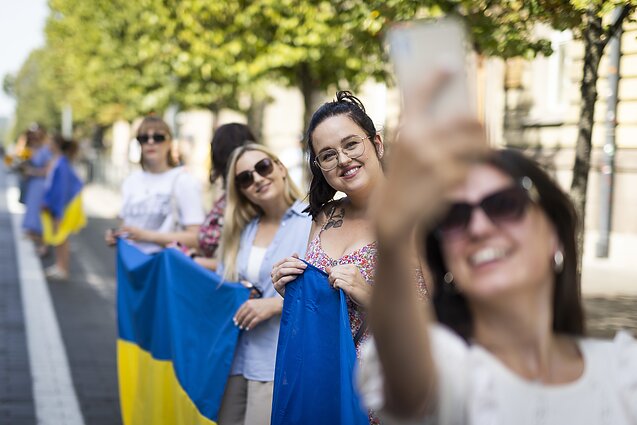
According to the United Nations refugee agency, about 50 percent of Ukrainians who arrived in their host countries at least six months are working. Others cite the language barrier or the care of young children as the main obstacles to finding work.
“Women are picky because they come with small children, so they have to balance childcare,” says Gabrielė Monkevičiųtė of the Lithuanian Employment Service. “Most of them do unskilled jobs, which often comes in shifts, so that makes it more difficult to integrate.”
Psychological traumas of war are also a barrier to integration.
Moreover, with the war in its third year, local Lithuanians are less willing to offer assistance.
Ukrainians granted temporary protection are entitled to social assistance, a one-off resettlement allowance and compensation for pre-school education.
“We can see that the initial mobilisation that was there in spring 2022 has subsided, attention for this group has decreased, but it is important to note that Ukrainians are still coming to Lithuania, the war is not over and that attention to the new arrivals in particular, to help them to make a successful start in Lithuania, is very important,” says Vuta Kontvainė, spokeswoman for the UN Refugee Agency.
According to the data of the Migration Department, about a thousand Ukrainians have arrived in Lithuania in the last month. In all, 75,000 Ukrainians have residence permits in Lithuania, more than half of them are considered war refugees.

Newsletter
Every Friday morning.