












The Rail Baltica project in the three Baltic states may need 10-19 billion euros more than planned, auditors from Lithuania, Latvia and Estonia said in a joint report.
One of the EU’s biggest infrastructure projects in the Baltics, Rail Baltica is meant to connect the three countries and Poland with a European-gauge high-speed railway. The construction, however, has been beset by delays.
“The Rail Baltica project’s progress is at risk because its estimated cost has quadrupled over seven years and the project’s size could lead to a budget deficit of 10–19 billion euros,” the auditors said on Wednesday.
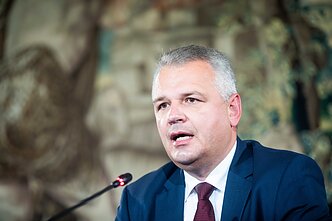
“The project will not be completed by 2025 as planned. Not only the five-year delay in the project’s implementation is a cause for concern, but also the more than four-fold increase in its budget, which will require an additional almost 9 billion euros to implement the planned works in Lithuania,” Auditor General Mindaugas Macijauskas said in a statement.
The authorities estimate that a further 19 billion euros will be needed to complete the entire project: 2.7 billion in Estonia, 7.6 billion in Latvia, and 8.7 billion in Lithuania.

The auditors calculated the estimated need for additional funding by looking at the latest Rail Baltica budgets for the three countries, including European Union (EU) and national funding already committed since 2014 and still to come, 23.8 billion euros across the Baltic states.
According to the auditors, Rail Baltica’s deficit would be reduced to 10.1 billion euros by 2030 (1.8 billion in Estonia, 4.4 billion in Latvia and 3.90 billion in Lithuania) if the countries reduce the scope of work as they are planning, by building local stations with minimum functionality or delaying their construction, and by building single-track railway on some sections.
However, it is not clear how much funding will be made available for the project from 2028 onwards from the Connecting Europe Facility, which is currently the main source of funding, according to the report.
According to the auditors, there will be a gap in European funding between 2027 and 2028, which will have to be covered by the Baltic countries themselves.
Even if the countries manage to complete the first phase of the project by 2030, they say, the trains may not start running in 2031, as procurement could take eight years.
According to Macijauskas, if Rail Baltica is to be operational in 2030 or 2031, it is necessary to decide now whether the trains will be bought or rented, or whether the operators will have to use their own trains. According to the auditors, this decision has not yet been taken by the countries.

Moreover, the costs of purchasing, maintaining, and operating the trains are not included in the project budget and cannot be financed with EU money.
According to the auditors, countries have still not taken several important decisions to make the new infrastructure operational by 2031.
“There is no decision setting out the roles, responsibilities and principles of governance of the railway, including how profits and losses will be shared, conflicts will be resolved, etc.,” the report says.
According to Lithuania’s Ministry of Transport and Communications, the entire Rail Baltica project connecting the Baltic countries to Europe is scheduled to be completed in 2030, while the connection between Lithuania and Poland is expected to be completed in 2028.
Rail Baltica will connect Tallinn, Pärnu, Riga, Panevėžys, Kaunas, Vilnius and Warsaw. In Lithuania, the track will run 392 kilometres.
The Baltic joint venture RB Rail said on Monday that Rail Baltica has appreciated in value by a factor of 2.6, to 15.3 billion euros, in six years, compared with an estimated value of 5.8 billion euros in 2017.

Minister blames Lithuanian Railways
Transport Minister Marius Skuodis blames the Baltic joint venture RB Rail for the slow pace of the construction of Rail Baltica and calls on Lietuvos Geležinkeliai (Lithuanian Railways, LTG) to identify those responsible for the delays in Lithuania.
“Once and for all, we have to stop talking and covering for each other. Even the State Audit Office fails to indicate clearly who is responsible. The responsibility lies with the Baltic joint venture, which has not provided us with projects for two years,” Skuodis told reporters in Jonava.
“If the LTG, its management board, doesn’t take responsibility to find those at fault and make them answer, the Transport Ministry will. I’m also talking about people who are no longer in their positions; they shouldn’t feel safe,” he added.
On Tuesday, Skuodis publicly urged LTG to accelerate the construction of the European standard-gauge railway.

“In our letter of expectations to the LTG management board in 2022, we wrote that the essential works [on the railway section] up to Panevėžys had to be completed in 2024,” the minister told reporters in Jonava.
“Today, although the work is well underway, which can’t be denied, we aren’t yet talking about completion,” he added.
Skuodis emphasised that the Rail Baltica project must be completed in 2030, with the Lithuanian and Polish lines to be connected in 2028, and the Lithuanian and Latvian lines in 2030.
“We’ll do [the work] up to Panevėžys. But if I don’t see progress from the Latvian side in building the tracks toward Lithuania, we’ll have questions about our further work,” he said.

The minister criticised Latvia and Estonia for what he described as smaller-scale construction efforts compared to Lithuania, noting that the countries prioritise building stations over tracks.
“What I don’t want is to do what some of our neighbours are doing – using the funds for building stations. We need tracks. I’m pleased that in Lithuania, we are building tracks, not stations. The private sector will build the stations,” he said.
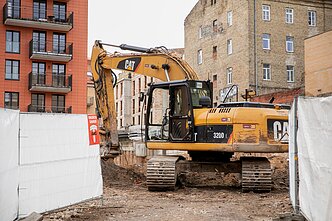
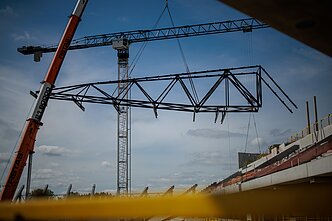
RB Baltic says that in Lithuania, the construction of 29 kilometres of the mainline is underway, with plans to extend the construction to a 70-kilometre section by the end of the year.
Estonia has started the construction of 21 kilometres of the mainline and Latvia is planning to start building the first 13 kilometres in the coming months.

Newsletter
Every Friday morning.