








The European Parliament election concluded this Sunday, with eight Lithuanian parties sending their delegates to Strasbourg and Brussels: the Homeland Union – Lithuanian Christian Democrats (TS-LKD); the Social Democratic Party of Lithuania; the Lithuanian Farmers and Greens Union; the Freedom Party; the Union of Democrats “For Lithuania”; the Electoral Action of Poles in Lithuania–Christian Families Alliance (LLRA-KŠS); the Liberals’ Movement, and the People and Justice Union (centrists, nationalists). What does this mean for Lithuania and Europe?
Predictions and reality
Prior to the elections, political analysts predicted Europe swinging to the right, and their predictions came to fruition this voting cycle.
France’s right-wing National Rally won against President Emmanuel Macron’s Renaissance party, causing the president to dissolve parliament and call for elections.
Austrians also voted right with the Freedom Party of Austria and the conservative Austrian People’s Party taking the lead for the first time.
“Far-right parties are growing in influence. Not radically, but increasing nonetheless, which means that making joint European decisions will be even more difficult than before. So, we will miss that good, real Europeanness and we will have quite high tensions within Europe itself,” said Lithuanian President Gitanas Nausėda.

Lithuania’s voters, meanwhile, were predicted to lean towards the opposite side of the political spectrum, with the centre-left Social Democratic Party enjoying the highest pre-election ratings.
Despite leading in opinion polls, the Social Democrats took second place in the EP elections with two mandates, while the conservative TS-LKD snatched three as the frontrunner.
“Both parties have quite a strong electorate, but it is the TS-LKD that brings its voters to the polls, no matter what, and the Social Democrats have an unpleasant tendency – the real results tend to lag behind their ratings, as we have seen again,” said political analyst Ignas Kalpokas.
First reactions mixed
Lithuania’s newly elected MEPs have had positive as well as negative reactions to the results.
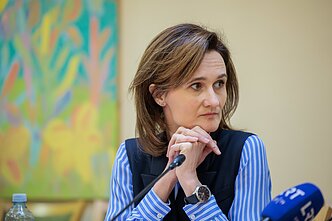
Social Democrats expected to gain three mandates this time around, but Vilija Blinkevičiūtė, chairwoman of the party and re-elected MEP, is celebrating their repeated success of gaining two mandates, despite the low voter turnout of 29 percent.

The Lithuanian Farmers and Greens Union’s expectations were crushed even more, as they were hoping for three seats in the EP. However, their only winner, Aurelijus Veryga, said, “it feels good to finish the job of representing our voters in the EP. We are happy, we had forecasted it, we had hoped for better, but it is a very good result.”
The People and Justice Union’s Petras Gražulis commented on his triumph as well, “a miracle has truly happened. Many say there is no God. There is God. If I got more [votes] in a liberal society than the liberals, there is God. I will definitely go [to the European Parliament].”
Veryga has shown a willingness to work with Gražulis in the European Conservatives and Reformists Group by saying, “we can judge a person for their character in all sorts of ways, but in the end, it is the push of a button that determines one way or the other, that is constructive or not constructive. [...] I hope that he will join the group that represents conservative values. [...] I think he will behave in a collegial manner.”

No one is happier than the Freedom Party and the Union of Democrats “For Lithuania” for their first victory in the EP elections – “the [political] party is only two years old, it’s our first election, and we managed to win a mandate,” said Virginijus Sinkevičius, the democrat’s elected candidate.
The Freedom Party has outperformed their fellow liberals in the Liberal Movement, with the latter implying that the party used the Lithuanian Pride on the election weekend as an electoral platform. To which the party’s chairwoman Aušrinė Armonaitė replied: “It was a natural step for us to take part in the march. I am very sorry that other party leaders and heads of state did not find the time. [...] If it helped the Freedom Party, I hope it will be an invitation to other leaders to also support the LGBT community and the issues that are important to it in Lithuania.”
The parties that did not clear the 5-percent threshold have indicated they will take time to reflect upon their strategies. The Labour Party says it is considering restructuring the organisation, while the National Rally sees Petras Gražulis’ victory as a vindication of their own positions.
Support for Ursula von der Leyen
Ursula von der Leyen is seeking to be re-appointed as president of the European Commission, but most of Lithuania’s MEPs have yet to extend their endorsement.

So far, only the conservative delegates, who belong to von der Leyen’s European People’s Party group, [JŠ2] stand in her corner.
Andrius Kubilius, who was re-elected with the TS-LKD list, said, “we will certainly try to convince opponents to support the candidacy of the current president. The nomination of von der Leyen as president of the commission should be seen as a common interest of Lithuania”.
Other MEPs have indicated they wish to vote based on coalitions and groups that they will join in the parliament.
On the other hand, Petras Gražulis was blunt about his dislike of the current EC president: “Why should I vote for her?”

Newsletter
Every Friday morning.