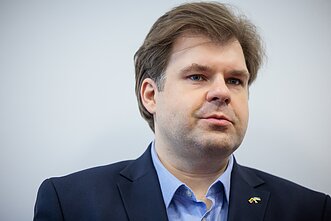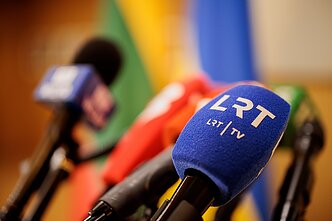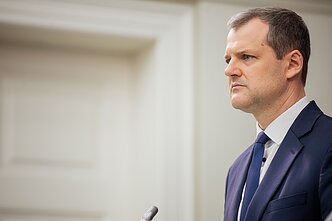


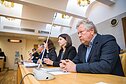


Serhiy, Genadiy, and Maksym survived almost two years in Russian captivity. In an interview with LRT.lt, they shared their first-hand experiences of torture. “I hope that Lithuania will never experience what our country has gone through these years,” said one of the soldiers, Genadiy.
Serhiy Hudziuk and Genadiy Zbandut, both from Mariupol, defended the city as long as they could. When it finally fell, the Ukrainians retreated to the Azovstal plant. They fought there for almost three months, while the whole world watched.
“During the war, we saw many horrors, how Russians tried to ‘help’ the city. We saw the aftermath left by the Russian missiles, as well as the bodies of civilians in the streets because nobody could pick them up,” Serhiy told LRT.lt.
“We stopped thinking about ourselves. We only knew that we had to complete our order – to defend Mariupol,” said Genadiy.

Eventually, the besieged and constantly attacked Azovstal defenders started to run out of ammunition. Then they received the order to surrender.
“[We] were the first people to be captured. We were carrying two wounded soldiers,” said Genadiy.
Maksym Paltanin was a regular worker, but soon after the invasion, on March 5, 2022, he was mobilised. He was fighting in the Kharkiv region, which is still under heavy Russian pressure.
“Why are civilians in Kharkiv guilty? Why are they being killed when they just go to the stores? I also know civilian houses, cars in Kharkiv are just being bombed. There might be children,” said Paltanin.
After three months of fighting at the front in Kharkiv, Maksym was captured by the Russians.

In Russian captivity
“The first thing we heard when we were captured was to forget the Geneva Convention,“ told Genadiy.
He and Serhiy were held together. The men said that the Russians did not call them prisoners of war (POW) but coined a new term – “people who resisted special military operation”.
“The food didn’t matter. All that mattered was that we were always under the psychological pressure. We didn’t know what would happen to us the next day, the next 30 minutes,” said Serhiy.

The men said that the Russians called them fascists, Nazis, nobodies.
“The word bad cannot describe how they treated us. They treated us not as human beings but as animals. They were brainwashed into thinking that they were here to save us, all Ukrainians,” added Maksym.
Many testimonies of the Ukrainians who have returned from Russian captivity as well as their relatives are shocking. There is not only the lack of food and medical care but also cases of humiliation, torture, sexual abuse, death sentences, and even murder.
One of the most staggering tragedies was the Olenivka prison massacre when an explosion killed 53 Ukrainian prisoners of war. Most of them were Azovstal defenders. Kyiv claims that the attack was carried out by the Russians.
“There were some days when I felt like I didn’t want to experience the next day,” Maksym shared. He said these POW camps reminded him of the 1940s – the only modern thing in them was the CCTV cameras.
They were also deprived of food and medical help and only those in severe pain were given antibiotics.

Having been in five POW camps, Maksym said that the last one was the worst. Eight people were made to stand for 16 hours in a cell measuring two by five metres.
“You are just standing there from the morning to the night. They tell you to sing the Russian anthem and you have to remember every letter of the anthem, every comma, every dot, who wrote it and what the Russian flag looks like. If you cannot answer, they torture you. You cannot talk to each other, you can only look straight ahead and you have half a minute to eat,” said the soldier who survived Russian captivity.
This is what the Russians called the “welcoming to the camp”.
Serhiy also said that many of the Ukrainian soldiers who were captured were sentenced to 10–20 years in prison for crimes they did not commit. They were told to sign documents for an alleged exchange, said Ukrainian.

“They would come back having signed the papers that convict them of the crimes they didn’t actually commit, or they would just come back all beaten because they didn’t sign them,” he explained.
The most awful thing is to hear others being tortured, admitted Maksym.
“You go through the tortures every day just because you are Ukrainian and they probably do that to show you that you are Ukrainian and not a human. It’s basically a genocide, and you cannot do anything when this is happening. There were instances when people were just murdered, killed when they were going through the torture. And you feel like you can do nothing, you just stand there and can do nothing,” Maksym explained.
The soldiers also said they did not see the Red Cross during their captivity.
“I know many of the places where our soldiers are being locked and we know for sure that there is no Red Cross there,” Serhiy said. Kyiv has repeatedly criticised the organisation’s inaction in the war-torn country.
The men admitted – it is difficult to talk about all this. Difficult because many Ukrainians are still held captive by the Russians. According to Serhiy, after each interview, the Russians, who monitor the information space, torture POWs even more.
“There is a lot of our men in the captivity, and I want to ask for the release of all of them because they have been in Russian captivity for more than two years now. And the conditions are horrible,” Maksym said.
But how is it possible to survive in such terrible conditions?
“I hoped very much that my son and wife were alive and I would meet them. I talked to God about it in my mind,” Serhiy answered.
Maksym said that it was not only the thoughts of his loved ones that gave him strength but also the Ukrainians who were imprisoned with him.
“There was one soldier, Dima, who celebrated his 30th birthday in captivity last year. He helped me a lot”, he said.
For Genadiy, the pillar of strength was his faith in the future of his hometown. Before the war, he had spoken to Ukrainian President Volodymyr Zelensky about the development of Mariupol.
“When I was fighting, when I was in captivity, I dreamt of a free Mariupol. I still believe that it will be free and that the water park promised by President Zelensky will be built there”, the Ukrainian noted.

Finally – homeland
After 22 months in captivity, Serhiy and Genadiy returned home. Maksym survived 19 months of Russian captivity. When asked how they felt returning to Ukraine, all three men sighed and smiles lit up their faces.
“Unforgettable. It feels like your second birthday, but in a way, it’s the first because nobody expects to be released. After you survived Azovstal, where you were attacked from all sides and had nothing more to fight back, and the captivity, when you come back you see the flags, you see the people, you remember the numbers of all your relatives, you call them. And everyone was waiting for you,” Serhiy shared.
“On the way to Dnipro, we crossed all the villages. It was night and in all the villages people would come out with lights and shout ‘Slava Ukraini’. Then you finally feel that you are in your homeland,” said Genadiy.

The Ukrainian soldiers who returned from captivity underwent rehabilitation in Lithuania with the help of the organisation Back to Life. They say that this is especially important for them because hospitals in Ukraine are overcrowded. Moreover, Lithuania has peace and quiet.
“In Ukraine, you hear air alerts every day. And here there is silence. You can enjoy the silence. Every family in Ukraine is affected by the war, and there is no region that has not experienced war. But this silence cures. Ukraine doesn’t have it, we have to fight for it”, Serhiy stressed.
Soldiers pointed out that, after such experiences, rehabilitation is necessary to recover not only physically but also psychologically. However, they all insisted they will return to the front as soon as they can.
“It is important that every Russian neighbour knows that Russia can only bring grief and horror. I hope that Lithuania will never experience what our country has gone through these years. We are defending the world,” Genadiy said.

Soldiers said they were frustrated that although the war started in 2014, the West was still struggling to come up with a unified response. They emphasised that Ukraine is not the limit and Russia will attack countries west of it. They believe that the Russians themselves support this aggression by Vladimir Putin.
But the Ukrainian soldiers were also in no doubt – Russia has already lost.
“Moscovia has already lost. If we look at their propaganda, they are still living in the past while Ukraine is fighting for the future. The sooner the international community recognises this, the sooner we will achieve peace.
We have a future and they are living in the Soviet Union,” said Ukrainian Genadiy.

Anna Humenna from the Ukrainian Youth Group in Lithuania helped with the translation.

Newsletter
Every Friday morning.