















East London's Beckton was once nicknamed Bektoniškės and Little Lithuania due to its large Lithuanian diaspora. Following Brexit and rising rental prices, the Baltic face of the area has been changing.
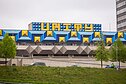
Beckton still hosts a Lithuanian restaurant Bernelių Užeiga, as well as a Lithuanian school. The epicentre, however, is a supermarket that houses a grocery and flower shop on the ground floor, with the first floor dedicated to a Lithuanian cafe, jewellery shop, beauty salon, bookshop, and law firm.
The Knygnešys (book smuggler) shop was opened in 2007 by Lina Garnytė before being permanently based in Beckton in 2008. There are now over 16,000 different titles available here in Lithuanian. As part of the cultural programme, the bookshop also hosts various talks and events.
“We organise educational lessons for children because there are Lithuanian language schools around. We also had a candlelight concert, as well as a police investigator as a guest where we talked about detectives in books and in reality,” said Garnytė.
“Book presentations are regularly held here, and we have had a huge number of guests from Lithuania,” she added.
Various well-known Lithuanian authors have presented their works here, including Nijolė Narmontaitė, Nomeda Marčėnaitė, Beata Nicholson, Kristina Sabaliauskaitė, and Andrius Tapinas.

According to Garnytė, it’s not easy to maintain the Lithuanian bookstore, but being in the Lithuanian shopping centre helps.
“That’s why we depend on each other. Because there is a grocery store, jewellery store, and beauty salon, there are also people coming here. It would be harder to work separately,” she said.
However, many of the emigres have been moving back to Lithuania or a different part of London, according to Garnytė.
'Lithuanians are now scattered'
The shopping centre is also home to a legal firm, separated by a glass wall from the bookstore.
“Within four to five months of working here, it became clear that there was a real need for legal services, people needed help with certain documents,” said Laura Nenartavičienė, one of the founders of the company. “The main issues are divorce, powers of attorney, inheritance, pensions. There is also a small percentage of people who don't speak English, even though they have been living here for many years.”
According to Sandra Širvienė, another co-founder of the company, they decided to open the law firm in the shopping centre due to the large number of Lithuanian people that come here.

“It feels like Little Lithuania. It was also strange to communicate in Lithuanian all day because we were used to English,” she said.
Although the co-founders do not live in the area, they say Beckton has been favoured by Lithuanian emigres for years.
“Wherever there were more Lithuanians, that’s where the newcomers would also settle,” said Nenartavičienė.
“But now the Lithuanians are scattered. Lithuanians come here to eat, shop, and get haircuts, but there are fewer Lithuanians living in Beckton than before,” added Širvienė.
According to them, the area used to be more secluded, but over the years it has become more accessible to central London, meaning the rental and property prices have gone up.
“Prices became unaffordable for many and then Lithuanians started moving further south of Beckton,” said Širvienė.

People moving out
Aiva Ivanovienė has lived in Britain for 15 years. For the past nine years, she has worked at a beauty salon in Beckton.
The majority of her clients are Lithuanians, but the number of Romanians, Ukrainians, and Britons is growing.
When she started working here nine years ago, she often heard people describe the area as “Little Lithuania” or “Becton’s Little Lithuania”.
“People who had never visited before said they felt like they were in Lithuania because everybody spoke Lithuanian, no English was needed,” she said.
Kristina Kaminskienė, one of the clients at the salon, said Lithuanians were once drawn to the area because of the attractive rental prices. Many of them have also managed to buy their own homes.
“We are pleased that there are very good transport links to central London and there is plenty of space to park a car. But prices have changed a lot, both here and in England in general,” said Kaminskienė. “A lot of people are now trying to move out because of the prices.”
An urban myth?
Petras Tverijonas is a priest who has lived in London for almost 25 years. However, he is sceptical about Beckton ever deserving the “Little Lithuania” title.

According to him, people started referring to Bektoniškės around 2007 when Lithuanians were starting to travel and work freely in the European Union. Up to 8,000 Lithuanians then settled in Beckton.
At the time, there was even flag-painting rivalry between Brits and Lithuanians at a local park.
The Lithuanian tricolour would be sprayed over the white-red-white graffiti, only to be covered again by the colours of the English St. George flag.
“Only now there is no more of this play fighting,” said the priest.
However, Bekton has never been an exclusively Lithuanian district, said Tverijonas.
“It’s a myth that you could speak Lithuanian everywhere you went,” he said.

Beckton, like other areas of East London, was attractive at the peak of Lithuanian emigration to the UK because of the rental prices.
“Becton was attractive because [...] of the relatively cheap rent and the proximity of the builders’ commute to work. I used to joke that Jesus was a carpenter like the average Londoner,” said Tverijonas.
The change was mostly spurred on by the financial crash of 2008.
“Since that crisis, Britain has not recovered. A large number of wealthy people from all over the world invested in London property, while salaries for Lithuanian builders and other professions were stagnating, so they had to go further afield to buy their own home,” said Tverijonas.
“Because of the extremely high rents and house prices, Lithuanians are moving both to Lithuania and to other parts of England,” he added.
Even if Beckton is no longer an epicentre for Lithuanian emigres, there are still around 300,000 people living in Britain, most of them in London.

Newsletter
Every Friday morning.