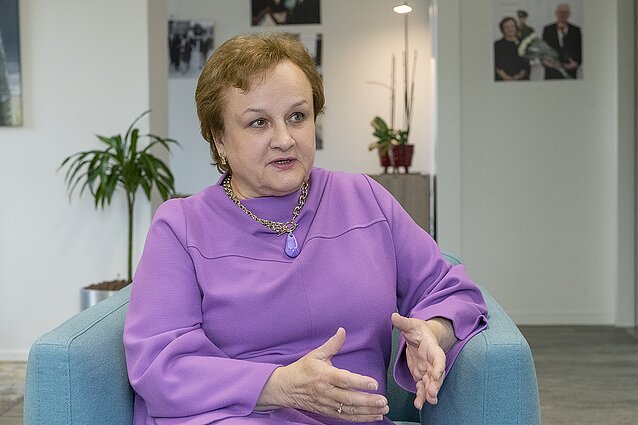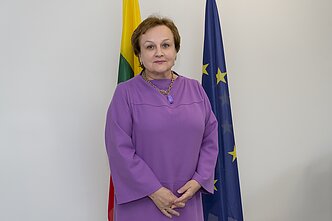






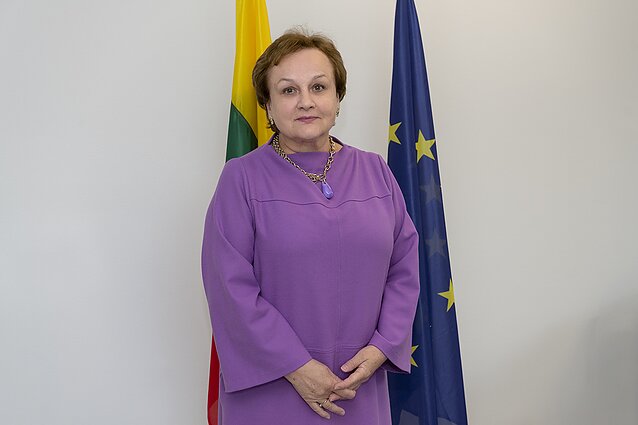
On May 1, Lithuania celebrates 20 years of membership in the European Union, a powerful economic and political union. We spoke with former minister of European affairs Laima Andrikienė, one of the key figures in Lithuania’s EU accession process.
She is also a former member of the European Parliament, the national parliament Seimas, and a signatory to the Act of Independence.
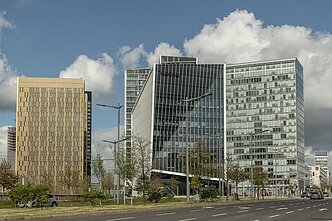
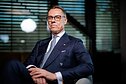
Now Lithuania’s delegated member of the European Court of Auditors in Luxembourg, she keeps photographs on her office wall that testify to many memorable moments in an illustrious political career. Andrikienė’s insights underscore the profound impact of EU membership on Lithuania: from security and economic development to individual freedoms.
Ms Andrikienė, we know that international recognition and full-fledged membership in Western alliances was a goal, right from regaining independence. What were the most challenging moments in this process of preparing to become an EU member state?
Lithuania made an official application for EU membership on December 8, 1995, leading to the start of formal negotiations on February 15, 2000.
I recall many challenging problems we had to overcome on our path to the EU. It is worth mentioning our large-scale privatisation programme, including Lithuanian Telecom, the Mažeikiai oil refinery, Klaipėda seaport stevedoring companies, the Lietuva Hotel, Lietuvos Kuras with all its gasoline stations across the country, etc.
A huge task ahead of us was the implementation of the acquis communautaire – legal acts and court decisions that constituted the European Union law, the EU’s legal system. Try to imagine more than 35,000 pages of different EU regulations and directives to be integrated into Lithuanian law, before that discussed and approved by the parliament. It required setting up a special legal section in the EU Ministry.
One of the most contentious issues was the abolition of the death penalty, a hot potato not just for the parliament (Seimas) but also for Lithuanian society.
As a minister, I was advocating the abolition of the death penalty. This wasn’t solely to meet EU demands, but because of our Christian faith. For a predominantly Roman Catholic nation, the death penalty shouldn’t exist in our society and judicial system.
It was a tricky situation because even the Catholic Church in Lithuania was not supporting us until the then archbishop of Vilnius, Audrys Juozas Bačkis, stated during an interview that he was in favour of abolishing the death penalty. Finally, on December 31, 1998, the death penalty was abolished in Lithuania.
Another sensitive issue was our energy policy, specifically related to the Ignalina Nuclear Power Plant with its two Chernobyl-type reactors in Visaginas (north-eastern Lithuania) and a clear demand from the European Commission to close that power plant. The Visaginas plant was finally closed in 2009. In total, eight nuclear sites were closed in new EU member states Lithuania, Slovakia, and later in Bulgaria.
In addition to the energy sector, another challenge arose when EU Commissioner Hans van den Broek visited Vilnius in 1997, with a large delegation, and brought a new, prominent issue to the forefront: reparations and restitution of property to the Jewish community.
What were the best outcomes of the accession process and negotiations?
The absolute highlight of the accession process? Of course, hearing the “yes” from the European Commission and the EU Council and especially considering we were part of a ten-country group and we had started the accession negotiations in 2000 with a two-year delay.
Reaching that milestone in December 1999 at the Helsinki EU Council Summit wasn’t just a win for Lithuania on a national level, but a personal one for me as well. In retrospect, achieving membership in just nine years, from our 1995 application letter to 2004 accession, feels incredibly fast. Though back then, it seemed like an eternity.
In which areas do you think Lithuania benefited most from EU membership?
It is an extensive list. But let’s start with the most important situation now, Russia’s war against Ukraine. We managed to avoid war and live in peace inside the EU. We now live in a union that respects European values, call them human, Christian, or European values, the rule of law and human dignity.
Being part of the EU offers a safe haven, it feels like paradise in comparison to what Russia does in Ukraine, and the situation in Belarus. Our European borders are respected, but we have dangerous neighbours.
EU membership has strengthened democratic institutions and fostered a vibrant civil society. We also received significant financial assistance from the EU. Almost 30 billion euros from the EU between 2004 and 2022 helped to transform our country remarkably and irreversibly.
In addition, Lithuanians enjoy the freedom of movement within the EU for people, goods, services, and capital. Some may criticise emigration, but it is about the freedom of people, one cannot keep them by force. Everybody enjoys living in a democracy. I may not have all the numbers but look at the enriching experience of large numbers of Lithuanians studying abroad benefiting from the Erasmus programme. Upon return, they are more content and motivated.
Coming back to the energy security problems, when after the first European elections in Lithuania in 2004, Vytautas Landsbergis and I arrived at the European Parliament, the issue of energy security was high on our agenda. One nuclear reactor of the Ignalina plant had already been closed and the second one would be soon thereafter. And there was the issue around the Mažeikiai oil refinery with the cut-off oil supplies from Russia.
Initially, we met a lot of scepticism from other MEPs as a common energy policy wasn’t part of the EU constitution. Slowly but surely, we all in the EU were moving in the direction of having an EU energy security strategy, and from 2015 there was the EU Energy Union! It required an enormous effort. We reduced and mostly eliminated our dependency on Russian energy. Now we are interconnected, no longer an energy island, and that feels a lot safer.

Finally, as part of the EU, we can trade with the entire world, from the USA, Canada, and Asia to Latin America. Imagine the resources we would require negotiating and signing bilateral trade agreements with all these countries.
Did EU membership benefit mainly cities and tax-free zones such as those in Kaunas, Klaipėda, Šiauliai, Panevėžys?
Larger cities with universities, colleges, industrial enterprises, and tax-free zones have undoubtedly benefited from EU membership, but there has been a positive impact on smaller towns. My birthplace, Druskininkai, a small spa town with a population of about 12,500, is a good example showcasing the improvements in infrastructure, businesses, and overall vitality, fuelled by a combination of EU funding and local initiatives. Visiting recently, I saw restaurants full of young people and families. Locals speak of a rebirth.
We must acknowledge the challenge of attracting young people who often gravitate towards larger cities for education and opportunities. However, success stories like Anykščiai, Palanga, and Molėtai demonstrate that smaller towns can reinvent themselves, as now we see with Teltonika’s high-tech investment in Molėtai.
The Common Agricultural Policy is expected to result in fewer farmers producing more food due to technological advancements. While younger farmers feel more optimistic and are adapting, older farmers may feel disadvantaged, and both groups complain about subsidy distribution. [...]
How do you see Lithuania's role in the future of the European Union?
We will be a forward-looking and modern country. We are a competitive regional leader, especially in areas such as fintech, within the EU. Of course, we have a much larger neighbour, Poland. Our highly educated society is one of our solid foundations and assets to make significant contributions to the EU’s future.

Newsletter
Every Friday morning.