











Banks are closing their branches throughout Lithuania, leaving some regions severely underserved. Instead, they have installed a hundred new ATMs, saying everyone has good access to a cash point. That is not enough for some clients.
The western Lithuanian town of Telšiai has a population of over 20,000 and titles itself the capital of Samogitia. Several bank branches operate in the town as well as a handful of ATMs. Telšiai residents say these serve their needs well, but people from other towns and villages often have to travel to a nearby city to get cash.
“It’s really bad. There is no bus, hard to come. Once you’re here, it’s difficult to return home. With all that cash, someone might mug you,” says a resident of a nearby village.
Responding to public pressure, banks have installed 100 additional ATMs in rural regions over the last two years. They say that, currently, 90 percent of the population can withdraw cash within 10 kilometres from their place of residence.

However, customers see another problem: banks are closing more and more of their physical branches. They say it makes no sense to maintain them, since with the expansion of online services hardly anyone goes to a branch.
According to a poll, 60 percent of the population did not visit a physical bank branch once last year. A third went to one up to three times, and three percent said they visited a bank between three and six times.
Consumer rights groups say that is because many simply do not have access to conveniently located bank branches.
“People might be happy to talk to and consult a bank teller about how to do things better, to make transactions, but all people are left with is online banking,” says Marius Jansonas, board member of the Consumers Alliance.
Banks say that is not the case. Where there are no branches, banks send their employees to help people solve their issues. There are other options.
“Credit institutions offer virtually all their services by telephone. That is, you can call your credit institution and get everything sorted out,” insists Eivilė Čipkutė, president of the Association of Banks.

According to the World Bank, the Netherlands has the lowest number of bank branches 5.5 per population of 100,000. Latvia has just under 7 branches, Estonia has 7.5. Lithuania has about 11 bank branches per 100,000 people. In Europe, the most accessible credit institutions are in Spain and Luxembourg. Bulgaria has almost 6 times more physical bank branches than Lithuania.
“It probably make sense that if a bank closes a branch that used to provide cash services, there should be an ATM in that place so that people can at least withdraw money or deposit it through an ATM,” says Edita Lisinskaitė of the central Bank of Lithuania.
The problem is that cash is getting more expensive. For example, SEB Bank changed the prices of its service plans in April. For customers without a monthly plan, withdrawing 500 euros costs 10 euros, more than double the previous 4-euro fee.
“I wouldn’t say that we’re raising fees,” counters SEB Baltic Private Client Segment Manager Linas Januševičius. “It’s just that we’re changing our everyday banking services and introducing new plans. We’ve raised the free withdrawal limits in all plans.”
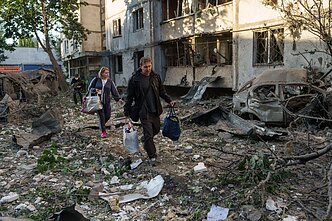
Jansonas, of the Consumer Alliance, says that pressures to move towards a cashless economy do not make sense at the moment, particularly as the war in Ukraine has demonstrated the vulnerability of infrastructures underlying cashless transactions.
“Today, we need to actually keep two or three-months-worth of wages at home at the very leas,” he says. “Look at Ukraine, certainly when such events happen, all the banks and ATMs are closed, people have to survive somehow on their own.”
Both the Association of Banks and the Bank of Lithuania say that they do not notice that the war in Ukraine has led to an increase in cash withdrawals by Lithuanians.

Newsletter
Every Friday morning.