















A Lithuanian company co-owned by the mayor of Kaunas has been exporting sanctioned items, classified as “battlefield goods”, to Russia, the LRT Investigation Team has found. Vičiūnai Group admits it was shipping goods needed to maintain its factory in Kaliningrad, but claims it was not aware the items were sanctioned.
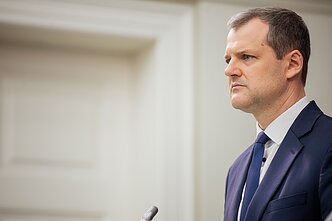
Plungės Kooperatinė Prekyba (Plungė Cooperative Trade), based in western Lithuania, belongs to the Vičiūnai Group of companies co-owned by Kaunas Mayor Visvaldas Matijošaitis. The company’s main activity is the production of surimi food products.
However, LRT Investigation shows that the company is used by Vičiūnai Group to export goods to Russia. It supplies the Vičiūnai-owned Vičiūnai-Rus plant in Sovetsk, Kaliningrad, with equipment, parts, and labels.
The company continued to export to Kaliningrad even after Moscow invaded Ukraine and the EU imposed a series of sanctions on Russia. The exports even include goods classified as battlefield items and put on the EU’s sanctions lists.

What are battlefield goods?
As part of their sanctions on Moscow, the EU, the US, the UK, and Japan published a list of “common high priority items”, or battlefield goods, to limit their exports to Russia.
It lists goods needed for the production of armaments. These items are barred from even being transited through Russia. The point of the list is to restrict Russia’s ability to develop its military technology, defence and security sectors.
“The list is based on information on the components of armaments found on the battlefield in Ukraine,” explains Arūnas Adomėnas, senior adviser of the Operational and Non-Tariff Measures Control Division of the Lithuanian Customs.
The list currently includes 50 items that are of particular importance to the Russian weapons system. Some of these goods were banned at the beginning of the war, others were added later in subsequent sanctions packages.

The LRT Investigation Team has documents showing that Plungės Kooperatinė Prekyba was exporting bearings – used in various types of machinery, including tanks – to Russia, as well as light-sensitive semiconductor devices, electrical components, and other goods included in the sanctions.
Moreover, according to LRT sources, Plungės Kooperatinė Prekyba was one of the companies over whose activities Lithuania received a warning from the European Commission. Lithuania was warned about battlefield goods exported to third countries in January-July 2023 that ended up in Russia.
Products from a manufacturer that left Russia
In April 2022, a few months after the start of Russia’s large-scale attack on Ukraine, the world’s largest ball bearing manufacturer SKF, based in Sweden, announced that it was ceasing operations in Russia.
“We have concluded that we can no longer continue to operate in Russia as there is no basis and no stability for our business,” SKF CEO Rickard Gustafson said in a statement at the time.
However, the Swedish company’s products were among those exported to Russia by Plungės Kooperatinė Prekyba. Since the beginning of the war, the Lithuanian company made 11 shipments, five of them after these specific product codes were added to the EU sanctions lists.
Information about the shipments was gathered by the LRT Investigation Team from the ImportGenius system. It publishes data from Russian customs offices that report the fact of entry of goods into the country. Specifically, Plungės Kooperatinė Prekyba transported SKF ball bearings to Russia.
Bearings are an essential element of any mechanism and are essential for the Russian military industry. They are used to manufacture heavy vehicles, including tanks.

Russia, which used to import ball bearings from the US and Europe, has been experiencing shortages even before the Ukraine invasion, due to fractured supply chains during the Covid-19 pandemic.
The situation became even more complicated since 2022. Last year, a study by the Center for Strategic and International Studies in Washington revealed that Russia does not have enough bearings to sustain the continuous production of new vehicles.
The EU added a number of bearing types to the sanctions list as early as July 2022 and further extended the list in February 2023. The EU, the US, the UK, and Japan have also added bearings to the list of battlefield goods.
In imposing the sanctions on bearings, however, the EU provided exemptions for contracts signed before February 26, 2023. An additional month was added to complete any ongoing agreements.
However, documents held by LRT show that Plungės Kooperatinė Prekyba exported bearings to Russia until the end of June 2023. This is the latest data provided by ImportGenius.
The receiver of the goods in all cases was the Vičiūnai-Rus factory in Sovetsk, Kaliningrad.

Data analysed by the LRT Investigation Team show that, in addition to ball bearings, other controlled dual-use goods were shipped to Russia. According to the commodity codes declared to the Russian customs authorities, these are light-sensitive semiconductor devices and electrical components. These goods are also classified as high priority battlefield goods.
According to data available to LRT, Plungės Kooperatinė Prekyba transported prohibited goods to Russia on 11 different dates.
Blame on customs authorities
In a reply sent to LRT, representatives of Vičiūnai Group admitted that they had transported sanctioned goods to Russia, but insisted that they were not aware of this. They say the Lithuanian customs authorities failed to inform them about the sanctions.
“Spare parts for food production equipment have historically been purchased in Lithuania and transported centrally to all Vičiūnai Group plants, so this technical export continued to Russia. Parts to support the operation of food production equipment are usually supplied in complete assemblies, so neither we nor the Lithuanian customs were aware of the sanctions imposed on individual elements.
“As soon as we were informed, we stopped the process and started an internal investigation,” the company said in a written statement.
When asked when and by whom they were informed of the sanction violations and when they suspended the process, the group has not replied.
Meanwhile, Adomėnas of the Lithuanian Customs insists that it is the responsibility of the exporting companies to keep track of any sanctions that may apply to them.

“The EU regulation imposing restrictive measures is directly applicable in all member states and in Lithuania. It applies to all persons. It is the responsibility of companies involved in imports and exports to be aware of these laws,” said Adomėnas.
According to him, the Lithuanian customs authorities could only let through a shipment of sanctioned goods if it were transported to Russia via third countries.
“Lithuanian Customs has risk assessment systems that work by commodity codes, by other criteria, usually when restrictions are imposed on certain goods, the company creates a risk profile that works by code [...]. When [the bans] came into force, the risk profile should have been triggered: the customs officer receives instructions on how to check. If it is found that bans are in place, the goods are not allowed to be exported,” Adomėnas explained.
Exports have not stopped
Available data show that since the start of the Ukraine war in February 2022, Plungės Kooperatinė Prekyba has exported a total of more than 5-million-euros worth of goods to Russia.

According to customs declarations, these were mainly spare parts for previously imported equipment. Since the beginning of the war, almost 1,300 items – manufactured by Siemens, Multivac, Festo, Motovario, Schneider Electric and others – have been shipped from Lithuania to Russia by Vičiūnai Group.
Liudas Skierus, one of the shareholders of Plungės Kooperatinė Prekyba, says that all exports have since halted. “We were exporting. We are no longer exporting now,” the businessman told the LRT Investigation Team.
The last shipment was sent “after the new year”, he clarified.
Business in Kaliningrad continues
Vičiūnai Group’s Russian plant, Vičiūnai-Rus, is the largest employer in Sovetsk, a town of some 40,000 people. Although Visvaldas Matijošaitis, the mayor of Kaunas and co-owner of Vičiūnai, has attracted much criticism for failing to divest from Russia, the plant is still in operation today. Russian commercial registers show that the shareholders of Vičiūnai-Rus and other Vičiūnai Group companies have not changed to date.
Earlier this week, however, the Russian newspaper Kommersant has reported that the Lithuanian group received permission in February from the Russian government’s Foreign Investment Control Commission to sell Vičiūnai-Rus.
Speaking to LRT, the plant’s co-owner Skierus was not able to say when Vičiūnai Group would finally leave Russia.
“If we knew the date, if we could manage the process, if it was up to us... We could say [the date]. We don’t control it... We can’t do everything,” he said.
When asked about possible buyers, Skierus would not comment either.

“There have been interested parties since the very beginning when we put [the company] on sale. But the process is very complicated,” the businessman explained.
Baltko, which sells Vičiūnai products, and its subsidiary Baltko Neva are both based in Moscow. Based in Sovetsk are the logistics companies Refterminal, Frost Logistics and Vičirustrans, all directly owned by VG Holding, the owner of Vičiūnai Group. Frost Logistics also owns the logistics company Centrum in St Petersburg.
In total, there seven companies related to Vičiūnai Group operate in Russia.
In Kazakhstan, which is in a customs union with Russia, the group owns the trading company Vičiūnai-Kazakhstan.
The LRT Investigation Team also approached Kaunas Mayor Matijošaitis, the other co-owner of Vičiūnai Group, about the sale of business in Russia and the export of sanctioned goods. He has not responded.
Matijošaitis and Skierus each own 50 percent of the shares of VG Holding, the owner of the Vičiūnai Group.
Further reading
PM orders an investigation
After this investigation was published in Lithuanian, Prime Minister Ingrida Šimonytė said that the Customs Department has been instructed to investigated what goods were exported by Plungės Kooperatinė Prekyba.
The authorities will then decide whether national restrictions should be tightened or whether the company should be subjected to liability for breaching sanctions.
“We’ve agreed that a thorough internal investigation will be conducted within the Customs, and then I think we’ll be able to say what really happened here,” Šimonytė told reporters on Tuesday.
“Different situations call for different measures. If there’s ambiguity, we’ll assess if our current national restrictions are sufficient or if they need tightening. But if it’s a straightforward breach of sanctions, there are the codes and liability for that,” she said.
The internal investigation will seek to clarify whether the dual-use goods shipped to Russia are subject to strict EU sanctions or to Lithuania’s national restrictions on their exports to third countries, according to the prime minister.

Newsletter
Every Friday morning.