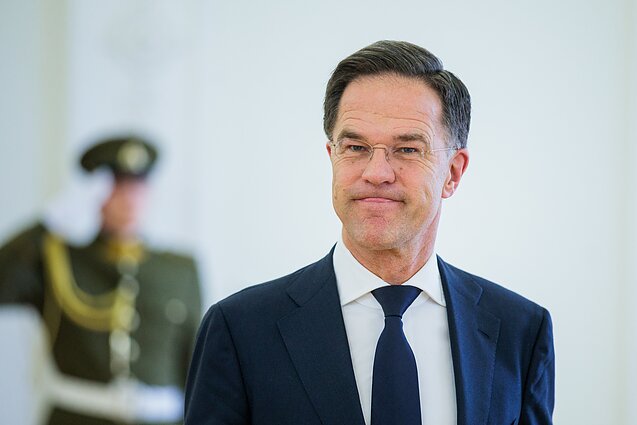









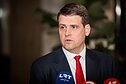




Dutch Prime Minister Mark Rutte is seen as the front-runner in the race to succeed Jens Stoltenberg as NATO secretary general, and Lithuania supports his candidacy. In an interview with LRT, he says the Netherlands considers Lithuania’s border with Russia and Belarus as its border.
Further reading
If you were to become the next NATO secretary general, your term would coincide with a period during which the war with Russia may come, as many intelligence services and defence ministries in Europe warn. What does NATO still have to do to be prepared for this eventuality?
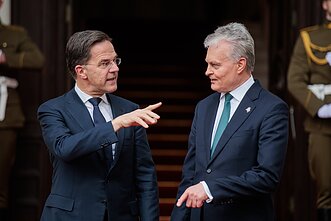
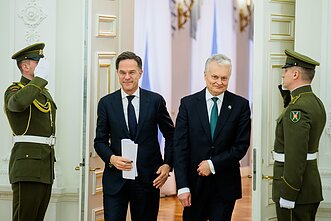
It’s always a bit difficult to talk about myself in a new role. Let me tell you what I want to do as prime minister of the Netherlands, and we discussed this at length with the Lithuanian president here in Vilnius.
It is crucial that NATO maintains a deterrence, that we all realise that this border of the Baltics and other countries on the eastern flank with Belarus and Russia is our collective border. And let me assure you that since the Malaysian airliner MH17 came down on July 17, 2014, killing 298 people, including 196 Dutch people, for us in the Netherlands, our border is also with Russia. Not literally, but at least mentally. That means that we have to do everything to make sure that we maintain deterrence and to make sure that Putin understands that if he made the slightest move towards EU and NATO, he would be in big difficulty.
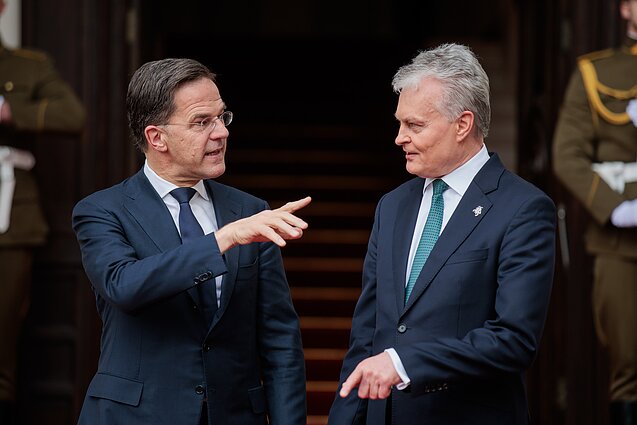
But in more concrete terms, what does it mean to maintain the deterrence?
First of all, it means all of us spending at least 2 percent [of GDP] on defence. It means also increasing our defence of the eastern flank. We discussed, for example, the future of the NATO Enhanced Forward Presence here in Lithuania. We know that Germany is committing a huge increase of its capacity here, and we are working with the Germans to see how we can best navigate that in the future.
But it’s also about air policing. It’s about air defence. It’s about enough Patriot systems in Ukraine, for example, around Kharkiv where they do not have any form of air defence or almost no air defence, but also on the eastern flank. We have to address all these issues collectively over the coming months.
Are the Western European societies prepared to mentally shift to the war economy?
What I saw in my country, and I was really taken by that and happy about that, is that after the unprovoked Russian invasion of Ukraine, there was huge societal support to spend 6.3 billion euros we committed to Ukraine. That means that we will also take all the necessary steps in the future to make sure that NATO as a collective maintains a deterrence, and that as countries, we are able to support Ukraine in this effort against Russia.
There is a lot of support in the Netherlands for what we are doing at the moment, being much further away from Russia than you are.
Your country is saying a loud “no” to the defence bonds in Europe. What could be the alternative?
First of all, we have to make sure we all increase our spending. Then we have to make sure that we use, for example, the European Investment Bank in a way that can deliver the maximum capacity also on defence. I think that is possible. We can do that, and there are many other ways. But the Netherlands traditionally is not in favour of Eurobonds because it means collective borrowing, and we think this should not be done.
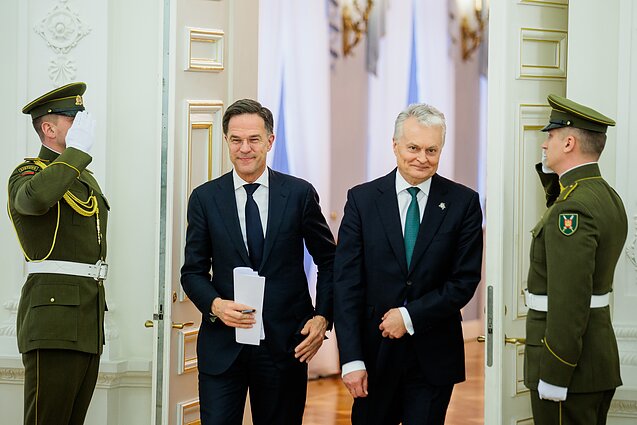
You’ve just been in China. What have you heard in terms of their support? Are they pivoting away from Russia and from pressuring countries like yours and ours?
That pressuring of countries is unacceptable. I know that there has been a situation between China and Lithuania, which I do not accept. That’s why the anti-coercion instrument is so important.
What I did in my visit was particularly focussing on Ukraine. I said that I find it painful, and I do not understand why China is not doing more to prevent the circumvention of sanctions, not doing more to prevent the exports of dual-use goods into Russia, and why China is not doing more in terms of putting maximum pressure on Russia to change its course on Ukraine. If China wants to be friends with us, and they say they want to have strong relations with the West, they have to understand that for Lithuania, for the Netherlands, for all of us in the EU and NATO, if Russia was successful in Ukraine, that would be a threat to our collective security.
Your country will host the NATO summit next year. Will there still be NATO then?
Absolutely. NATO is vital. The transatlantic relationship with the US and Canada is vital. All of us, the 32 countries now including Sweden, have to make sure that Putin understands that if he moves one inch towards you or us, or towards any country in the West, he is in big trouble. We have to do that through the EU, but when it comes to defence, through NATO.

Newsletter
Every Friday morning.