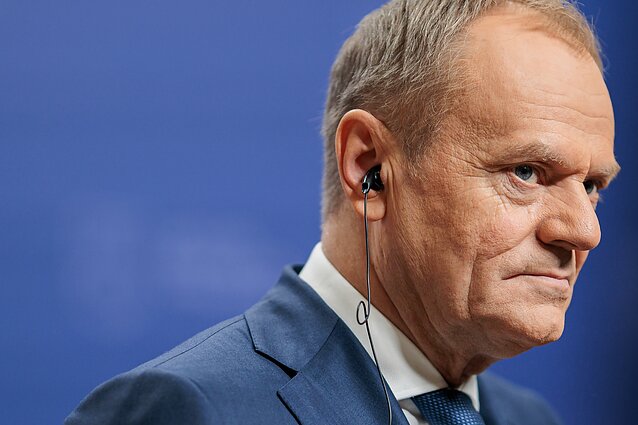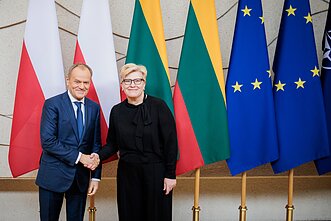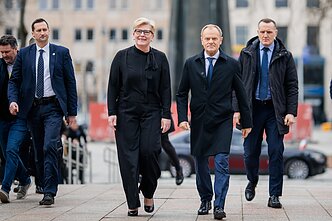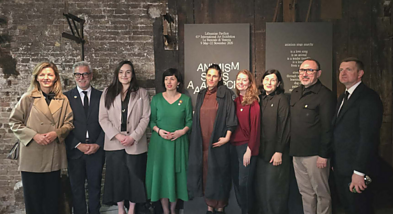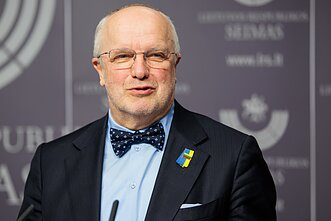



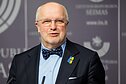





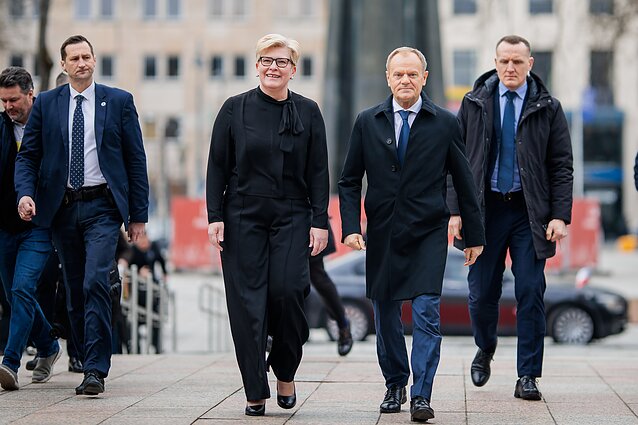
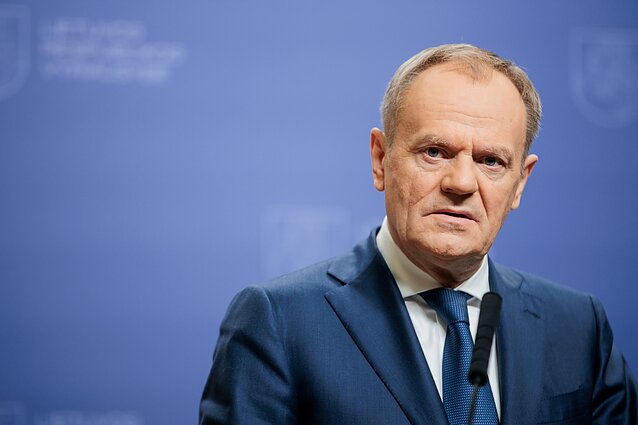
Polish Prime Minister Donald Tusk, who is visiting Vilnius on Monday, said that Poland’s solidarity with Lithuania in case of an attack is not questionable, adding that the country’s ministers will soon meet to discuss this issue in detail.
Tusk was reacting to Lithuanian Prime Minister Ingrida Šimonytė’s recent comment that despite NATO’s Article 5, Poland’s internal documents “do not foresee an obligation” to send troops abroad in the event of a war, including to Lithuania.
“The solidarity of Poland and Lithuania in the event of aggression is not questionable,” Tusk told a press conference in Vilnius.

According to him, the Polish and Lithuanian foreign and defence ministers would soon “decide on all the details so that there are no communication issues and no uncertainties” on the question.
“On my way to Vilnius, I looked at what is written in our defence plans on the events of Lithuania or Poland being attacked and our cooperation in this context,” Tusk said, but stressed that a press conference is “not the place to discuss operational plans, NATO plans, or individual countries’ defence plans”.
Šimonytė later said she did not mean that “the Poles will not defend us”, but that she was referring to specific legal restrictions that are now being addressed with Poland at the “political level”. She did not specify the restrictions she was referring to.
Russian grain
Talking about the grain issue, Tusk said the European Union should take joint decisions on banning Russian and Belarusian grain imports.
“I am convinced that a joint European decision will be much more effective than decisions taken by individual countries,” he said. “I would like us, as the EU, to jointly make decisions on sanctions against Russian and Belarusian agricultural products.”
Tusk said he would ask the speaker of the Sejm, Poland’s lower house of parliament, to initiate a decision on sanctions against agricultural produce from the two countries.
“Today, I will address the marshal of the Polish Sejm regarding the Polish Sejm’s decision on the application of sanctions on Russian and Belarusian agricultural production,” he said.
The prime minister said that the tightening of sanctions is important not only because of the war in Ukraine but also for the security of the agricultural market of Poland and Europe as a whole.
“These markets are feeling a lot of pressure because of the war, and there is no doubt that one of the main tasks is blocking the possibility of exports from Russia and Belarus to third countries that have traditionally been the recipients of those agricultural products,” he said.
Ukrainian grain
Last Friday, Polish farmers started blocking a major highway at the former Kalvarija-Budzisko border checkpoint and checking trucks, citing fears that some of the Ukrainian grain imported into Lithuania is returning to Poland.
According to Tusk, the protests are not political and only reflect farmers’ concern for their own interests.
“It is not an easy task for the Polish government to keep order at the border when large groups of people want to block that border. They are certainly scared for their own interests,” Tusk said in Vilnius on Monday,
He said he has asked Lithuanian Prime Minister Ingrida Šimonytė for understanding.
“That was the human request I made to the prime minister. This is not politics, these are protests, this is just life that concerns Polish farmers, half a million families, who live on this, who earn an income from agricultural produce,” the Polish prime minister said.
He agrees that some of the problems of Polish farmers might be exaggerated and that statistics show that there are no problems with Ukrainian grain coming back to Poland from Lithuania.
“But the people who are protesting do not necessarily know the exact statistics and do not always have access to them. You should understand that this is not only a problem in Poland but also other countries,” he said.

Newsletter
Every Friday morning.