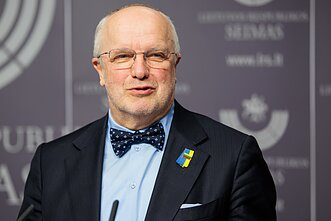















Passing the same-sex civil partnership bill will require a solid majority, as it may have to overturn a presidential veto, says Lithuanian Parliament Speaker Viktorija Čmilytė-Nielsen as the bill is facing an uncertain future.
The civil union law passed the first reading in the parliament, Seimas, last spring by a slim margin. However, its authors, the liberal Freedom Party, have refrained from putting it to a final vote, fearing they did not have enough support.
According to Čmilytė-Nielsen, who is the leader of the Liberal Movement, without a strong majority behind the bill, it would be risky to put it on the agenda.
Further reading
“As long as it is not certain that we have 71 votes – not just random votes, but very strong votes – and that we can get them twice in a row, anticipating that there might be a veto and that the veto would have to be overridden, then, of course, it would be very disappointing to bring the partnership bill to the floor and to potentially kill it,” she told Info TV’s programme Info Commentary on Wednesday.
A simple majority was enough to get the civil union bill past the first reading last May, but its supporters fear that they will need an absolute majority – support from 71 MPs out of 141 – for the final reading, since the bill’s opponents can simply not show up for the vote.

At least half of all the MPs must be present during the adoption procedure.
Moreover, if President Gitanas Nausėda vetoes the bill, the 71-majority will be required to overturn the veto.
According to Čmilytė-Nielsen, the authors of the civil union bill made strategic mistakes from the very beginning, like associating it too closely with the Freedom Party.
“It [the bill] was highly concentrated, personalised, became a single group issue and became a target on which the fate of the coalition supposedly depended. And this, of course, became a huge obstacle to getting it passed, to getting the votes,” the speaker said.
In Lithuania, civil partnership is currently not available for either same-sex or opposite-sex couples. Previous attempts to introduce the law have been unsuccessful.
President Nausėda has not said explicitly whether he would sign the bill into law if it got passed in the parliament, but suggested that he objects to civil partners being treated as married spouses. Meanwhile, the Lithuanian constitution says that marriage is only between a man and a woman.

Newsletter
Every Friday morning.