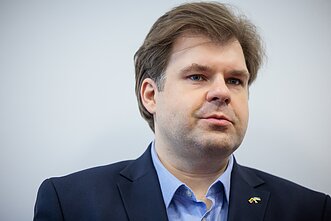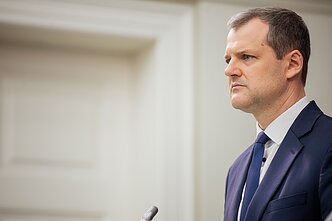
















Russia’s invasion of Ukraine has destroyed a key advantage of Europe – its strategic stability – and will present an already troubled continent with even greater challenges in the future. “Europeans must ask themselves how they would react to a possible re-election of Trump and what would be the consequences of it for their own security,” Thomas Gomart, director of the French Institute of International Relations (IFRI), says in an interview with LRT.lt.
In Vilnius, you gave a talk about European strategic autonomy. In your opinion, is the idea still relevant and can Europe achieve strategic autonomy in the light of the war in Ukraine and Israel?
There are different levels of strategic autonomy. It’s one thing trying to be independent in the technological field, for instance. Now, the biggest issue of strategic autonomy is related to military affairs. And I think for Europeans the biggest issue now is knowing what they will do if Donald Trump is re-elected president of the US and decides to behave in a way similar to or worse than in 2016-2020. So that will be the moment of truth for Europeans in terms of their ability to manage their neighbourhood, including Ukraine but also what is happening in the South, the situation around the Mediterranean Sea.
Of course, the transatlantic alliance between Europe, the US, and Canada is absolutely pivotal. Nevertheless, Europeans must ask themselves how they would react to a possible re-election of Trump and what would be the consequences of it for their own security because that is the ultimate hope of Russian President Putin.

What role will Russia play in this strategic autonomy? Will it continue to be perceived as an adversary or, as French President Macron stressed before the war, will we need to talk to Russia?
If you observe things carefully, you know that, for instance, the decision to set up the so-called European political community was made to oppose Russia.
Everyone clearly understands that Russia has attacked Ukraine, that it has violated international law, that it annexed Crimea in 2014, and so sanctions have been imposed on it. It is now very clear that it is because of Russia that Europe has lost its main competitive advantage at the global level – its strategic stability. It no longer exists. In the next years, it seems very important to avoid one thing – that is any attempts by Russia to repeat its behaviour.
Having said that, Russia will continue to exist, and it will continue to exist after President Putin. So, it’s important to make clear distinctions between time periods. The short term is the situation in Ukraine right now after the failure of the counteroffensive. The short term will last until the US presidential election in November 2024.
After that, there is the medium term. And it concerns the attitudes of the EU and NATO towards Ukraine in terms of security guarantees and the perspective of joining the EU.
And the long term is the preparation for having a new European security order. On that it’s too early to have a clear vision because many things can happen in Russia, in Ukraine, in Europe, and of course in the US. But this distinction between short, medium, and long terms helps us to see the different challenges we have to face.
Is there a complete change of attitude towards Russia in Paris? Or are there still those who believe that it is possible to return to the situation as it was before Moscow invaded Ukraine?
Don’t misinterpret Paris’ actions and President Macron’s statements. President Macron was one of the few serious people in terms of security matters compared to all the European leaders. Europeans started their disarmament in the 70s, already 50 years ago, and continued to do so after 9/11. Whereas other actors, like the US, China, Russia, Turkey, and Saudi Arabia, have increased their military spending, so we are very late.

In this regard, President Macron was the only one to decide to increase significantly the military spending in France in 2017. So, it’s absolutely clear in Paris that we do have a security challenge with Russia, but not only with Russia. We consider the situation in the Mediterranean region to be very tricky, too. But in security terms, there is absolutely no doubt in Paris about where the threats are coming from.
Do you think that the West has a good sense of what they want to achieve in the war in Ukraine?
The official line is to say that Ukraine will be supported for as long as it needs. I think that Westerners were surprised by different things. The first surprise was the Russian aggression. Secondly, we were surprised by the level of resistance being made by Ukrainians, by President Zelensky. We were also surprised by the lack of efficiency of the Russian military. And we were not really surprised, but there was a sort of over-optimism regarding the Ukrainian counteroffensive, which has failed. And the expectation in the US was that the war would end by the end of 2023.
And on the Russian side, they were also surprised by different things: by the intensity of sanctions, by the unity of Westerners. But the Russians also anticipate that this unity can be changed because there is a war fatigue and there are other political forces within Europe that are much more ready to accept the Russian narrative.
So now it’s very volatile. The problem for Europeans is to know if they’d be able to support Ukraine by themselves if the US with Donald Trump decide to stop or significantly diminish their support for Ukraine. That’s a real issue regarding strategic autonomy, and I have no answer to it at this stage.
Can the idea of strategic autonomy find support in all European capitals? The countries of the Eastern Flank do not want to talk about reduced confidence in US military power and presence in the region.
Imagine a situation in which Trump said, “I stop our NATO membership”. I’m not saying that it’s likely, but it can happen. So intellectually, we should prepare ourselves for this possibility.

I also think there’s a strong argument for the US to continue to support Ukraine. There is also the situation between Israel and Hamas. But these are not the strategic priorities for the US. Everyone would agree that the strategic priority for the US is China. There are very strong political forces in the US, saying that Ukraine is a second or third-rank issue compared to the preparation for a possible clash with China.
We also know from a current example that the US security guarantees are not always everlasting. [...] Have a look at Afghanistan, for instance. So, the point is that the alliance is absolutely crucial, but I think that within the alliance, Europeans should also prepare for difficult times.
How do you see the future? Are we entering a period of instability?
It’s already the case. Just to give you an example, I worked a lot on the preparation in France for the so-called military procurement law, which is preparing the organisation of military forces in 2024-2030. It was passed in June. Since then, we had a coup in Africa, there is the continuation of the attrition war between Russia and Ukraine, and the war between Israel and Hamas broke out. Three big things in only five months.

Newsletter
Every Friday morning.