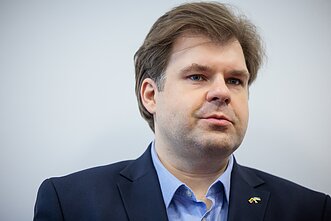














Lithuania’s main way of contributing to climate change mitigation is by transforming its energy sector, President Gitanas Nausėda said on Friday from Dubai, where world leaders are attending COP28.
“Our path and where I see our biggest opportunities is, of course, the transformation of the energy sector,” Nausėda, who is attending the United Nations Climate Change Conference (COP28) summit in Dubai, said in a video comment released by his office.
“Our energy situation today is such that we need to generate more, but we have to do so using renewable energy sources, and our goal is to become an electricity-producing and self-sufficient nation by 2030, mainly by developing renewable energy,” he added.
Nausėda also said he expected commitments to be made at the summit.
“In my speech, I would like to talk about how Lithuania is doing a lot, not just declaring but also implementing what it declares,” the president said.
“Since 1990, our gross domestic product has grown by 85 percent. Our pollution and emissions have decreased by 58 percent. In other words, for every unit of GDP we produce, we generate significantly less pollution,” he added.

In his address to world leaders at the COP28 plenary session, Nausėda said that Lithuania’s overall goal is to achieve a 70-percent reduction in greenhouse gas emissions by 2030, and to become climate-neutral by 2050.
The Lithuanian president called for stopping “ecocide” and focusing efforts on mitigating the consequences of harmful actions already taken.
Nausėda said that “Russia's brutal war in Ukraine has caused enormous damage to the environment, and the aggressor’s actions are incompatible with international law and go against the world’s joint efforts to stop climate change”, his office said in a press release.
On the sidelines of COP28, Nausėda is scheduled to hold bilateral meetings with other heads of state and to meet with Lithuanians living in the UAE.
The summit has brought together the heads of state from the parties to the United Nations Framework Convention on Climate Change (UNFCCC).
Priorities for this year’s climate change conference include accelerating the energy transition, identifying climate finance, and focusing climate action on nature, people, lives and livelihoods.
Around 70,000 people are expected to attend COP28, which started on Thursday, making it the largest UN climate meeting in history.

Newsletter
Every Friday morning.