














The Arctic may sound like a place of research for big countries, but Lithuanian scientists go on expeditions there too. Greta Kilmonaitė, a researcher at Klaipėda University who spent a week in the North, says that Arctic research is not easy: you have to live without the usual comforts, constantly watch out for polar bears, and plan your work according to weather.
But since the region is very sensitive to shifts in climate, scientific expeditions are needed to monitor how fast the Arctic is changing due to human activity.
In August 2023, a team of scientists from Klaipėda University’s Marine Research Institute (KU JTI) set out for the fourth time on an expedition to the northernmost point in Europe, the Svalbard archipelago in Norway. The Lithuanians, together with an international team, carried out research on a lagoon in Eidembukta Bay. Greta Kilmonaitė, a hydrologist who was visiting this harsh land for the first time, told LRT.lt about what it is like to work as a scientist in the Arctic and what signs of climate change are most striking.
What were the goals of your expedition?
I think that climate-sensitive regions like this are changing very fast. And I think it’s important to have some kind of reference points to compare how fast it’s happening and how much we affect it.
In the area we are studying, there are also changes: over 60 years, the glacier has retreated to the point where it has formed a lagoon, where water just goes out to the sea, to the ocean.
So, we want to see what kind of ecosystem it is and how it differs from a lake. In a lake, we have fresh water, whereas here we have salty water from the sea.

What was the preparation for the expedition like? How long did it take?
We started preparing around the New Year, maybe even earlier. Then we started planning how long it might take, how much we could do. Last year’s expedition was quite short, about four days, so it was just small steps towards what we could do this year. Among other things, we planned the activities, how many people could go, and the budget.
There was no specific preparation required, just a gun licence, which my colleagues took out. A gun is an important thing, you need to have it there, especially in the summer, because it’s dangerous to go anywhere alone [because of polar bears].
What about the mental preparation?
I think an important aspect is that, for example, I have had similar experiences in the past: I have worked on ships, I have collected samples in the Baltic Sea, and I have been to the North Sea, where you go away for several weeks and you don’t see any other people apart from your crew. I think that made it less difficult and less scary for me and my other colleagues at Klaipėda University, who have also had experience working in extreme conditions. However, for someone who hasn’t experienced it, this would probably be more difficult.
We had colleagues from the Institute of Oceanology of the Polish Academy of Sciences with us: a lecturer, a senior technologist, and six students. The students had to pass a special test: they were taken to the mountains and they could decide for themselves whether they could endure it.

How many people made up the expedition team?
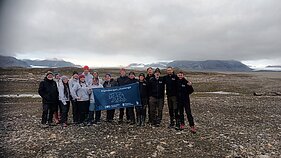
There were six of us from Klaipėda University, eight people from Poland, an archaeologist from America, and a physicist from Sweden. And then there were journalists from Lithuania.
How long did the expedition last? You mentioned that it was longer than last year.
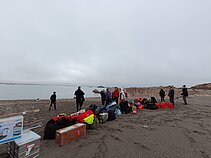
We arrived three days early so that we could prepare, to see if all our equipment was in place. And then we set off on the boat towards our expedition site. We stayed there for a week.
What were the conditions like in the Arctic? Was it as you expected?
We were greeted by a huge fog, and we had to stand still for a while to wait for it to clear and for the shoreline to become visible because we had to get into a smaller boat from a bigger boat and use it to get to the shore. And it was very cold and wet for practically the entire expedition. It was only in the last few days that the sun came out.
There is a perception that Antarctica and the Arctic are insanely cold. Is this true?
No, it was about 7 degrees centigrade all the days. Of course, closer to the glacier, maybe 3 or 4 degrees. And the sun that came out in the last few days was so hot that we needed sun cream to avoid getting burnt. It was the kind of weather we have in early spring.
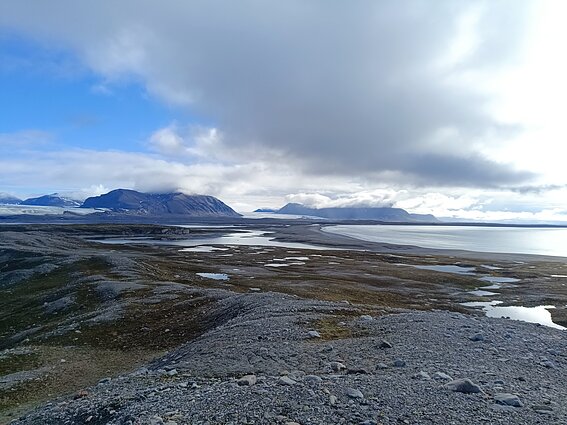
But, of course, in winter, the temperatures are much lower and the climate is harsher. Moreover, that period is much longer than the so-called summer, which is when we went there.
You mentioned that the area can be dangerous because of polar bears. Have you had any encounters with one?
When we arrived at our expedition site, we saw what looked like a house on the shore. Later on, our professor found out that there were Russian geological scientists there, and they were studying the geological side of the place. And they were located right on the shore of the lagoon. We thought that maybe we could stay in the same place, but since we knew that bears usually forage for food on the coast, we decided to pitch our tents where they were last year (200-300 metres from the sea).
The next morning, my colleague and I, with whom we were sharing a tent, heard someone shouting and then one of the scientists came to our tent and said: “Greta, polar bear!” It turns out that it was walking in the place where the Russian scientific base was located.
We then found out that the bear was a 17-year-old female, and we also got information about her route, that she has been wandering in the south of the island for the last few years.
What was a day as a scientist in the Arctic like?
We would get up at eight and plan our day. We had several groups: geologists, biologists and the so-called water group, which I was part of.
We tried to plan our work according to the weather conditions because some days were really very windy and it was impossible to work on the water, so people in my group would join other groups.

Then we had the problem that our generator stopped working and we couldn’t charge our equipment, so that was another day of little work.
But in fact, we used to work until about eight or ten at night, because we had to take other people with our group to their place of work so that they didn’t have to spend more than half a day walking there. This sometimes involved working as an Uber driver in the Arctic.
Tell us about the hydrological research carried out by your group. What were you trying to find out?
We did bathymetric measurements – we determined the depth of the lagoon, we found the deepest point. In addition, I carried out water profiling – I used a probe fitted with sensors to measure depth, temperature, salinity, light penetration, and turbidity.
The results of this research will help us to better understand how the living world works, what bacteria might be present in the lagoon, what kind of activity is possible on the bottom and on the surface, etc.
You have set up a temporary laboratory in your camp. What did it look like and what kind of research did you do there?
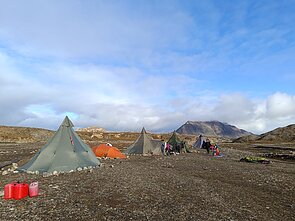
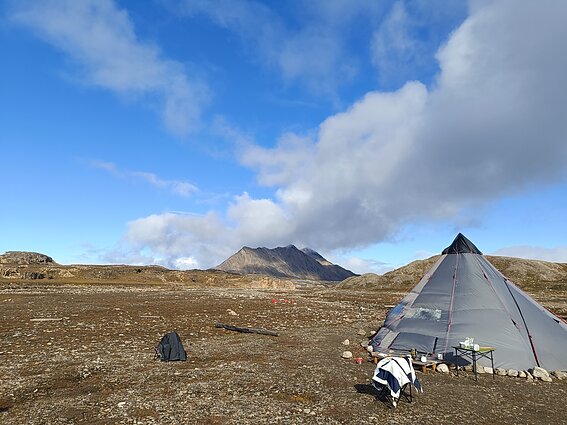
We had triangular tents, and in one of them, we set up our workshop-lab. We did our initial experiments there. My colleague Tobias Politis, with my help, did water filtration – when all the material in the water sample is deposited on the filter, we can calculate the concentration of chlorophyll [a plant cell pigment]. We also carried out so-called sample fixations, where poisons are injected and any bacterial activity in the water sample is stopped, and then we can determine the amount of certain gases that are released.
We put all these and other samples in boxes and they were transported by ship to Poland. We should be going to collect them soon. We will then be able to carry out further analyses.
What are the challenges of doing scientific work in such harsh conditions?
The most challenging part is that you have to think everything through from A to Z, and then some. This year, our generator was not working and we needed a freezer for the genetic samples, so we already had to think about how to move the genetic sample collection to the end of the expedition.
We have to plan what to do if some of our equipment does not arrive. This year, two boxes didn’t come and one of them had a boat engine, so we had to find a new one.
You have to be very creative in these conditions and not be afraid of things breaking down unexpectedly.
What are the most visible signs of climate change in the Arctic today?
I think one sign is warm water and ambient temperatures.
You can clearly see that the glacier is melting, but the scary thing is that it is not just dripping, but streams of water are running off it.
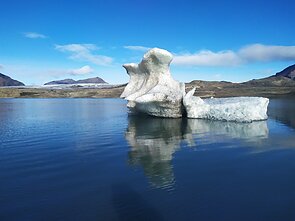
And, in fact, the environment there has changed so quickly – a year ago, the glacier was in one place, and now we can see that it has retreated 40 to 50 metres, and there are huge chunks of ice floating.
You have had the opportunity to carry out research in one of the most remote corners of the Earth. Would you go to the Arctic again if given the chance?
Definitely yes because this expedition was useful not only professionally but also personally: it gave me a better understanding of my own needs, of my body, of how much it can take, and of the limits it is pushing.
Of course, I also took away a lot of impressions in a scientific sense: when you go to a place and feel all the samples, when you see how things work, you can really understand a phenomenon better than when you see the calculations that are on your computer screen.

Newsletter
Every Friday morning.