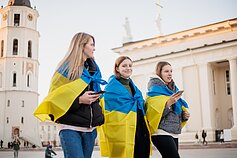











Even as Moscow’s war in Ukraine has triggered a rejection of everything Russian in Lithuania, the Russian language is more frequently heard on the streets today, mainly because of the thousands of Ukrainian refugees that the country welcomed.
Russian remains the most widely-spoken foreign language in Lithuania, even though English is catching up and will soon overtake it, Meilutė Ramonienė, professor of linguistics at Vilnius University, says in an interview with LRT.lt.
A decade ago, you conducted a sociolinguistic study “Cities and Languages” and recently you did a new research project about the linguistic proficiency of people in Lithuania. You concluded it just before the war in Ukraine. Can you share some of the results?
Not so long ago, in January, we published a book dedicated to the linguistic panorama of Lithuania. [...] The results of this new research are very interesting, for example, it turns out that there are more people who know foreign languages. And the number of languages they speak has increased, including languages that were not popular ten years ago.
Further reading
What languages are they?
These are, for example, Italian, Spanish, and Japanese. Eight percent of respondents said they knew Spanish.
We see an expanding scope of languages that people are interested in and study. There are those who know more than one foreign language, and who speak two, three or four. Even five or six languages – such people are not so few – 6 percent.
Of course, we have to take into account the margin of error, but still, 13 percent of Lithuanian respondents stated that they knew four languages. Twenty-nine percent said that they knew three languages, which is very high. [...]
Of course, this is not a test, it’s just a survey, […] we will not check if they really speak the languages they say they do. But ten years ago the figures were much lower.
What can you say about the proficiency in Russian and English and their relative weight?
According to the results of our research, which was conducted just before the war, the number of people who know Russian and English has almost equalised.
There are still enough people in our country who know Russian, it is the best-known [foreign] language. In our survey, 76 percent said that they knew Russian, while 70 percent said they knew English.
These percentages are moving closer together and it is very noticeable. It depends very much on age – for example, among people aged 65 or more, 87 percent said they knew Russian, while only 50 percent said they knew English.

In the youngest group, aged 18–24, meanwhile, 72 percent know Russian although they may only understand it, not speak it. As for English proficiency, 88 percent of the youngest say they speak English.
So the trends are very clear: Russian proficiency is decreasing and English is increasing. It looks like this trend is going to continue, which becomes clear from in-depth interviews. In all the interviews, many people, even those who know Russian, say that it is not that necessary.
And everyone stresses that one cannot do without English now. Even those who don’t know English say that English is prestigious, it is necessary, and you have to learn it. If you want to find a good job, you need to know English.
We also asked our respondents about their attitudes towards languages, for example, which one sounds good to their ear and which one does not. Only Russian speakers – native speakers who have a good command of the language – and members of the Polish minority and other ethnic minority groups expressed a favourable attitude to the Russian language. Ethnic minorities still have an emotionally positive relation to the Russian language.

As for ethnic Lithuanians, they did not mention Russian in this context. Interestingly, they did not express an emotionally positive attitude towards the English language either, but many of them think that English is necessary. It is necessary, but no one expressed a strong emotional connection with English.
The most vivid and pronounced emotional connection is with one’s native language, Lithuanian for Lithuanian speakers and Russian for Russian speakers.
Over the last couple of years, more than a hundred thousand migrants came to Lithuania from Ukraine and Belarus, and many of them speak Russian. Residents of Vilnius in particular have noticed that they hear much more Russian on the streets. Have linguists noticed this and are they studying the changes?
We would very much like to do research and get some representative data. But surveys cost money. [...]
Of course, the number of Russian speakers in the country has increased noticeably. We also have the experience of our colleagues temporarily leaving the country, for example, to teach Lithuanian at various universities around the world. They come back and say that it is not so easy to get a service in Lithuanian anymore, to bargain at a hairdresser’s.
And young people nowadays do not know Russian or do not know it well enough to speak it fluently. Everyone notices this.

Has the war and migration affected your faculty at Vilnius University?
When the war started in Ukraine, our Philology Faculty got involved in providing assistance to refugees and invited volunteers to teach Lithuanian to Ukrainians. We had many volunteers from both faculty and students, our own students said they wanted to teach.
This year, we also co-operated with Vilnius municipality. After all, it is not enough to want to teach a language, you also have to know how to do it. The Department of Lithuanian Studies also gathered a group of people who wanted methodological advice on how to teach Lithuanian to beginners, who are completely unfamiliar with the language, and organised large groups of people who wanted to learn.

I didn’t teach myself, but I saw what the courses organised for refugees looked like.
Mainly Ukrainian women signed up for Lithuanian classes because men were at war. These women said that these classes and communication with other people were a kind of psychological therapy for them, they were able to learn and distract themselves from thinking about their problems and the horrors of war.
Scholars use terms like linguistic or language integration. It is not an easy or fast process. And it is noteworthy that the population of the receiving country may feel anxiety and even fear about a large number of migrants speaking other languages. In our case, it is Russian, which also irritates local people to some extent.
I am reluctant to make generalisations about it until we have research results.
In our faculty, teachers do not link the Russian language with politics, as others do. We have a slightly different approach.
Further reading
After all, there are indeed many people in our region, not only in Lithuania, for whom Russian is their native language.
Yes, it is their native language and they want to preserve it, they want their children to speak it. I think that the next generations of these people should know this language, keep in touch with the culture, have access to literature in the original language.
On the other hand, in Lithuania, there is a real need to know Russian, even if for political reasons, to have people who speak the language of, if you will, the enemy.
It is true that this year, for example, there were no students applying to study Russian philology, so this emotional background apparently still has an effect. But perhaps this is only a temporary phenomenon. We’ll see how things go from here.
Further reading

Newsletter
Every Friday morning.