





Although the Soviet Union collapsed more than 30 years ago, its ghosts still stalk Lithuanians in some countries. Lithuanians living in Portugal have contacted LRT.lt about cases when the documents issued to them indicate the Soviet Union as their country of origin.
Ona Šivickytė was astonished to see her place of birth listed as the Soviet Union when she signed up for driving classes in Lisbon. The Lithuanian woman was born after Lithuania regained independence and asked the driving school to correct the mistake.
“I was told that there was no mistake. They said that they do the same thing with the former Portuguese colonies. For those born during the colonial period, it is written that the person was born in Portugal,” Šivickytė says.
The woman was informed that her driving license would also name the Soviet Union as her country of origin and that there was nothing that could be done to change it.
“I was stunned and dismayed. I didn’t expect that in 2023, someone would still not realise how humiliating any links to Russia are,” she shares.
“In Portugal, there is a perception that all the Baltic countries suddenly appeared after the collapse of the USSR. They do not realise that these countries existed before and that the Russian occupation was temporary,” Šivickytė adds.
‘Where could I go?’
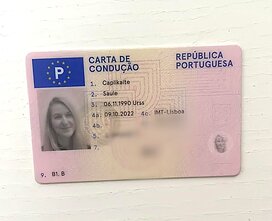
Saulė Čaplikaitė, another Lithuanian living in Lisbon, confirmed that there are cases when the Soviet Union, not Lithuania, is written on driving licences issued to Lithuanians in Portugal. She collected her own document in December last year.
“Then I saw it saying that I was from the URSS [União das Repúblicas Socialistas Soviéticas in Prtuguese],” she says.

The employee of the Portuguese Institute for Mobility and Transport (IMT), the body that issues the documents, told Čaplikaitė that the system listed her nationality as Lithuanian and citizenship as that of the USSR.
“I was born in a free Lithuania on November 6, 1990. They have seen my ID, which states that I am a Lithuanian citizen. I was completely shocked that such things were possible,” she says.
“During the 11 years I lived in Portugal, I had to prove many times to the state institutions that Lithuania was an EU country, but to write down a non-existent country... I asked them, where could I go with such a license?” the Lithuanian woman adds.
LRT.lt contacted the Portuguese IMT about these cases but did not receive a reply within several weeks.
The Portuguese Embassy in Denmark, which is also accredited to Lithuania, said it had no information about these cases and could not comment on the situation. “However, we will forward this information to the competent authorities,” the embassy said in a written reply.
Rare cases?
The Foreign Ministry confirmed to LRT.lt that there have been cases when foreign countries issued Lithuanian citizens with documents listing the Soviet Union as their country of origin. However, such cases are very rare and only occur when a person is born before 1990, it said.
“The problem with the driving licences issued in Portugal to Lithuanian citizens born before 1990 was addressed as early as 2015. When it became clear that the place of birth in the above-mentioned documents was entered as ‘USSR’, the Lithuanian Embassy in the United Kingdom, accredited to Portugal, contacted the responsible Portuguese authorities to draw their attention to this unacceptable practice,” the ministry explained.
According to the ministry, if the problem is recurrent, Lithuanian diplomatic missions turn to the foreign state institution with a request not to associate Lithuanian citizens with the former occupation period and to indicate Lithuania as their country of origin.
“It is imperative to point out specific cases and specific institutions that have done this. The Embassy in the UK will ask the Lithuanians in Portugal about the relevance of the problem you mention,” it said.

Newsletter
Every Friday morning.