















Lithuania’s State Defence Council on Monday instructed the country’s government to reach an agreement with Latvia and Estonia on the synchronisation of the Baltic electricity grids with Western Europe and their disconnection from Russia’s BRELL system in early 2025.
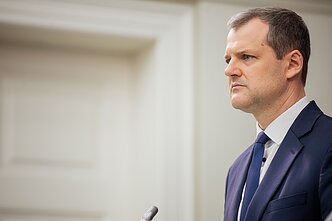
Kęstutis Budrys, the chief national security advisor to Lithuanian President Gitanas Nausėda, told reporters after the meeting that the government was asked to “agree in writing with Latvia and Estonia in the near future [...] on the date of February 2025 as the last date for synchronisation”.
“Until then, we will have to take certain action, which means announcing the withdrawal from the BRELL agreement in August 2024, and also taking other technical and other actions,” Budrys told journalists after the meeting.
According to Budrys, there is currently no “fundamental objection” among the Baltic states to early 2025 as the final synchronisation date.
“Today, the position of our closest Baltic partners was also discussed. The February 2005 date was reiterated during the first visit of Latvia’s new president, so we don’t see any fundamental objection to that date,” the advisor said.
The possibility that any attempt to reach such an agreement might fail was also considered, he said, adding that contingency plans are put in place.
“We also considered what action should be taken in the near future [...] in case such a written agreement could not be reached,” Budrys said. “I wouldn’t want to elaborate on everything as we also need to weigh some risks.”

Cannot do it alone
Lithuania wants to step up the disconnection of the Baltic grids from their joint electricity system with Russia and Belarus (BRELL) earlier than agreed – as early as February 2024.
However, as things are stalling in Estonia and Latvia, Rokas Masiulis, CEO of Litgrid, Lithuania’s power transmission system operator, said earlier this month that Lithuania would not be able to do it alone.
The Baltic States are part of the BRELL synchronisation agreement that connects them to Belarus and Russia. The contract is renewed annually in February, and to legally terminate it, six months’ notice must be given.
Timo Tatar, deputy secretary general of the Estonian Ministry of Climate, said earlier this month that the earliest date for disconnecting from the Russian-controlled BRELL ring and synchronising with continental Europe would be the beginning of 2025.
Lithuanian Prime Minister Ingrida Šimonytė said previously she hoped to convince her Baltic counterparts to speed up the synchronisation project. Energy Minister Dainius Kreivys has said the issue of the non-extension of the BRELL contract must be resolved this year to make synchronisation possible in 2024.
Lithuanian President Gitanas Nausėda said in his annual report that “this year is decisive for disconnecting from the BRELL network as quickly as possible”.
In mid-June, the Seimas adopted legislative amendments that create the legal conditions to step up the synchronisation of the Lithuanian power grid with continental Europe and to do so in the first half of 2024.
Under the 2018 agreement signed by the Baltic leaders and the European Commission, Lithuania, Latvia, and Estonia have to synchronise with the continental European grid by the end of 2025. Lithuania, however, aims to complete the process by the first half of 2024.
Further reading

LRT English Newsletter
Every Friday morning.