








The last couple of weeks saw much talk about possible health issues suffered by Belarus’ strongman president Alexander Lukashenko. Exiled opposition members started speaking about “a window of opportunity for democracy”. However, observers interviewed by LRT.lt believe that even Lukashenko’s departure will not mean the end of repressions – or Russia’s ambitions to pull the strings in Minsk.
“Who could potentially replace Lukashenko? It will depend very much on what is going on in Belarus, Russia and even Ukraine at the time,” Pavel Slunkin, a former Belarusian diplomat based in Warsaw, tells LRT.lt.
He says that Lukashenko has not been grooming anyone to be his successor, so Moscow would exert a major influence on Belarus’ future, while the opposition’s current predicament is unlikely to allow it to take over.
Further reading
Major health problems
Lukashenko used to boast about his supposed athleticism, playing ice hockey in public, skiing or doing farm work. Recently, however, such displays of physical prowess have made him an object of ridicule rather than admiration. For example, in 2021, Lukashenko took part in a skiing competition in which his competitors deliberately collapsed on the slope so that the leader could win.
The first signs of Lukashenko’s health problems were noticed during the Victory Day parade in Moscow on May 9. The Belarusian leader was seen with a bandage on his hand, unable to walk the 300 metres to the Unknown Soldier monument, where he was transported from Red Square by a security vehicle.
Later, the Belarusian opposition newspaper Nasha Niva reported that Lukashenko did not stay for lunch in Moscow and immediately flew back to Belarus with a medical escort. On the same day, Belarusian opposition media reported that Lukashenko had been taken to hospital.
According to the media, he had developed serious disorders which had led to endocrine and heart problems. It is also known that medical professors from Moscow have flown in to treat Lukashenko.
“I think we can say that overall, Lukashenko’s health has probably deteriorated significantly over the last three years,” says Katia Glod, analyst with the Washington DC-based Centre for Euopean Policy Analysis (CEPA).

Previously, there had been reports of Lukashenko’s health problems related to his legs and joint problems. Glod estimates that Lukashenko may have suffered three bouts of Covid-19, the pandemic virus he initially ridiculed.
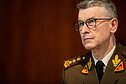
The health problems after Victory Day seem to have been more serious than ever before in his biography. On May 22, Lukashenko rushed to dispel rumours about his ailment and visited the country’s air force headquarters. Lukashenko wore a military uniform, looked grim, had a bandage on his hand, was stunted and some photographs looked retouched, while the leader reminded of a wax doll.
In Glod’s view, it was Lukashenko himself who decided that it was time to make a public appearance in order to reassure he was well and strong. If that was indeed the point, he failed.
“We can clearly see that he is not completely healthy, but he is now capable of doing something,” says Slunkin, the former diplomat.
The site for the first public appearance, observers believe, was not chosen by chance and intended to send several different messages. First, Lukashenko announced that the Belarusian military had been put on high alert after four aircraft had been shot down in southern Russia.
According to Slunkin, Lukashenko’s visit following these incidents was intended to show that, amid escalating threats, he is on top of the situation and Belarus is ready to counter possible attacks from Ukraine.

“Lukashenko understands that Belarus is part of the war and that the consequences of the war can reach Belarus. They need to be prepared for a possible Ukrainian response when Kyiv is actively preparing for a counter-attack,” the former Belarusian diplomat says.
He does not rule out that Ukraine could target Russian and Belarusian supply chains and attack infrastructure, which is why Lukashenko is trying to reassure his population that the government is prepared.
Another message of the visit could about Lukashenko’s health. According to Glod, he would hardly be able to pull this off outside a very controlled environment, among outsiders or where he’d have to walk long distances and communicate with many people.
“They showed him in a comfortable environment with the military. He has spent a lot of time sitting in rather dark rooms, so we can assume that he is definitely not yet capable of travelling long distances or speaking in public,” the analyst believes.
The cult of one man
Lukashenko’s health problems at 68 have prompted a debate on whether the Belarusian regime has a replacement for him in case he were to step down, or whether an outside power like Russia would send a puppet to take over.
The regime built around Lukashenko is characterised by its personality cult. It is to him that all the good qualities, achievements, successes are attributed, while failures are seen as the fault of other politicians, bureaucrats, diplomats, or even the army.
“Lukashenko has created a system so that he is not compared to anyone, so that no one is seen as his possible successor. Lukashenko wanted it to be that way,” says Slunkin.
According to the latest and controversial Belarusian Constitution, a head of state can be removed from office if he or she is permanently unable to perform his or her duties for health reasons. In the event of Lukashenko’s removal or unexpected death, his duties should theoretically be taken over by the head of Belarus’ upper chamber of parliament, Natalia Kochanova. A new presidential election would have to be called within 37 days.

If, however, the president is assassinated, his duties would go to the Secretary of the State Security Council of Belarus, Alexander Vofovich. Until the constitutional amendment, the prime minister would have been the interim head of state.
However, observers interviewed by LRT.lt question whether the law would actually be respected in such a case.
The constitution was changed, according to Glod, because Lukashenko trusts Kochanova, who has repeatedly proven her loyalty, especially in the wake of the massive opposition protests of 2020. Both she and the current prime minister are close to Russia and regularly pay official visits to Moscow.
“She [Kochanova] has obvious links with the Lukashenko family and has been successful in talking to the public. Because she is a woman, the public sees her as softer, more approachable. She can be very supportive if Lukashenko decides to appoint his son Viktor Lukashenko as his successor,” says Glod.
Viktor Lukashenko is said to be respected among senior civil servants and the military. Until recently, he was his father’s national security adviser, which brought him closer to the military leadership.

The president has two more sons, Dmitry and Nikolai. The latter is most often seen at Lukashenko’s side but is not mentioned among possible successors.
Slunkin argues that if Lukashenko felt a real threat to his position, he would probably seek to protect his family from possible repression in the event of a complete change of government – and try to install his eldest son as his successor.
However, Slunkin also believes that, at least for the time being, there are no signs that Lukashenko is preparing for a transfer of power.
Russia, which is increasingly bringing Belarus into its sphere of influence, would also play an important role, with Minsk and Moscow having signed an agreement on 28 Union State programmes on economic integration in November 2021. Russia is also a major influence on Belarusian foreign policy.
Although Moscow will keep a close eye on who takes over the reins of Belarus, Slunkin doubts it Russia will try to annex the country completely.
“They could hold fake referendums like in the Ukrainian occupied territories. But it would be easier for Moscow to appoint its own man to the position, and in any case, Lukashenko’s successor will be very dependent on Moscow, where decisions would be taken,” Slunkin believes.

Moscow’s plans for Belarus would also be strongly affected by developments in Ukraine – the more difficult the situation there, the less attention Russia could dedicate to Belarus. However, according to Glod, influence would still be strong and annexation processes would continue under the radar.
“It’s simply not worth it for Russia to formally annex Belarus now that it is already being ruled from Moscow,” she believes.
Ineffective opposition?
Belarusian opposition leader Sviatlana Tsykhanouskaya has urged the society to be ready for political change following reports on Lukashenko’s health.
“[We need] to put Belarus on the path of democracy and prevent Russian interference. We need the international community to be active and quick,” she said.
Pavel Latushka, another opposition spokesman, shared a similar view. If Lukashenko’s health deteriorates, a window of opportunity for change could open in Belarus and democratic forces must be ready to take power, said Juozas Olekas, Lithuanian MEP and the head of the European Parliament’s delegation for relations with Belarus.
Meanwhile, Vytis Jurkonis, a lecturer at Vilnius University’s Institute of International Relations and Political Science (VU TSPMI), told LRT TV last week that the West did not have a strong policy towards Belarus during Lukashenko’s rule, and he doubted it could emerge after his death.
After 2020, public support for Lukashenko remained low, but interest in the opposition among Western leaders was also low, according to Glod, as it was seen by some as ineffective.

“The main problem is that the opposition is very disorganised. They would of course like to take advantage of this opportunity, but I don’t see any practical way in which they could do it,” says Glod.
She doubts that the opposition has a clear plan for what to do if Lukashenko dies. According to Glod, the opposition has done too little internally, and has not made useful contacts with the regime’s civil servants who could help the opposition gain a foothold during the transition period. Alexander Dobrovolsky, an adviser to Tsikhanouskaya, also spoke last week of the need to establish such links.
“We understand that our task is to prepare for the new elections, to ensure that the economy is stable during this period. I think that this is the place to negotiate with the people in power who understand that Belarus is in crisis and who would be interested in getting out of this crisis,” Dobrovolsky said.
However, the opposition is struggling to secure any tangible gains amid the government’s continued repression. Hundreds of political prisoners are still in Belarusian jails.
“Even if Lukashenko were to die, repression would probably continue in Belarus. The opposition would be beaten when they take to the streets, hundreds of people would be imprisoned, as they were in 2020, and fewer people in general might decide to support the opposition,” believes Slunkin.

Newsletter
Every Friday morning.