















Burial (Kapinynas), directed by Emilija Škarnulytė
“Uranium was created in supernova explosions about 6.6 billion years ago” are the first words to appear on-screen in Emilija Škarnulytė’s documentary Burial, now streaming on Mubi as a platform exclusive.
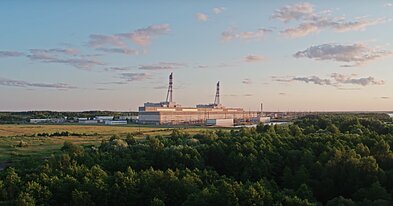
“Documentary” is how the site classifies its genre, although the sixty-minute piece is certainly not a doc of the conventional, informative talking-heads variety. What Škarnulytė has crafted is more like an audiovisual essay, short on narration and contextualisation yet rich in atmosphere and intriguing visuals. The topic of the film is Lithuania’s decommissioned Ignalina nuclear power plant, or perhaps more broadly nuclear power, or perhaps something grander still.
The opening words, appearing atop a sequence of images that perhaps represent some form of uranium, or merely colourful abstractions, immediately stake out the film’s ambitious thematic scope that far exceeds its specific subject matter. The uranium that humanity has mined for power for less than a century carries within it far deeper histories and, as Škarnulytė makes clear, extends forward into futures that may well outlast our own.
On this cosmic timescale, the Ignalina power plant’s few decades appear as but a blip, and that transience is captured evocatively by the quiet scenes of anonymous workers dismantling and scrapping, bit by bit, the plant’s skeleton and complicated machinery.
The Soviet-era Ignalina complex, a sibling of Ukraine’s Chornobyl and therefore rightly or wrongly itself under a heavy shadow of concern, was decommissioned as part of the agreement that led to Lithuania’s accession to the European Union in 2004. But the complicated work is ongoing and will not be completed before the 2030s; it is this process that Škarnulytė has captured and that forms the bulk of the material in Burial.
The title, then, might reasonably be assumed to refer to the plant itself, which is being put to rest, as it were. Yet the film provides no simple answers, and it is equally plausible that what is being buried here is in fact humanity itself, self-destructive and helpless in the face of the relentless onward march of time.
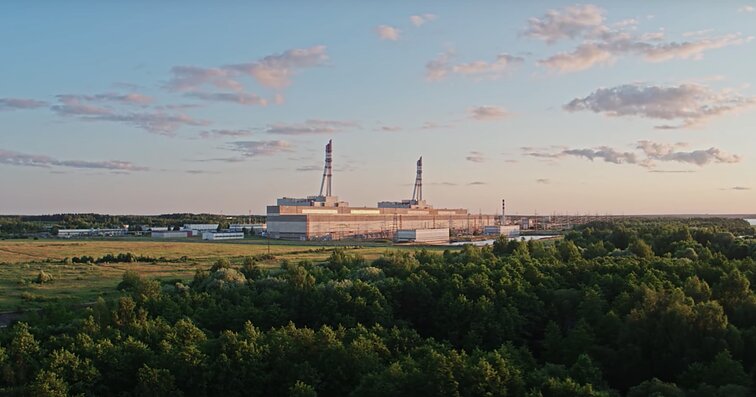
There is a certain brooding sense of fatalism that imbues the film throughout. This would perhaps be justified by the subject matter alone, but in the present day one’s mind inevitably turns to the renewed fears of nuclear catastrophe that have been unleashed by Russia’s senseless aggression in Ukraine; Chornobyl itself briefly became a battleground last year, and concerns over the fate of the still-active Zaporizhzhia plant periodically make the headlines.
There is thus a sense of urgency to the film that may not have been intended: having premiered in April 2022, the initial conception of Burial certainly predates the February invasion, although it’s unclear to what extent its final form has been influenced by those events.
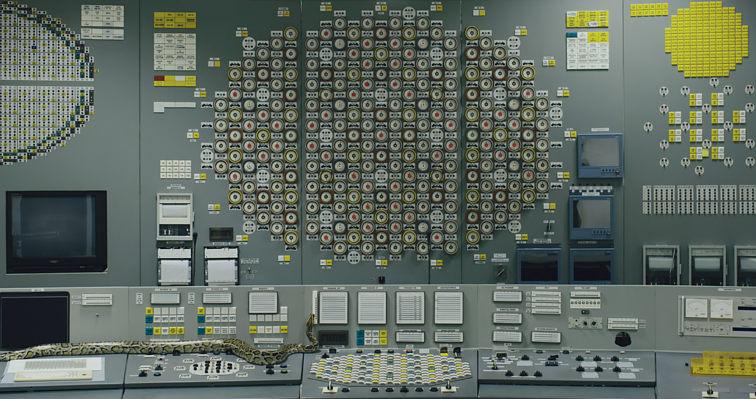
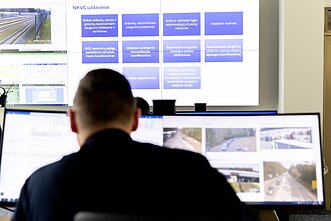
Fundamentally, however, Burial is not about contemporary events and has no straightforward moral. It is, first and foremost, a fascinatingly crafted visual experience: the desolate industrial scenery, the heavy machinery and incredibly intricate control panels of the power plant make for an engrossing cavalcade of sights.

The effect is enhanced by the fact that little explanation is given, and a non-expert watcher can certainly not be expected to understand much of what is shown on-screen. There are glimpses of what appears to be a scale model of the plant, all blinking lights, reminiscent of a toy or a prop from a sci-fi movie. Or maybe the plant itself is the toy, carelessly tossed aside once playtime is over?
Indeed, there is very little signposting throughout, apart from a handful of faint captions that appear atop moving images in the middle of the screen, perhaps deliberately difficult to read. It is left to the audience to piece together something like a coherent whole out of the succession of scenes that make up the film. This is not always easy, and a sequence towards the end of the film shifts the wordless narrative to locations that are not introduced or contextualized, though the more curious viewer may pick them out of the credits. This is, ultimately, not necessary: it is the images themselves that do the talking.
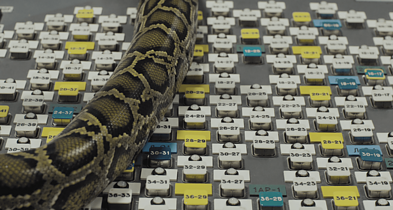
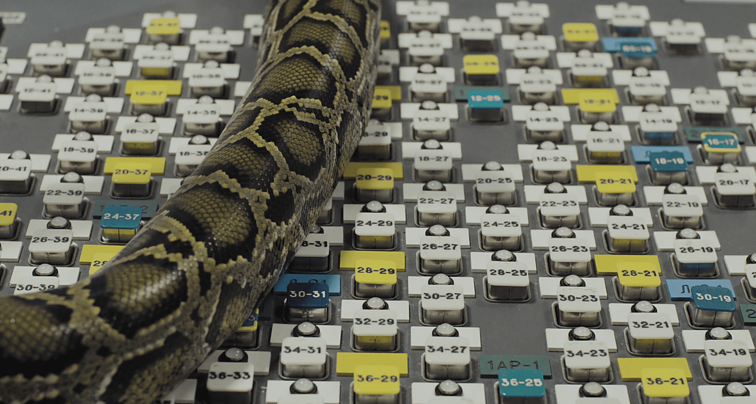
Among the most memorable, and certainly the most surreal, of the film’s images is an extended scene of a large snake, perhaps a python, seeking its winding way on and among what appears to be the control interface of the Ignalina plant. Snakes appear elsewhere, too, a central metaphor in the Burial’s visual syntax. But standing for what? For the biblical temptation of sin, the desire for forbidden knowledge – in this case, the splitting of the atom? Or merely as a disinterested emissary of the natural world, the uncaring universe that gives rise to humanity’s follies and outlives them?
Worth mentioning are also the film’s haunting soundscapes. As mentioned, there is no narration; instead, the soundtrack consists of a mix of the very mundane – the thuds and clanks of heavy tools, of simple labour – and the atmospheric music, largely darkly ambient but interspersed by a couple of raw unaccompanied vocal tracks. Snippets of words and voices also float through occasionally, some from Cold War-era broadcasts, others unidentified, even unintelligible. It all adds up to a thoroughly immersive sixty-minute experience.
In its final scenes, the film seems to – interpretations may vary – turn its focus into some kind of imagined future, or futures, offering images that are in turns dystopian, apocalyptic and strangely hopeful.
The mood in these last moments is, ultimately, suggestive of the inevitable passing of things – and Škarnulytė’s enigmatic and dispassionate camerawork embodies this detached, superhuman perspective perfectly. There may not be much here by way of lessons to learn, but there is no doubt that Burial manages to raise questions and to provoke a great many thoughts.
Mikko Toivanen (@aruinedmap) is a cultural historian with a lively interest in the literatures of the world and the craft of translation. He is also the co-author of a blog on fragmentary fiction.

Newsletter
Every Friday morning.