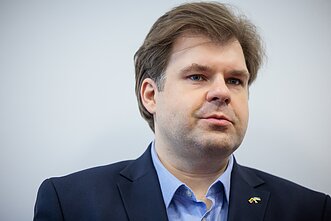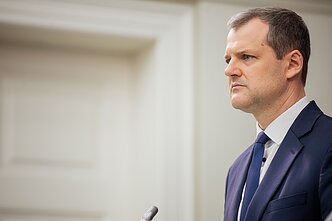
















German brigade needs to be permanently deployed in Lithuania if Germany wants to be the pillar of NATO’s Eastern flank defence, Nico Lange, senior fellow at the Munich Security Conference, said in an interview with LRT.lt.
At the Munich Security Conference, we heard a lot of talk about supporting Ukraine until its victory. You also attended this conference. Do you think the West will support Ukraine for as long as needed?
In the speeches at the Munich Security Conference, the unity and strength in supporting Ukraine were demonstrated. The support for Ukraine was there across the board from the US, UK, Germany, and France but also from many other countries.
I think there’s no question about that. The question is about whether the weapons and the ammunition are coming to Ukraine fast enough, and that is certainly where the countries must improve.
In Munich, there were a lot of discussions with Europe’s industrial players about the increase in ammunition production, and some progress was made. I’d still want faster progress, but I think the general direction is very clear – Ukraine will be supported until it’s strong enough to bring peace.
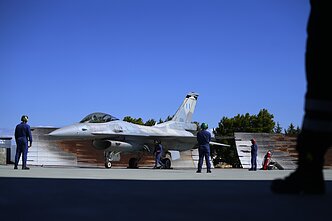
There is also talk of the need to transfer F-16 fighter jets to Ukraine. Does Ukraine need these fighter jets, and can it get them?
I think the most important problem now is ammunition and the production of ammunition, so that needs to be solved quickly.
Also, the infantry fighting vehicles and main battle tanks need to be integrated so that Ukraine can build the combined arms to really crush the Russian front lines. I hope this will be done in the coming weeks.
We already see that the Russian spring offensive is not as strong as some people expected it to be. So, there’s a good chance for Ukraine’s manoeuvres now.

I think any jets will be needed at a later stage to support Ukrainian troops on the ground. We’re talking about multi-role jets, and F-16 would be a good example of that. The UK and Italy are ready to train pilots, and the US Congress also decided a few months ago that pilots should be trained, so it’s a good development if the planes are transferred eventually.
But my advice would be to not focus on these highly symbolic discussions about Leopard tanks or fighter planes – those are not the things that are deciding the outcome of the war. The war will be decided by logistics and industrial production, so that’s where we must support Ukraine.
We hear Ukraine saying that they are not getting enough weapons and ammunition. What is stopping the West?
Many 155mm calibre artillery pieces, which are standard in NATO countries, were delivered. But Ukraine consumes more ammunition than the US and EU produce in a month.
Sometimes you can still find some ammunition in partners’ storage, as was found in Pakistan recently, or the US ammunition that was stored in Israel. But this is coming to an end, so the production capacities must increase now. It should have been done half a year ago. But it’s typical for such discussions – everything is eventually going in the right direction, but half a year too late.
Talking about Leopard tanks, Germany says that Ukraine will receive some of them at the end of March or the beginning of April. But Kyiv says that they need the tanks now. Could the late delivery of tanks complicate the situation for Ukraine?
The sooner, the better. Ukraine needed infantry fighting vehicles and armoured personnel carriers already in March 2022. Ukrainian soldiers were unprotected at the front lines, for example, in June when Russia was intensively using artillery in Donbas. And many of those soldiers, who had to use regular cars at the front lines, are dead by now.

So, this hesitancy and discussions we are having cost lives in Ukraine. Political leaders should be reminded that time is not just something you can work with politically. For Ukraine, time means the lost lives of its citizens and soldiers.
Ukraine did not have infantry fighting vehicles in place before summer and fall. Kyiv had a chance to continue counterstrikes but was not able to do so because our deliveries were not ready. We should at least learn from that.
But if tanks and infantry fighting vehicles are coming later, it’ll still help because they’ll give Ukraine a realistic chance to break through the front lines, especially in the south.
In the international arena, we hear talk about Germans delaying the necessary decisions, for example, regarding tanks. Why are they doing so?
First, it’s fair to say that German military assistance to Ukraine is better than its reputation. Germany is delivering a lot of very good weapon systems to Ukraine. The weapon systems, equipment, and ammunition that are coming from Germany are making a difference on the battlefield. And Germany is among the few countries delivering rocket launchers to Ukraine.
So, Germany is doing a lot. But it’s also true that the German government only moved forward when it came under pressure. However, we shouldn’t confuse this with Germany not helping Ukraine. Germany’s help is very important and strong.
And if we’re completely honest here, I think it’s good to put pressure on Germany, but it should also be put on France, Spain, or Italy because those countries have a significant arms industry. The Baltic and Nordic states gave basically everything they had to Ukraine. Now, industrial production is what matters. That’s why the European countries with significant arms industries must now play an even stronger role.

Vytautas Jonas Žukas, a former Lithuanian chief of defence, said that the current Russian attack could be its last because it does not have enough artillery and other weapons. Do you agree with this opinion?
I’m very cautious about making predictions. War has many elements that are not predictable. But we can clearly see that Russia is attacking in the most primitive way imaginable, exactly where it is expected to attack, with front soldiers storming well-fortified positions. This leads to extremely high losses on the Russian side. It is a very Soviet way of trying to win a war. I think it’s impossible that Russia will gain much from this; all they can gain is a few kilometres of wasteland for a very high price.
It's clear that Russia cannot achieve anything with this kind of warfare. All they can do now is continue the war. And a question that has not been asked often enough is what a good outcome of this war could look like from a Russian perspective. What is it trying to achieve? They lost half of the territories they occupied during the war. They don’t have any big cities, and there’s, I think, no realistic chance for Russia to occupy any big city in Ukraine. Everything that they have tried so far has failed, including this spring offensive. So, yes, we should not create this mythological idea that the Russian army is endlessly strong.
One of the main discussions in Lithuania and Germany right now is about whether the German brigade should be rotational or permanently deployed in Lithuania. How do you assess this situation?
I think it’s right that many leading politicians, including German Chancellor Olaf Scholz, Foreign Minister Annalena Bearbock, and Defence Minister Boris Pistorius, say that Lithuania’s security is Germany’s security.
The logical consequence of this would be to have a better-trained brigade permanently stationed in Lithuania, together with soldiers and their families. Here, their children could attend kindergartens and schools, and they would be provided with the other infrastructure that they need. That is the meaning of saying “your security is our security”.
That is what the Americans did in Germany when the Iron Curtain was still in place, and if Europe wants to take more responsibility for its own security, the Europeans must now do it on the Eastern flank of NATO.

Are you saying that the German brigade should be permanently stationed in Lithuania?
Yes, that’s what I’m saying. I think the right approach is to say that Germany, as the European pillar in NATO, is taking more responsibility for the alliance’s Eastern flank, and we cannot rely on the United States forever.
If there’s a problem, Europeans must be able to solve it themselves. I’m in favour of having better-trained troops from Germany, but also from France, Spain, Italy, and other NATO countries permanently stationed on the Eastern flank.
Why do you think there is so much controversy about the presence of this brigade in Lithuania?
I think there are issues, as always, that need to be resolved. If the discussion about permanent deployment continues, the infrastructure needs to be in place and host nation support needs to be there.
If I was Lithuanian, I would not give Germans the chance to argue that infrastructure is not in place, I would just make sure that everything is up and ready. And when it comes to the political debates in Germany, I think we are just at the beginning of the debate of what it means to be more responsible because we’ve been outsourcing our security to the US for a very long time.
I think that the permanent deployment [of the German brigade in Lithuania] would be the right signal [...]. And I know from talking with many soldiers of the Bundeswehr that they, regardless of political debates, are committed to defending every inch of NATO territory.
Nico Lange was chief of the executive staff of the German Defence Ministry until January 2022.

Newsletter
Every Friday morning.