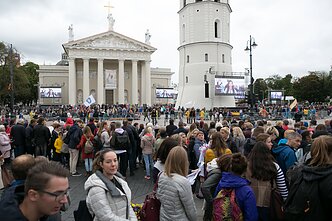











There are around 203,000 more women than men in Lithuania. Despite all efforts, male mortality remains extremely high, while women are facing poorer and lonelier life in their old age.
The choir Likimai (Destinies) will turn 35 next year. It was founded in the late 1980s, during Lithuania’s singing revolution, and has remained active until today. Amateur singers are rehearsing, going on tours, giving concerts. The repertoire ranges from folk songs to opera and church music.
The only problem for the choir is that it cannot get enough male voices.
“There is always a deficit of men. I can’t say that our men have gone to war, but there is always a shortage,” says Giedrė Baltuškienė, the leader of the choir.
In the best of times, the choir was barely half male. Now the 30-member choir has 6 men, so the choristers are happy to have every tenor or bass.
A male-female imbalance also exists in Panevėžys, Lithuania’s fifth-biggest town where the choir is based. In all of the country’s municipalities there are more women than men, with the sole exception of Kaišiadorys.
“There are always fewer women than men up to the age of 40, because more boys are born [...], but from the age of 40 onwards, the number of women is constantly increasing in proportion to the number of men,” says Inga Masiulaitytė-Šukevič, deputy head of the State Data Agency.

Of Lithuania’s 2.8-million population, 1.5 million are women. They number 203,000 more than men. There are 1,153 women per 1,000 men.
In addition to domestic reason, last year the disproportion grew due to a significant number of Ukrainian refugees.
“For the first time in the last 30 years, there was a recorded increase in the population of 54,000 people, and 32,000 of them were women,” emphasises Masiulaitytė-Šukevič.
But the longer-term reason is a significantly shorter life expectancy of Lithuanian men. On average, men can expect to live 9 years shorter than women.
Daumantas Stumbrys, a demographer at Kaunas-based Vytautas Magnus University, says that the causes of men’s higher mortality in Lithuania are specific to post-Soviet countries.
“Murder, suicide, all kinds of accidents, drownings, frostbite and so on,” Stumbrys lists some of the common causes of death.

According to the demographer, tackling the mortality imbalance – lengthening men’s lives – will be a long task. Efforts such as promoting healthier diet, cutting smoking and drinking, increasing physical activity do not produce results immediately. Moreover, progress has been halted by the pandemic.
Currently, two-thirds of the Lithuanian population aged over 65 are women.
“Most of them are widows. This is also a kind of loss, a life event that is shocking. Old age, loneliness, is also connected with the loss of a loved one. This raises certain problems of social exclusion,” Stumbrys says.
Poverty affects women more than men. On average, women get lower pensions, because they used to get lower pay. The gap is around 11 percent.
In 2021, the at-risk-of-poverty rate for women was almost 22.5 percent, compared to 17 percent for men.

Newsletter
Every Friday morning.