













The traditional Sartai Horse Race may be cancelled again this year. The weather has been too warm for a natural ice cover and the racetrack requires a major reconstruction. Neither the government nor the municipality wants to shoulder the costs.
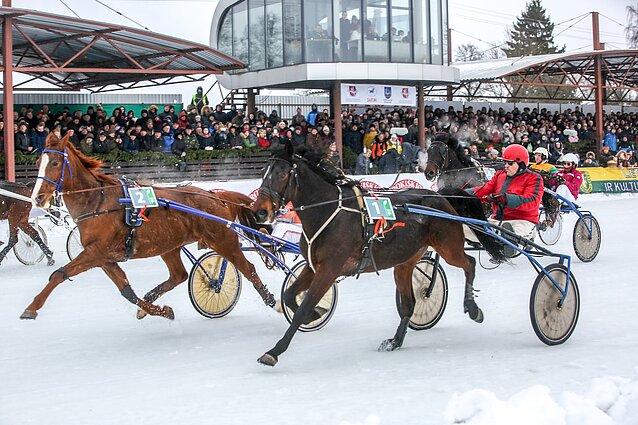
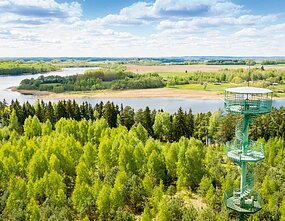
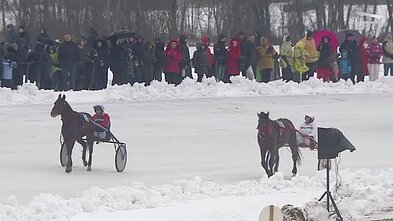
The Sartai Horse Race is a centuries-old tradition in the northeastern town of Dusetos, Zarasai District. The horses used to race on frozen Lake Sartai, but the competition was moved to the nearby Dusetos Hippodrome several decades ago due to security concerns.
However, even this venue may no longer be suitable. The last time the Sartai Horse Race was held was in 2019. Since then, the Covid pandemic or unsuitable weather have prevented the event.
Benjaminas Sakalauskas, director of the Zarasai Municipality Administration, says it may be cancelled again this year.
“There’s a 90-percent chance it will not happen, because there is no ice on the racetrack, which needs at least ten days of temperatures below minus five degrees to form. And there are no good forecasts from meteorologists on that point yet,” Sakalauskas said.
In order to ensure that the century-old race can take place under any weather, the Dusetos Hippodrome requires a major reconstruction. It is owned by the company Lietuvos Žirgynas, which is almost 90-percent owned by the Ministry of Agriculture.
However, the latter is reluctant to open the purse. Arūnas Šileika, head of the Livestock and Animal Welfare Division of the Ministry of Agriculture, suggests that the local authorities should do so.

“If the Zarasai municipality sees an interest, they should take care of it themselves. On a national scale, the government has already invested in other racetracks, so having another racetrack constructed with taxpayer money makes no sense,” says Šileika.
Sakalauskas, director of the Zarasai Administration, retorts that it would make even less sense for the municipality to invest money in a venue it does not own.
“You see, their attitude is, in my opinion, completely reprehensible,” he says, adding that he plans to appeal to other members of the government.
Although the Sartai Race, which is scheduled for February 18, has not yet been officially cancelled, the funding for the event is still unclear. The main organiser of the event, the Ministry of Agriculture, has not yet confirmed how much it would contribute financially.
Joana Kerytė, Director of the National Horse Racing League, says that this uncertainty is causing a lot of problems for athletes.
“Looking at the whole situation, we cannot announce and invite guests from neighbouring countries – Estonians, Latvians, Swedes – because we simply don’t know many things about how to prepare for this competition. After all, it’s not just two weeks or a month, it’s a year-long plan to prepare an athlete for a racehorse,” says Kerytė.

The future of the competition is uncertain, she says, as there are no plans for permanent infrastructure.
“While we are hoping and praying for good weather, the Ministry of Agriculture is hoping that it will be warm and that nothing will have to be done once again. I would like to ask the ministry,” Kerytė says.
“Looking at this whole situation, there is nothing more to say than that we are losing one of the biggest Lithuanian festivals, which has been held for more than 200 years and attracts 30,000 to 50,000 spectators, which has a very deep tradition and which no other country in the world has,” she adds.
As the Ministry of Agriculture is not yet talking about revamping the Dusetai Hippodrome, one of the options proposed is to move the Sartai Horse Race to another venue, for example the nearest one in Utena.
According to Ramūnas Keršys, a representative of the Zarasai Tourism and Business Information Centre, this would completely destroy the meaning of the festival.
“Moving the Zarasai races elsewhere would not be as popular and would not be as much of a trademark, so to speak. Since old times, these traditions have been a factor in the subconscious of the people, who used to come here all the time with their relatives, parents and children and take part in a winter festival,” Keršys insists.
Regardless of whether there will be a horserace or not, the town of Dusetos will have a winter festival, with horse parades and various events aimed at remembering centuries-old traditions.
The Sartai Horse Race is the oldest traditional annual horse race in Lithuania, held in Dusetos and dating back more than 200 years ago. Due to wars and unsuitable weather conditions, it would not be held every year.