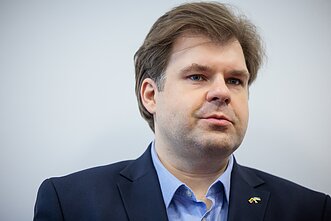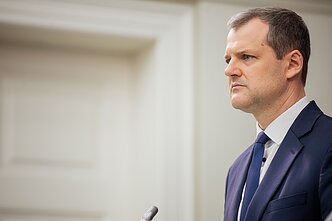
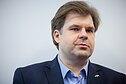









All of Latvia’s integration programmes for Russian-speakers over the past thirty years have failed, according to Riga Mayor Mārtiņš Staķis. With more Russians coming to the country, Staķis says the choice is simple – “if you don't want to be integrated, or you want to live here but you still believe in Russia in your heart and mind, maybe this is not the best place for you.”
In an exclusive interview with LRT.lt, Staķis talks about the recent demolition of Soviet monuments and how Riga is becoming a centre of Russian exiles.
What has been the fallout, or reactions, to the dismantling of the Victory monument?
We have to measure this. There was a very interesting poll in March. We asked the question to the Russian society in Latvia, what do you think about the Russian attack on Ukraine? The results were quite shocking for us because 25 percent said we do support, 22 percent we do not, and about 55 percent said we don’t know, or we are confused or we don’t have an opinion.
In July, we asked the same question and 52 percent of the Russians already said we do not support [the war] and only 16 percent said they did support it. So we see quite a dramatic change in society in only two or three months. And I think we have to do the measurement once again after the demolition of the monument.
[The demolition] was really a skilled operation and we were prepared for it. Because we knew what happened in Tallinn in 2007 [when riots broke out after the relocation of a Soviet-era memorial]. We had four scenarios – the soft scenario A, and D, which was quite tough. For instance, my family should move out of the city if this scenario happened.
We were prepared for all those four scenarios and, in the end, the A scenario happened. [We saw] that a small part of the Russians are really loud, but we didn’t see them on the streets.
You mentioned Estonia in 2007 – there was clear involvement from abroad. Maybe Russia has its hands full in Ukraine?
We knew that there were a lot of cyber attacks in those days, but this time we were quite well prepared. Also thanks to the know-how we got from Estonia during these days.
We know that there could be some provocations, like squads sent by Russia. But the moment [to remove the monument] was the best. Russia is too busy with its problems in Ukraine, and maybe that’s why they didn't work on new ideas.
They are actually using the same weapons that they were using in 2007 in Tallinn. The only difference is that we now know these weapons.

So did the Baltic capitals discuss and share knowledge on how to do this correctly, so as to cause least damage?
If there's one guy I can call my friend, it is [Vilnius Mayor] Remigijus Šimašius. We were also discussing what happened in Vilnius when he demolished the monument [Soviet statues on the Green Bridge] when he became mayor [in 2015].
Of course, I discussed this question with the mayor of Tallinn, Mikhail [Kõlvart]. But the difference is in politics because Remigijus and I are on the same political path, but the mayor of Tallinn [is] on another, let’s call it like this politely.
The mayor of Tallinn said [relocating the Soviet statue] was the worst decision made by Estonia in the history of Estonia, or at least in the history of Tallinn. And the mayor of Vilnius said to me – just do it.
You have mentioned the local Russians, but what reactions did you see from the recent, post-February 24 Russian arrivals?
We don't have so many of them, because many of them have been living in Latvia, or at least they had permission to live in Latvia, for a long time. We don’t have the exact numbers, but I’ve heard around 90,000.
I have met a couple of them, because many of them have real estate here in Latvia [...] and basically all of them are in opposition to Putin's regime.

I asked the question – now you are here in Latvia, now you are free to demonstrate, nobody will put you in jail, so why don’t you do that?
We have not seen demonstrations here against Putin’s regime from the Russian side. The few that we did have were done by the second or third-generation Russians who are living here, or whose parents came in the 70s or 80s and who want to say to society that, yes, we are Russians, but we are against Putin.
But they are locals, not the ones who came after the war. Those who came after the war keep quiet.
Taking into account Latvia's contentious experience with the non-citizen issue, are there dos and don’ts on how Latvia should accept the new Russian arrivals into the society?
This is a very tough question and I have mixed feelings. On the one hand, our borders were open for six months, so everyone who wanted to escape had this opportunity. I really don't believe those who wanted to escape when mobilisation started, because that is the question – what are you running from? Are you running from Putin's regime or the mobilisation? Because you can run from the mobilisation, but you support Putin, which is what you did for the last six months.
Read more: Latvia moves to end Russian non-citizen deadlock
On the other hand, I think we need talented and skilled people from Russia. I think Lithuania did a great job by attracting talent from Belarus, we didn’t.
We need to have this list of people or vacancies that we need, like doctors, engineers, IT people and so on, and I think we need to let them into the country. At least when the war is over.

So you are suggesting applying an economic lens to what could be seen as a sociopolitical issue?
I think this is quite a practical issue, not even a social issue. It's about our labour market and our integration policy. Let's face the truth, it's very difficult to attract an IT specialist from Norway because his salary is 12,000 euros, which I can’t afford. But maybe I can afford to pay 3,000 euros to an IT guy from Krasnoyarsk [in Russia].
We need to have these four clear statements from the people who we will probably be going to invite – that the Latvian language is the only language we want to speak here in the country, that Putin [has committed] war crimes, the war in Ukraine is genocide against Ukrainians, and, most importantly, that [...] this is Europe and here are European values and you should respect those, and we are here to decide what will happen, because this is our country.
If you follow those four rules, I don’t see any problems if there are people who don’t want to live in Krasnoyarsk but want to live in Riga. [...] For example, Ukrainians, there are 20,000 in Riga, and there are six doctors who speak Latvian. They learned the language in six months and I think this clearly shows their attitude to living in Latvia.
Integration is always a tough question. What we understood is that all the integration programmes we had in the last 30 years were not effective. Because integration is a choice, and for those who don’t want to be integrated, none of the programmes work. In these cases it’s better just to take a solution like we did – in the future, there will be no transition period, and the only official language in school is the Latvian language.
Because all these integration programmes clearly failed. For those who have goodwill to be integrated, or at least open minds, to those we need to communicate.
As to those who don't, I don't see any chance to change their mind. For them there is only one way – if you don't want to be integrated, or you want to live here but you still believe in Russia in your heart and mind, maybe this is not the best place for you.
I was visiting the refugee centre we had every single day for one reason – I wanted to hear the story of these people [from Ukraine]. And these stories are the ones that are telling the truth, and they are so different from what we hear on television.

How are they different?
For instance, my government was quite sure that those people hate everything about Russia, especially the Russian language. But the reality was different. Mariupol, Kharkiv, Zaporizhzhia, Donbas, 80 percent of the people were Russian-speaking. They are not against the Russian language, they are against Russia.
[According to Ukraine‘s 2001 census, Russian-speakers made up 74.9 percent of people in Donetsk region and 68.8 percent in Luhansk region. The percentage was significantly smaller in other regions, including 48.2 percent in Zaporizhzhia and 44.3 percent in Kharkiv regions.]
Many of them choose to [send their children] to the Russian schools in Latvia not because they are pro-Putin. They said we are Russian-speaking, but in our hearts and minds, we are Ukrainian.
Have you noticed any tensions arise between Ukrainian refugees and Russian arrivals, or Ukrainian refugees and Russian-speakers in Latvia?
Yes we did. Thirty years ago in my hometown, there were Russian schools and Latvian schools and we were fighting on the streets. So what happened in March and maybe a bit in April is that the fights were happening between the Russians in schools – Russian kids whose parents support Putin and Russian kids [whose parents] are against the war.
That’s why it was so interesting for us to see this change in society, from 23 percent who said no, to 52 percent. This means that also in the family, what they talk about when they eat pancakes on Sunday has changed.
We don't see those fights anymore in schools and I think this is a very good message. Many Ukrainian kids who are now going to school were telling their friends about their experience, what they saw and what happened to their relatives in Ukraine. This was also a game-changer for many Russian kids.
Sometimes the messages that kids deliver from schools to their families are more important than the information parents receive from the television. I noticed this when I was working in the Ministry of Defence.

We had a concept that every family should be ready for a catastrophe – the 72-hour programme. We understood that the best way to persuade the families to grow this readiness is actually to work with the children, because they are coming back to school and asking their parents if they are ready for this situation.
I truly believe that Ukrainian kids really change society. We as a municipality, of course, support this, there are a lot of Latvian seminars and lectures in schools with pictures and videos to show what's really happening in Ukraine.
I think the best decision made by our government was not the demolition of the monument, as you need to demolish the monument [in your head] first – it was forbidding to transmit Russian propaganda channels.
We talked for 20 years about this decision, that we need to find other ways of information. No, the first thing is to take this needle out and then you can talk with the drug addict about what really is a drug and what is not.

Some Russians coming to the Baltic states are worried they will find so-called Russophobia. But what about the contentious dates that we do have in the Baltic states, like the March 16 rally in Riga commemorating Latvian units that fought alongside the Nazis? Do you feel something that is part of Latvian history may affect relations between the Russian exiles and locals?
This is a minority. This topic is for what, 100 people? [...] I think it's very important to not pay attention to those minorities, as what we saw during the demolition of this [Victory] monument is that this minority is really small. And if you look at what is happening on March 16, it’s getting smaller every year and I think it will just disappear one day. Because if you ask my children, for them it's totally different.
I was a volunteer, a teacher in a school, and in every Latvian you have seven or eight Russians who are Latvian-speaking Russians. They are living together, and for them, this topic is just not important. So I think time will solve this issue anyway.
This interview was condensed and shortened for clarity.

Newsletter
Every Friday morning.