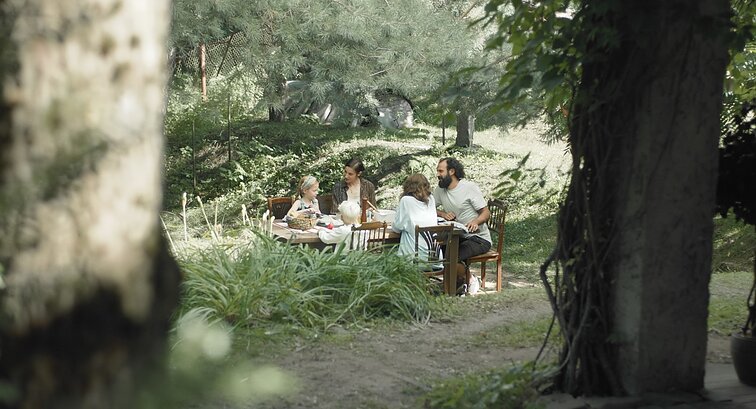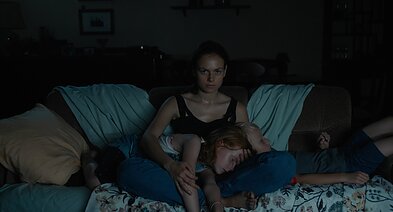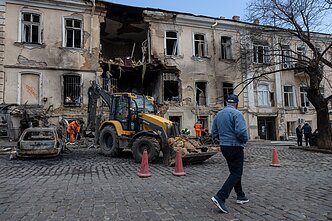










Remember to Blink (Per arti), directed by Austėja Urbaitė.
Among the many world premieres at this year’s Warsaw Film Festival (October 14–23) there was also one Lithuanian title, director Austėja Urbaitė’s impressive feature-length debut Remember to Blink (Per arti). The film, introduced by the director herself and with some of the cast and crew in attendance, was screened as part of the event’s 1-2 Competition lineup and received a warm reception from the appreciative festival audience.
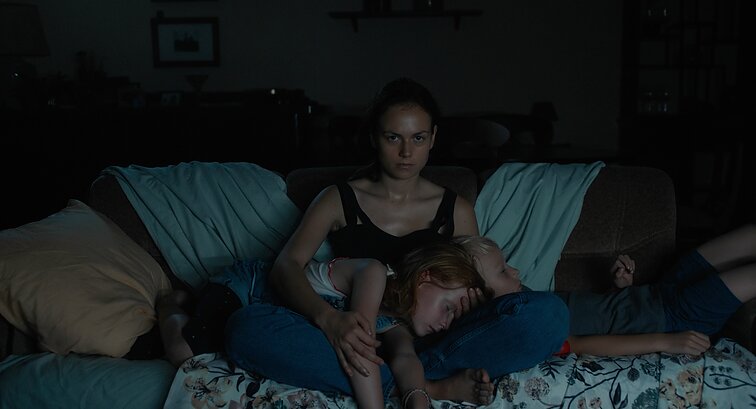
A psychological family drama, Remember to Blink tells the story of a middle-class French couple, Jacqueline (Anne Azoulay) and Léon (Arthur Igual), who are in the process of adopting two siblings, a young boy and a girl, from Lithuania. To help the children with their adjustment to the new environment, the couple also welcomes the twenty-something medical student Gabrielė (Dovilė Kundrotaitė), also from Lithuania, who helps with translation and childcare like a kind of specialised au pair.
The film opens with the three adults’ first encounter, a cute scene suffused with the lighthearted, summery awkwardness of a holiday abroad. However, that seemingly innocent nervous energy quickly starts to develop into something more sinister after the arrival of the children, as their bright yet fragile presence (naturally conveyed by Inesa Sionova and Ajus Antanavičius) throws the reimagined family unit’s internal relations off-kilter. An uncontrollable mutual distrust cascades between Jacqueline and Gabrielė as a jealous rivalry for the children’s affections comes to dominate their relationship.
From early on, it becomes clear that this is a story about the two women, with Léon a likeable but sidelined, ultimately ineffectual presence in the developing drama. The film charts the shifting and complicated power dynamics between the two with great subtlety: there are clashing maternal instincts and suppressed traumas, yes, but also the looming background of Europe’s internal inequalities – Jacqueline offhandedly remarks that Russians and Lithuanians “are the same” and insists on changing the children’s names into French ones. On the other hand, Gabrielė’s independence and future medical career contrast with the unease Jacqueline feels with her circumscribed life of a bourgeois housewife, seemingly without any day-to-day occupation of her own.
The ambivalence of language, whether Lithuanian or French, emerges as one of the film’s central themes: a means of communication but one with painfully sharp limits, it creates barriers as much as bridges between individuals, turning into a source of doubts and a tool of betrayal. It opens up a chasm of distrust between Jacqueline and Gabrielė, whom she suspects of dishonesty. But it is also an anchor: for the children, in the past they don’t fully understand the need to leave behind; and for Jacqueline, in the future family she desperately yearns for. And all the while some of the best scenes in the film record fleeting wordless understandings and intimate, playful misunderstandings between the family-to-be, reminding us of the true breadth of communication beyond language.
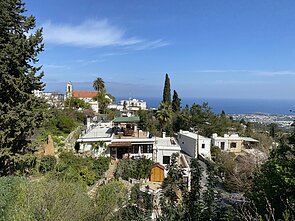
The tight focus on these few interpersonal relationships could easily get claustrophobic, especially as barely any other characters appear on screen and all the action takes place around the family home and its immediate environment. Yet the film opens up through Julius Sičiūnas’s impressive cinematography, finding contemplative views of that environment that give the drama much-needed space to breathe. A succession of impressionistic natural vistas – lush hill scenes and waterfalls shot in Tuscany though the film itself names no explicit location – are interspersed throughout and serve to ground the characters in the earth and water that surrounds them. Towards the end of the film, raging late-summer forest fires come to parallel the growing tensions in the household, symptoms of a wider dysfunction that is at once natural and human.
There is a constant play of different scales, zooming in and out from nation to family to individual, but also in the nature scenes. Majestic landscapes alternate with close-up shots of insect life and snakes, the latter in particular becoming a meaningful double symbol: initially, the obvious reading would seem to posit Gabrielė as the proverbial snake in the private paradise Jacqueline and Léon are attempting to reclaim for themselves. Yet an alternate imagery emerges from the snake-haired Gorgon that Léon is sculpting in his workshop – is this a premonition of the monster that Jacqueline is at risk of turning into through her increasingly controlling behaviour rooted in fear?
Urbaitė marshals the film’s wealth of suppressed passions with a deft hand, never giving into lurid excesses and steering well clear of the kind of banal seduction subplots the premise might have been mined for in more sensationalist Hollywood fare. Instead, even at their most unreasonable – and perhaps indeed especially in those moments – Gabrielė and Jacqueline retain their basic humanity and force the viewer to respond with recognition and empathy, their actions rooted in, respectively, a youthful lack of experience and a painful excess of it. This is greatly aided by the compelling and nuanced performances from Kundrotaitė and Azoulay, oscillating between fierce and confused, confident and fragile in turn.
Remember to Blink is a remarkably accomplished and assured debut from Urbaitė, made all the more impressive by the international, multilingual scope of the production. It is a drama that feels simultaneously both big and small in all the best ways, an intimate and timeless story about normal, imperfect human beings but also one about today’s Europe. A film about love, pain and jealousy; a film with heart.
Mikko Toivanen (@aruinedmap) is a cultural historian with a lively interest in the literatures of the world and the craft of translation. He is also the co-author of a blog on fragmentary fiction.

Newsletter
Every Friday morning.