










The EU’s sanctions on Russia tend to include Belarus as well. But suggestions that Schengen tourist visas should be denied for Russians and Belarusians alike ignore important differences between the two countries, argues Andrei Vazyanau.
There are calls in Lithuania and Europe to stop issuing visas not only to Russians, but also to Belarusians, as the territory of their country is used by the Russian army to bomb Ukrainian cities. However, the two societies arrived at this point in different situations, and the majority of Belarusians do not support this war or want to become part of Russia. Ukraine itself differentiates policies for the citizens of the two countries, and ignoring the Belarusian difference can be used by the Kremlin.
Read more: Regional visa restrictions for Russians to be discussed next week, Lithuanian FM says
Recently, Baltic states have introduced serious restrictions on citizens of Belarus, a country used by the Russian army to launch missiles into Ukrainian cities. Issuing tourist visas to Belarusians is virtually stopped; Latvia and Estonia plan to stop issuing and extending working residence permits for them. Gabrielius Landsbergis has called to cancel the already issued Schengen visas for Belarusians.
To be more precise, the politician mentioned that during the Russian invasion “Estonia, Latvia and Lithuania don’t wish to welcome Russian visitors who are, in majority, supporters of Putin’s war”, but the ban extends to Belarusians. What about the situation for Belarusian majority that, by any data available, does not support the war? How does life in Belarus after 2020 differ from that in Russia? What do Schengen visas mean to ordinary Belarusians? And why does Ukraine differentiate between citizens of the two states?
Belarus after suppressed protests
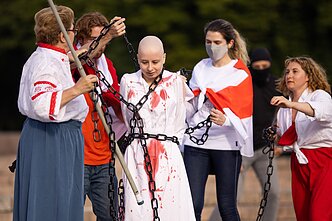
In 2020-2021, Belarus saw one of the most massive protest waves in Europe since the breakup of the Soviet Union. The protests were suppressed. While Alexander Lukashenko was not recognised as elected president by Western governments, Belarusian democratic forces headed by Svetlana Tikhanovskaya have no control of the territory of Belarus.
Read more: Baltics, Poland to seek tougher solutions after EU adopts ‘half-measure’ on visas for Russians

Keeping power with the help of the Kremlin, Lukashenko’s regime also had to integrate with Russia in many spheres. Despite commonalities between the two dictatorships, life conditions and public opinions about war are different.
First, unlike Russia, Belarus practises death penalty. In prisons, forced labour is systematic. Court trials for political cases may take place in absentia of the accused, and protesters can be deprived of Belarusian citizenship. Add arrests for speaking Belarusian and continuing daily arrests for the protests of 2020. The number of political prisoners in Belarus is almost 1,300 (in Russia, the number is around 500, according to PACE). In any international ranking of freedom and human rights, Belarus is far below Russia.

For a long time, Belarus has been the world’s Schengen visa champion with the lowest refusal rate for applicants. This in spite of the fact that, until May 2020, Belarusians had to pay 80 euros for Schengen visa (while Russian citizens paid 35 euros). Still, mass emigration from the country only started in autumn 2020, with the outbreak of severe repressions.
In 2021, according to Eurostat, 149,000 Belarusian citizens, out of the population of 9.4 million, were granted first residence permits in the EU. Citizens of Russia, a country of 146 million, were granted 86,800 permits during the same year. It is only a small portion of those who left Belarus. Poland alone has issued more than 297,000 non-tourist visas to Belarusian citizens between August 2020 and April 2022. Dozens of thousands of Belarusian citizens came to Lithuania, Georgia, as well as Ukraine – especially those who did not have time to obtain EU visas in Belarus and could not risk leaving the country via airports, where checks were stricter.
During the two years since the rigged elections, more than 6 percent of the population – half a million Belarusians – may have left the country (for comparison, 6 percent of the Russian population is 8 million people). More Belarusians left for third countries than Russia since August 2020, and most of the departures from Belarus happened before February 24, 2022.
Since Russian troops entered the territory of Belarus under the guise of military training in February 2022, all available polls show that the majority of Belarusians do not support Putin’s war and are even less willing to see Belarus participating in it.
The percentage of Belarusians who want Belarus to join the Russian Federation remains marginal, less than 10 percent. Moreover, while Belarusian troops do not leave the territory of Belarus, in Ukraine thousands of Belarusians fight on Kyiv’s side in the Kalinouski regiment, Pahonia battalion and other groups. Belarusian communities all over Europe actively volunteer and donate for Ukraine, being among the most active donors for Bayraktar missiles.

Tourism which is not tourism
Today, it is harder for Belarusian citizens to obtain a Schengen visa than for Russians: in Belarus, fewer embassies remain open and with less personnel. Therefore, Belarusians apply for and obtain Hungarian, Italian, Spanish and other Schengen visas in Russia, which means spending four nights on the bus going to and returning from Moscow.
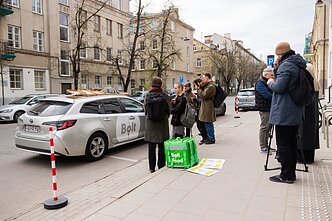
Despite these complications, some Belarusians still commute between Belarus and Vilnius. Many of these trips, however, are hardly tourism, even if done with Schengen tourist visas. They are largely linked to the consequences of the repressions.
Parents who remained in Belarus come to see their children. Some people come to Vilnius to issue a power of attorney in order to avoid dispossession of property in Belarus, where Lukashenko threatens to confiscate real estate from protesters who left the country.
Postcards and small donations for political prisoners are passed from Vilnius, since these can’t be sent via international post and/or bank transfer from Minsk. Some other stories cannot even be told because it would be too risky for travellers. And only a small part of these trips is done with humanitarian visas.

According to a UN report, “while many Belarusians who left their country in the past two years would likely be entitled to asylum or other protection under international human rights and refugee law, only a small number have sought international refugee protection”.
The majority of those who opposed the Lukashenko regime remain in Belarus. Among them are thousands of helpers for the project Bielaruski Hajun who monitor the movements of Russian military equipment in Belarus. For these people, remaining in a country with or without a humanitarian visa means additional suspicions and risks; so tourist visas serve as a thing “to use in emergency”.
Should all the long-term Schengen visas for Belarusians be cancelled, as some politicians suggest, partisan resistance inside Belarus would become even riskier. Even today, employers collect information about valid visas held by their employees. Radically narrowing the spectrum of officially available visas means that the owners remain under increasing surveillance. The flow of requests for humanitarian visas will increase sharply, which will increase the burden on consular offices.
Why Ukraine recognises the difference
Whether banning visas for Russian citizens makes sense remains beyond the scope of this piece, but including Belarusians into the visa ban has its separate significance.
First, it goes against the logic of proportionality and distinction, basic principles of international humanitarian law – to sanction the population of the state whose role in the war is estimated in the range from “aggressor’s ally” to “country occupied by Russia” in the same way (or de facto more than) the population of the state unequivocally recognised as the first and principal aggressor.
Second, banning Belarusians from entering the EU is not what Ukrainian leaders are asking for. The Ukrainian authorities introduced a restrictive visa regime for Russian citizens from July 1, 2022, but not for Belarusians – who use the opportunity, for instance, to bring humanitarian help to the country (with additional border checks though).
Volodymyr Zelensky, in his appeal to Europe to close borders for Russians, did not mention Belarusians. Many link these differences to domestic political interests of Ukraine, but they also correspond to the legal principles mentioned above.
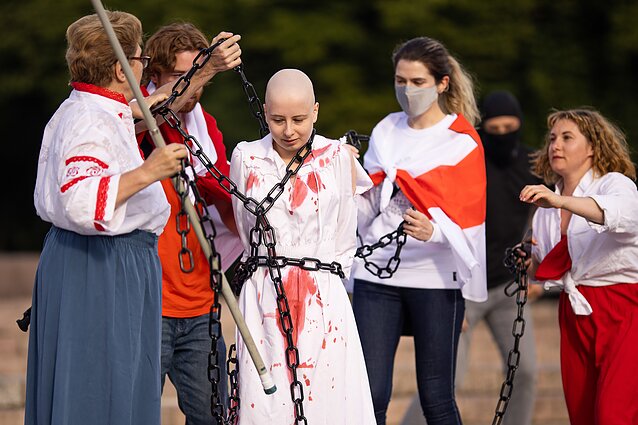
Third, most Belarusians do not expect to remain unaffected by the war, but hope that the protests of 2020-2021, suppressed with the help of the Kremlin, will not be forgotten by democratic countries. These protests did not only show the will of the Belarusian majority for both peace and democracy, they also meant 1,373 injured including children; 4–11 dead; at least six are missing; more than 39,500 arrests in 2020 and 2021 (thousands of further arrests are happening in 2022); 11,000 criminal cases. In this context, the words of Lithuanian MEP Petras Auštrevičius who said in July that “Belarusians must rebel” and “forget about the visa-free regime” predictably frustrate ordinary Belarusians rather than motivate them to continue resistance.
Additionally, it is unlikely to motivate Russian dissident movement by showing that even much harsher repressions do not make any difference for their allies in the West.
If the ultimate goal of visa restrictions is to bring closer Ukraine’s victory, the EU countries need a more elaborate and distinct policy for the citizens of Belarus. Ignoring Belarusian particularities is helpful to no-one except the Kremlin.
Andrei Vazyanau is a lecturer at the European Humanities University in Vilnius

Newsletter
Every Friday morning.