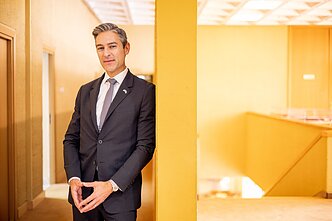












The enlargement of NATO in 2004, when the three Baltic states joined the alliance, was the right decision. Otherwise, Russian troops might already be in Lithuania, says Damon Wilson, director of the US non-governmental organisation National Endowment for Democracy and former senior US and NATO official, in an interview with LRT.lt.
From 2001 to 2004, Wilson served as Deputy Director in the Private Office of NATO Secretary General Lord Robertson. Later, he worked at US President George W. Bush’s National Security Council as the Director for Central, Eastern, and Northern European Affairs. He was involved in the preparation of the 2008 NATO summit in Bucharest and contributed to Washington’s policymaking on Ukraine and Belarus.
You worked in some positions in NATO and the US government, and you witnessed first-hand the NATO expansion in 2004 when the Baltic states joined the alliance. Now, Russia is saying that the alliance had promised not to expand eastward and encouraged tensions by doing so. What would be your response to that? Do you see the expansion as a correct way to further defence and security in the region?
As a Lithuanian, what I would say is “Can you imagine what the situation would be in Vilnius today if we had not enlarged the alliance?” We very well may see Russian troops in this country if we had not enlarged the alliance.
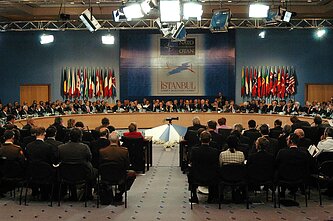
So, was the decision to expand NATO correct? Hell yes. Absolutely. I think we can be very proud of the work that the Baltic states made first. Because this wasn’t Washington’s strategy – this was an insistence first by Czechs, Hungarians, Poles to embarrass Europeans and the United States and say, “You must let us into your family.”
When we began that process (I worked for the US government at the time), we created the membership action plan (MAP) – a tool learned from some of the challenges we had in Hungary – to help prepare countries. Then, we could better assess countries’ suitability to join the alliance.
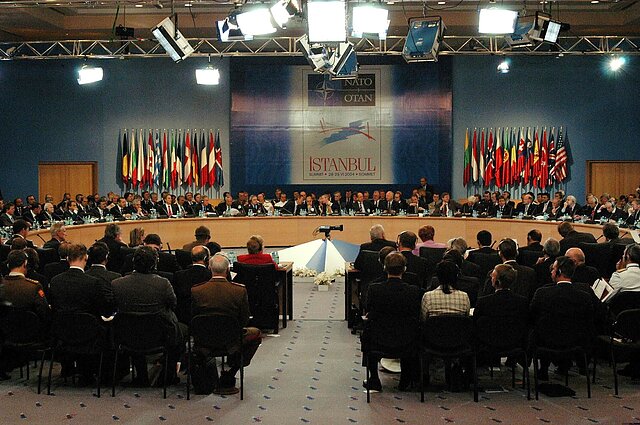
It was what the Baltic states did themselves to transform their societies that made it so compelling. We could not say no to countries that have done so well, objectively speaking. So, using the historic window of opportunity, as Lithuanians saw it at the time, to secure their freedom was absolutely the right call because it means your people are safe and secure today, and their independence is guaranteed forever. We wish the Ukrainians could say that too.
Your question is also a reflection of the intentional Russian cynicism and disinformation that’s meant to convince our societies that we promised not to enlarge the alliance. Which is wrong. That’s a lie that’s not based on historic facts. From the Soviet German and American archives, we know that the conversations were about bringing a united Germany into Europe and NATO. During those talks, no one even imagined that NATO enlargement would be possible, and so, it wasn’t even discussed as a commitment not to enlarge. That’s just wrong, historically speaking.
Read more: LRT FACTS. Has NATO ever promised Russia not to expand east?
The second argument that NATO expansion is provocative and is what has caused this war… I think Lithuanians know better than most that it’s actually a total misrepresentation. The reality is that it is a Russian imperialist ambition to dominate its neighbours, expand its sphere of influence, and recreate a version of the Soviet Union, to reconquer the territories of Peter the Great, as Vladimir Putin himself has told us. This has very little to do with NATO enlargement. And this has a lot to do with an autocratic ruler, who essentially lost the social contract of legitimacy to govern his own people. He’s not delivering them greater prosperity and economic rights. So, what is he delivering them? Chest thumping nationalism to distract them and to provide a rationale for his leadership – Russia is under threat. It is creating a false sense of enemy, whether it’s from homosexuals or NATO. And then, [Putin] defends the Russian nation by aggressively going on an attack.

It’s a very cynical ploy to blame NATO enlargement. The truth is that if we had been even more bullish, it could have helped prevent the war today. But unfortunately, the Ukrainians and Georgians suffer from that lack of clarity.
During the famous Bucharest NATO summit in 2008, when the open-door policy was declared, NATO did not invite Ukraine and Georgia to join. Do you think that was the right decision?
The right decision in Bucharest would have been to embrace Ukraine and Georgia’s NATO aspirations, welcome them enthusiastically into MAP, and back that plan up with robust assistance and reforms to ensure that they would have been ready for NATO by now. That was the position of the United States, in part because that was the position of Lithuania, and [Lithuanian] President Adamkus and [Polish President Alexander] Kwaśniewski weighed in very heavily with President Bush at the time. They underscored the importance of welcoming Ukraine and Georgia’s aspirations.
It had a profound impact on American thinking and strategy, on President Bush himself, so we went to Bucharest convinced that we needed to do this. Unfortunately, German Chancellor Merkel did not agree, and we failed to reach a consensus that had devastating consequences. We were not able to agree on MAP. I think Putin was spooked by the decision, which was a failure to agree on MAP and yet a pretty bold statement that Ukraine and Georgia would join the alliance in the future.
The statement was the product of the Baltic states and Central Europeans pushing that the alliance say something bold even if we couldn’t agree on MAP. That’s where that statement came from. That wasn’t American diplomacy. But we needed to have taken the policy decision, and perhaps, that could have prevented the idea of a grey zone and the temptation to Vladimir Putin to invade Georgia shortly thereafter and now, to invade Ukraine.

Do you think that the West or NATO should have supported Ukraine more prior to the invasion?
Yes. It’s taken us a very long time to realise that we should provide the kind of military support that’s important for their defence. Many in the West fell into the trap that standing by [Ukraine] would be escalatory, provocative to Russia. That’s exactly the backward way to see it. Not supporting frontline democracies is escalatory, not providing significant military assistance to their civil societies is provocative because it demonstrates a lack of clarity, lack of will and helps to demonstrate to Vladimir Putin that maybe you can get away with it.
The truth is that Vladimir Putin doesn’t understand the power of the people, and people power in Ukraine and Georgia is what is helping these countries be resilient, democratic and protect their freedom and sovereignty. From a rose revolution and an orange revolution to the Euromaidan revolution of dignity, we see civil society, ordinary Ukrainians doing extraordinary things. That’s something Vladimir Putin can’t understand. It’s the people of Ukraine that have really helped stop the Russian invasion.
Do you think that now, the European Union is taking the right step in providing candidacy status to Ukraine and Moldova as a way to support democracies?
I think it is hugely significant because Europe is not known to act decisively. The European leaders came together in the midst of a war on the continent and acted decisively. It’s a very significant decision. And yes, we all know the process of joining the European Union is complex. It’s difficult, but it is significant that at a time of great vulnerability the European leaders came together to say, “We stand with Ukraine. They are part of our family, and we agree that they will be in the European Union, and we will begin this process.”
The process of the European Union creates, if you will, a path dependency. It helps incentivise those in Ukraine, Georgia, and Moldova that want to see the reforms take root, democracy institutionalised, European norms met. It will accelerate the Europeanisation of these societies. And that is a really good development. I’m hugely supportive of these decisions.
You have recently visited Georgia. The EU did not give the candidate status to Georgia. Should it have done so?
I just came from Georgia and Armenia. I think a part of our response to Russia’s war in Ukraine has to be the support of all frontline democracies – Ukraine first, but all frontline democracies, as well as democrats struggling in Belarus and Russia themselves.
Georgia is key. In many respects, Georgia should have been the front runner. It’s a society that is westernised, that speaks English, that is really ready to be part of Europe.
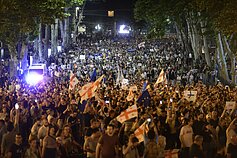
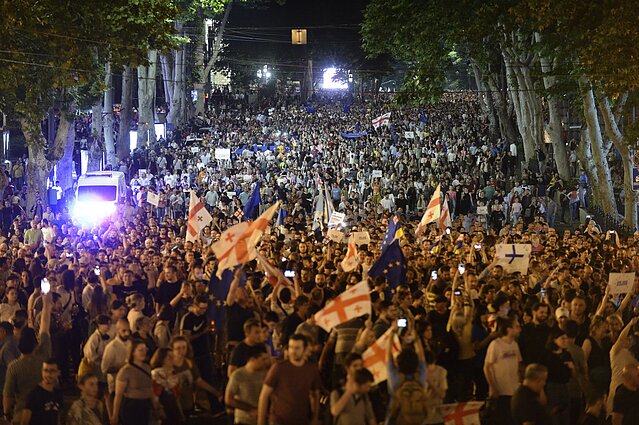
I think that the European Union made a strategic decision to signal to the Georgian people that they will be welcomed, that they have a European perspective. But Europe expects more. To be honest, the Georgian people expect more as well. You saw over a 100,000 people on the streets of Tbilisi on June 20 and subsequent demonstrations. People from across society, across the regions, across political views came out to insist that Georgia needs to be European. And so, there’s a very clear pathway, a very clear agenda, under the Charles Michel [President of the European Council] agreement. And civil society in Georgia has just come out with its own road map on how to get there.
It's not very difficult to see that pathway, and yet it will take political leadership and resolve, it will take compromise. I think that is part of why Georgia is suffering right now. It is a politically polarised environment in which it is very difficult for the government to feel that it can work with actors and Georgian society to advance the nation’s interests. I hope that Georgian leaders can come to that pathway and meet the EU benchmarks that are really Georgia’s commitments to itself. That’s what the Georgian people are insisting on, and it’s up to their political leaders to deliver.
You also worked on the US government’s policy on Belarus. Do you see that the last presidential elections were a sort of lost chance in the country’s path towards democracy?
I don’t see it that way at all. First of all, I’m really proud to have worked on the Belarus democracy act, on implementing it at the White House, to have hosted and welcomed the wives of the disappeared in Belarus to the Oval Office to meet President Bush, to have been part of an American group of activists that have kept Belarus on the front burner of the agenda.
So, I see the devastating electoral chicanery of stealing the election as an awakening of the people of Belarus. It’s so powerful. Every Belarusian I've talked to, many who have stayed in the country, have been awakened. […] They were ready for change. They know that there is a chance for something better, and it gives me great confidence in the future of Belarus.
It’s a tough time right now. Vladimir Putin, spooked by the people of Belarus, coached Lukashenko’s regime to keep it in office, to repress the Belarusian people. We’ve seen also the Russians giving a green light to Azerbaijan in Nagorno Karabakh in an effort to topple democracy in Armenia and now, to invade Ukraine to topple a democracy there. It was really the people of Belarus that helped underscore to Putin that if even Lukashenko’s Belarus wants freedom, he knows how insecure he is. He knows that if left to their own devices, the Russian people would also pick a different future. He’s scared of his people, and to protect himself he feels he must repress the free people of Belarus, Ukraine, Armenia, or Georgia.
Do you see a new wave of democratisation happening in this region?
We are in the 16th year, objectively speaking, of a democratic recession, as documented by Freedom House. But the past decade is unique because it’s been sharpened by Moscow and Beijing’s deep repressions at home, and they’re exportable tools, technologies, and tactics of autocracy and kleptocracy. It has put us on defence around the world, not just here in Europe. So, we’ve been in a bad situation.
I joined the National Endowment for Democracy at what is a consequential moment in history. I think it needs to be our goal to understand that we need to work together with our friends. That’s why I’m here in Lithuania, to support democrats around the world, to end this democratic recession, and to support the opening of what would be seen as a historic fourth democratic wave.

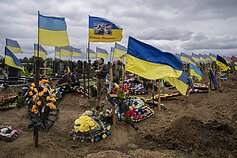
I’m not naïve but I think the sacrifice, the courage, the blood that’s been poured in Ukraine, we owe them that sacrifice to make sure that this is the low point for freedom and democracy around the world today. We can use their courage, be inspired by their work, rally first and foremost behind them, and by helping them succeed with their freedom and sovereignty in Ukraine, to use that to begin a democratic renewal. Democratic renewal begins with democratic solidarity. I think in this consequential moment in history, we need to look back on this as the low point and see the turning of the tide in Ukraine as the opening chapter of a new democratic wave.
Are you not afraid that the US government might turn to isolationism at some point?
No, I’m not. There’s always a significant debate in the United States about how much to be engaged in the world and how much resources to commit to the world. But look at what we’re doing. A 40-billion-dollar package was just passed for Ukraine. More to come. A NATO summit where we embraced further NATO enlargement to Sweden and Finland, where we committed a dramatic increase in our military forces in Europe, at the same time as we are mobilising a much more intentional structured campaign for an Indo-Pacific strategy.
Look at the National Endowment for Democracy. Congress acted to double our budget so that we could help support freedom and democracy around the world.
So, are there voices in the United States calling for isolationism? Of course, there are. That’s a big part of our debate and our history. But look at our actions right now. We are engaged in the world. President Biden has defined this as a time between democracy and autocracy, and we understand that our interests are advancing with our values. And the advance of democracy is one of the most effective national security strategies because everything that we have to spend our money on, everything we have to invest in national security, it is mitigated with the advance of democracy.
Right now, you see Republicans and Democrats in the mainstream agreeing on this cause of freedom, even if you will always have debates on the margin. We are a democracy after all, where ideas are debated and you don’t dictate policy.

Newsletter
Every Friday morning.