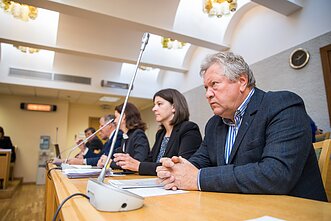
















Berlin is ready to significantly contribute to the formation of a NATO brigade in Lithuania in place of the existing battalion, German Foreign Minister Annalena Baerbock said in Vilnius on Friday.
According to Baerbock, a decision of the whole alliance was necessary for the deployment of a larger unit in the country.
“We are currently discussing the new defence concept with our NATO partners. Therefore, it is important that we act decisively together as an alliance and not as individual foreign ministers. It is important to be together during the process,” she told a joint news conference with Lithuanian Foreign Minister Gabrielius Landsbergis.

“If NATO decides that [the battalion] shall be reinforced to the level of a brigade, we, as the Federal Republic of Germany, will significantly contribute to that. I’ve understood that there is a necessity, there is a need, and Germany will take respective actions,” Baerbock added.
NATO battalions were deployed in the Baltic countries and Poland in 2017 as a way to deter Russia. Germany leads the multinational battalion in Lithuania and has around 1,000 troops deployed in the country.
Countries on NATO’s eastern flank seek to reinforce those battalions to the level of a brigade in response to Russia’s military invasion of Ukraine.
Read more: Lithuania wants NATO to prep 'forward defence' in Baltics
NATO’s current strategy of deterrence was no longer suitable in the Baltic countries, Baerbock said, adding that the alliance had to be ready to combat a potential threat and defend itself immediately in this region.

“The previous deterrence logic of NATO is no longer sufficient in the Baltic countries,” the German foreign minister said. “Putin’s Russia forces us to choose a new course.”
Lithuanian Foreign Minister Landsbergis added that Russia’s actions radically changed the security environment, which should be reflected in the decisions adopted by NATO in its upcoming summit in Madrid.
“The most important change is strategic so as to make sure that we are no longer stuck in a position where we respond later if we are attacked. The response should be immediate, in the first centimetre,” he said.

Newsletter
Every Friday morning.