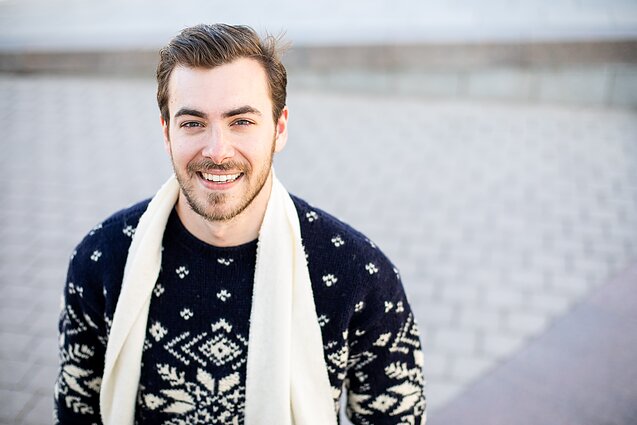











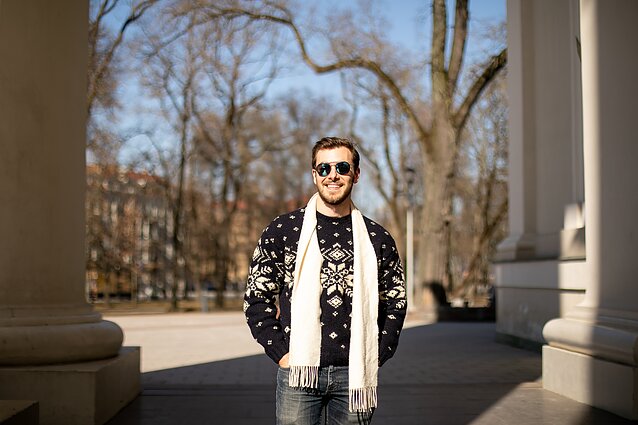
Drake Pooley was born and raised in the United States. One-quarter Lithuanian, he has only visited the country twice but successfully obtained its citizenship a couple of years ago.
Pooley’s great-grandparents were born in Lithuania’s Kaunas, but their life there was interrupted by the outbreak of the Second World War. Even before it began, the Soviet regime detained Pooley’s great-grandfather, forcing the entire family to flee Lithuania.
“My grandmother Brigita was born in a small Saxonian village in Germany in March 1945. They moved to the American zone of occupied Germany, Bavaria, where Romualdas [grandmother's brother] enrolled in a Lithuanian school and applied for immigration to the US,” Pooley said.
“In 1949, they moved to Venezuela, where Romualdas and Ksaveras [great-grandfather] found work as elevator constructors. They moved together with around 20 other Lithuanians,” he added.
Later, Pooley’s grandmother, who was 14 years old at the time, got a residence permit in the US, where she settled with family friends. After marrying an American man, she became a US citizen.
Remembering Lithuania
Although Pooley’s grandmother was not born in Lithuania, she always remembered her roots. In Chicago, she and her husband lived at the so-called Lithuanian Plaza, and her daughter, Pooley’s mother, attended Lithuanian schools.
“My mother grew up speaking a little Lithuanian. But my Lithuanian grandmother encouraged me to learn Spanish and Mandarin,” Pooley said, adding that he followed his grandmother’s advice, so he never learnt to speak Lithuanian.
Nevertheless, he says he has always been aware of his Lithuanian roots, and, despite his mixed family, he considers himself to be mostly Lithuanian.
“Almost everyone in America is from somewhere else. I'm 25 percent Lithuanian, 25 percent Danish, and 50 percent British. But I’ve always identified most with my Lithuanian side because my grandmother was often around,” the man said.

“For the last few years, I’ve been ordering Šakotis [traditional Lithuanian cake] from a Lithuanian bakery in Chicago for special occasions. We also have stickers with the Lithuanian Coat of Arms on our cars,” he added.
Obtaining citizenship
Pooley started the process of obtaining Lithuanian citizenship in 2016. According to him, there are two reasons why he wanted to have the country’s passport.
“First, my grandmother died in 2012. It’s a pity that I didn’t have the opportunity to know her story in more detail, so it was partly to feel closer to her,” he said.
“Secondly, I believe in a globalised, connected world. I have visited 59 countries on six continents. I have always admired Lithuania as a courageous country that cares about freedom and fights for what is right,” Pooley added.
The idea occurred to him after hearing on the radio about Americans obtaining second citizenships. Immediately thinking of Lithuania, he looked up the country’s laws and found out that it was possible to obtain its passport if a person had Lithuanian relatives.

According to the man, the process of obtaining citizenship was not difficult but lengthy. It took around 20 months to gather all the necessary documents.
“We still have a lot of family documents, such as Second World War refugee cards, emergency passports, immigration certificates, and so on,” he said. “I also had to find my grandmother’s birth certificate in a small church in East Germany.”
The process also took time because the documents had to be translated many times into different languages and because people’s names had changed. For example, Pooley’s grandmother Brigita became Brigitte after moving to the US.
Finally, in June 2020, Pooley, his brothers, and their young children were able to start calling themselves Lithuanian citizens.
For people of Lithuanian origin who also want to acquire the country’s citizenship, the man advises hiring local lawyers, as it could help facilitate the process. In his words, people must also remember that citizenship is a duty.
“I would advise people to take their responsibilities as citizens seriously. It is not only a chance to get an EU passport but also an opportunity to contribute to the well-being of a country that is important to you,” Pooley said.

Active citizen
In March, Pooley travelled to Lithuania for the second time. This time, he visited Vilnius, Kaunas, the Hill of Crosses in Šiauliai, and the Trakai Castle.
“I love being in the Old Town of Vilnius and seeing its contrast with the rest of the city. Vilnius is much more beautiful than most US cities. And I have to say, it’s gotten a lot more expensive since 2017 when I first visited,” the man said.
Even though he lives in the US, he tries to spread the word about Lithuania and contribute to its life culturally, economically, and politically, Pooley said. For example, while studying at Stanford, he brought Šakotis to a meeting and talked about Lithuanian traditions.
Pooley, who lives in Silicon Valley where he works with start-ups, said he was also interested in the possibility of employing Lithuanian software engineers.
“I’m a supporter of Lithuania’s development. Lithuania has progressed a lot in the last 30 years,” Pooley said, adding that some measures, such as legalising same-sex partnerships, could bring the country even closer to the West.

Newsletter
Every Friday morning.