











North America is full of Lithuanian sites and monuments, left by different waves of migrants. They are now all put onto a map.
Destination Lithuanian America map took five years to put together and marks some 750 sites of Lithuanian-American heritage, the authors say in a press release.
The final major expansion of the map was completed in January 2022, with 100 new additions. The map covers Lithuanian-American churches, cemeteries, club buildings, monuments, museums, famous burial sites and more.
Every single one of these additional sites were visited in person by the author of the map, Augustinas Žemaitis, who also took images and recorded their stories. Most of the information is available on the map's sister website, as well as True Lithuania Youtube channel and True Lithuania Facebook.
Here are some highlights included in the Destination Lithuanian America map:
Lithuanian heritage of the towns and villages of the Pennsylvania Coal Region
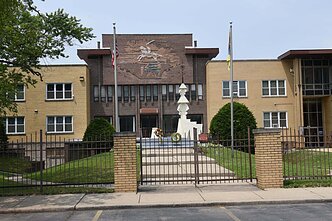
In Pennsylvania Coal Region alone, as much as 105 Lithuanian heritage sites were added to the map.
This was the first area where Lithuanians settled in huge numbers in the USA, starting in 1869 and numbering over 100,000 at the turn of the century. In this area alone, there are more than 40 Lithuanian churches, with a density of a Lithuanian church each 10 miles in some places, with one in almost every town.
Many of the Lithuanian parishes also had their cemeteries and there are non-religious Lithuanian cemeteries as well. The “capital” of Lithuanian heritage in the area, Shenandoah town, alone has six Lithuanian cemeteries. To this day, Shenandoah has some 12 percent of its population considering themselves Lithuanians, and the Schuylkill county where Shenandoah is located some 5 percent - making it the most Lithuanian county of the USA.
Other sites, such as Lithuanian club buildings (six of them still in operation), grand Lithuanian school buildings, and more, have also been painstakingly researched and mapped. Shenandoah, once known as the Vilnius of America, is also important for the history of Lithuania: it was there, at a location also included in the Destination Lithuanian America map, where the world's first Lithuanian-language novel was published in 1904, at the time when Lithuanian publishing was still banned in Lithunania itself.
While the Pennsylvania Coal Region was the most Lithuanian area of the east coast, similar patterns of Lithuanian churches, Lithuanian cemeteries, Lithuanian parish schools has emerged all over New England, Mid-Atlantic, and beyond (Pittsburgh area (PA), Merrimack Valley (MA/NH), New York City area (NY/NJ), Boston area (MA), towns of Connecticut, southern Illinois, etc.).

Buildings of Modern Lithuanian architectural style in America
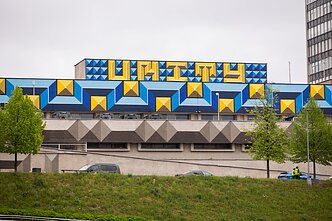
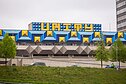
The map includes the world's best buildings and monuments of the Modern Lithuanian architectural style that was invented by Lithuanian-American architects in the 1950s and 1960s.
At the time, Lithuania was occupied by the Soviet Union. Lithuanians who successfully fled to the USA wanted to create “pieces of Lithuania” in the form of Lithuanian churches, monuments and club palaces.
For them, Lithuanian activities had to take place inside truly ethnic architecture. Lithuanian-American architects answered the call by reinterpreting traditional Lithuanian folk crafts on a monumental scale, using modern materials (eg building concrete church towers in the form of Lithuanian wooden chapel-posts), as well as using lots of Lithuanian symbols.
Such ethnic modern architecture was unheard of even in the USA where the “international style” dominated, and thus the Modern Lithuanian style attracted American attention and prizes for its architects.
Every building of the Modern Lithuanian style is included in Destination Lithuanian America, ranging from Chicago‘s Nativity BVM church and the Lithuanian Youth Center, to the Lithuanian churches of East St. Louis (IL) and Queens (NY), to a massive memorial for those who died for Lithuania in Kennebunk, Maine.
Famous Lithuanian burial sites
The Destination Lithuanian America map includes 44 graves of famous Lithuanians who are buried in the USA and Canada. Most of them fled the Soviet occupation in 1944.
Some of these people are known to nearly every Lithuanian, yet their graves are somewhat forgotten due to them being so far away from Lithuania.

Among those whose burials are marked are General Povilas Plechavičius, who thwarted the Nazi plans to create a Lithuanian SS legion; author Antanas Škėma, whose existentialist semi-autobiographical White Shroud about an underemployed Lithuanian-American refugee in NYC is considered the most important Lithuanian literary work of the 20th century; “father of Lithuanian basketball” Pranas Lubinas (Frank Lubin); poet Henrikas Radauskas; world boxing champion Jack Sharkey (Juozapas Žukauskas); tennis player Vitas Gerulaitis, Hollywood star Charles Bronson (Karolis Bučinskis); world-famous archibishop Paul Marcinkus, and more.
Also included is the grave of the non-Lithunian American Samuel Harris, who is known to be the only American soldier who died for Lithuania. He was shot by communists while lecturing the young Lithuanian armed forces in Kaunas in 1920, and now lies in Arlington, Virginia, where Lithuanians built a memorial for him with a Vytis bas-relief.
Lithuanian monuments in the USA
Destination Lithuanian America map includes 179 memorials and commemorative plaques in the USA, raging from “Monuments to those who died for Lithuanian freedom” to statues of particular famous Lithuanians and Lithuanian-Americans, to public plaques describing the history of local Lithuanian communities.

These have been erected in places from Yorktown, Texas (where the oldest known Lithuanian community of America exists, dating back to the 1850s) to Springfield, IL and Shenandoah, PA.
The world's first monument to Romas Kalanta, who self-immolated in protest against the Soviet regime, is located in Chicago, for example.
America also became a treasure trove of Lithuanian artworks, such as UNESCO-World-Heritage-inscribed large Lithuanian wooden crosses that also incorporate the pagan sun symbolism. Each of these large crosses or similar ethnic monuments is also included in the map, as well as two entire Hills of Crosses in Lemont (IL), Camp Dainava (MI), and Missisauga (ON), both inspired by the original Hill of Crosses in Šiauliai.
111 Lithuanian heritage sites in Chicagoland
Chicagoland is the largest treasure trove of Lithuanian heritage sites in America, with as many as 111 of them added to the map.
Chicago is known as the capital of Lithuanian diaspora. Before World War One, there were more Lithuanians in Chicago (by number) than in any city of the still-rural Lithuania. Well until the 1980s, Lithuanian mass was celebrated in more churches in Chicago than in any city of Lithuania itself. Each of the churches in Chicago – just like all over the USA – were (and many of them still are) hubs of secular Lithuanian culture as well, providing space for Lithuanian origanisations, dance groups, etc.

Each of Chicago's Lithuanian churches (one of them demolished by now) have been added to the Destination Lithuanian America map, as well as massive parish schools, Chicago Lithuanian clubs, two massive Lithuanian cemeteries full of Lithuanian monuments, famous burials, and ethnic gravestones.
Lithuanian clubs
Lithuanian immigration to America began in the 19th century, when Lithuania was under the Russian Imperial rule, which banned publishing in the Lithuanian alphabet.
Lithuanians could therefore build structures inscribed with Lithuanian symbols in America long before they could do it in Lithuania.
Among those Lithuanian Halls “as old as the Republic of Lithuania” are Philadelphia‘s Lithuanian Music Hall (1908), Grand Rapid‘s Vytautas Aid Society (1910), Baltimore Lithuanian Hall (1920), and more. Each of those are still in operation.
Localities named after Lithuania
Destination Lithuanian America map includes 54 localities named after Lithuania or Lithuanians, including entire neighbourhoods of Lithuanian streets in Lawrence (MA) and Nashua (NH), Lithuanian-named lakes Dainava and Kasulaitis in Quebec and Pennsylvania respectively, and far more.

Lithuanian museums
The map marks 11 Lithuanian museums in the USA, each of them a great introduction to Lithuanian traditions, crafts, and history.
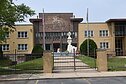
It also includes the unique historic sites built to embody Lithuania itself, such as the Lithuanian Cultural Garden of Cleveland, built before World War Two and full of sculptures of Lithuanian heroes, the Lithuanian Auditorium of Pittsburgh University, gifted in 1940 by the then-still-independent Lithuania, or the Lithuanian Our Lady of Šiluva chapel and Washington's National Shrine of Immaculate Conception.
In these places, every single artwork is meant to artfully represent Lithuania and its history. Their artistic quality (and the fact that they are surrounded by other similar sites artistically representing America's other ethnic communities) makes them popular among non-Lithuanian American tourists as well.

Heritage of Lithuania's minority communities
Destination Lithuanian America also include important places linked to Lithuania, but not built by ethnic Lithuanians.
Among those are the King Jogaila statue in New York Central Park built by Poles, two Polish-established settlements named Wilno (after Vilnius), a Jewish Telshe Yeshiva (relocated from Telšiai to Cleveland, OH), two synagogues named after Vilnius (Vilna), arguably America‘s oldest mosque that was built by Lithuanian Tatars (NYC), and Litvak zones of Chicago's Waldheim Jewish cemetery.
While most of the 160 mapped Lithuanian and Lithuanian-related churches and chapels are Roman Catholic, Lutheran Lithuanians, and National Catholic Lithuanians have left their mark as well. After all, before World War Two, some 10 percent of Lithuanians were Lutherans.
The Lithuanian National Catholic church had been established in the USA as a reaction to the internationalising influence of non-Lithuanian bishops in the Roman Catholic church. Its main parish still exists in Scranton, PA. It is yet another unique Lithuanian-American story, a counterpart for which does not exist in Lithuania itself.

Newsletter
Every Friday morning.