














EU leaders have expressed support for Lithuania in the wake of tensions with China. But why is the bloc sluggish in coming up with a joint response to Beijing’s economic pressure?
In November 2021, Lithuanian businesses started reporting difficulties in exporting their goods to China because of Beijing’s unannounced sanctions on the Baltic country.
Lithuania has angered China after it allowed Taiwan to open a representative office under its name in Vilnius.
Last week, members of the European Parliament sent a letter to top officials in Brussels, urging them to respond to China’s actions because the failure to do so would “embolden [Beijing] to engage in further coercion”.
According to Slovakian MEP Miriam Lexmann, who initiated the letter, China’s pressure on Lithuania is an attack on the entire EU, so the response must also be coordinated between all member states.
“I think it is important to express solidarity, but you cannot be fulfilled with just that,” Lexmann told LRT.
“If there are economic problems, economic action is needed. We need to take urgent measures to show that we are united and ready to defend the single market,” she added.
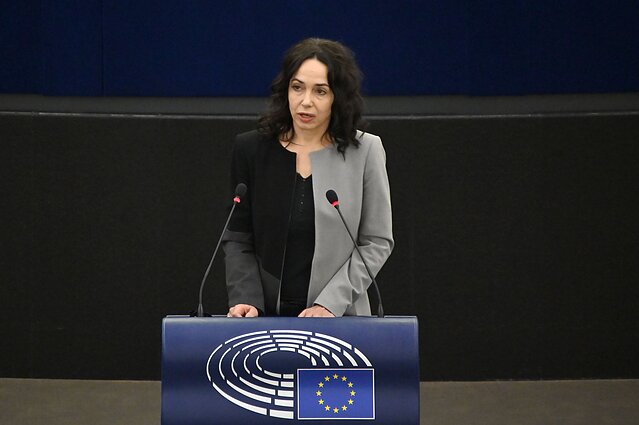
Among the actions that the EU must take are retaliatory sanctions and financial support for Lithuanian businesses affected by China’s embargo, Lexmann said. The bloc must also develop relations with democratic countries instead of authoritarian China.
But only 40 out of 700 MEPs signed the letter. This shows that support for Lithuania in the EU is much lower than could have been expected, according to the country’s MEP Juozas Olekas.
“The decision [to open Taiwanese representation] was not well-prepared in Lithuania. If there had been more negotiations, the [European] support could have been much stronger,” he said.
“Now, you go talk to people and they ask, ‘So, what have you done?’,” the MEP added.
According to Ramūnas Vilpišauskas, a political science professor at Vilnius University, the EU’s response is sluggish for two main reasons: China’s pressure on European companies and the bloc’s legal system.
“China has now become one of the EU's main trading and investment partners. For some individual countries in particular – whether it’s Germany, Greece, or countries in Central Europe – it is very important,” he said.
Beijing has reportedly been pressuring multinationals to drop Lithuanian suppliers or face exclusion from the Chinese market.

Read more: German firms pressure Lithuania to deescalate China tensions – media
For the EU to impose retaliatory sanctions on China, there must also be strong evidence of its economic pressure on Lithuania. But Beijing maintains that it is not blocking Lithuanian goods from entering.
According to MEP Petras Auštrevičius, Lithuania should talk as much as possible about China’s pressure in order to put the issue on the official EU agenda.
“It is true that [China’s pressure] is not being discussed at the EU level,” he said.
“We need to avoid this situation and raise the issue at the EU level more. The MEPs will start talking about it if it becomes a European issue,” Auštrevičius added.

Newsletter
Every Friday morning.