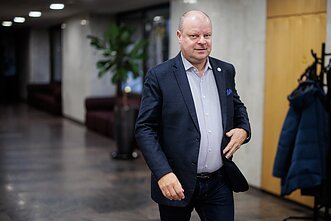










Lithuanian Prime Minister Ingrida Šimonytė says the ruling bloc will overrule the president's veto that rejected a law requiring unvaccinated workers to pay for their own Covid-19 tests.
President Gitanas Nausėda vetoed the law on Wednesday, further escalating tensions between himself and the government. Šimonytė has called his move deliberate interference with vaccination efforts.
Read more: Lithuanian president vetoes bill to make unvaccinated workers pay for tests
“It seems that the president's office has decided to deliberately block the progress of vaccination so that the president's own ambitious [vaccination] target is not achieved,” Šimonytė told reporters on Thursday, making an ironic reference to Nausėda's previous controversial statement in which he suggested that the government was stalling vaccination in order to humiliate him.
“You will see the results of the vote [on overriding the veto] in the parliament hall,” Šimonytė added.
Šimonytė also said that she expected the president to present his pandemic management plan, if he has one.
“I believe that if the president has a plan, he will present it,” she said.
Read more: Lithuanian president spats with government over ‘artificial slowdown’ of vaccination

Last month, the parliament passed a law, requiring that unvaccinated workers who are required to get regularly tested for Covid-19 do it at their own expense.
Since vaccines are currently available to everyone free of charge, the government should not be paying for the preventive tests for workers who refuse to take the jab, according to the prime minister.
“Given that vaccines are available to everyone and are free, alternative choices should probably come at a cost to the people who make these choices,” she said.
Šimonytė reiterated her appeal to people to get vaccinated because it is the “most effective protection”.
In her comment on the president's veto, the prime minister paraphrased Nausėda who claimed a few weeks ago that the government had been “artificially slowing down the pace of vaccination” over the summer.
“We practically missed the first half of the summer when the vaccination pace was artificially slowed down for some reasons that are not known to me. Perhaps the aim was not achieving the president's target of [vaccinating] 70 percent [of the adult population] by mid-July,” Nausėda said in late October.

“And when [the government] saw that large stocks of vaccines had built up and that there might be public criticism, they started going over the top,” he added.
On Wednesday, Nausėda refused to sign the bill into law, saying that the regulation could significantly reduce access to compulsory Covid-19 testing and discourage people from taking the tests.
This would lead to “delayed diagnosis and uncontrolled spread of Covid-19,” the president's office said in a press release.
The ruling bloc is seeking to overturn the presidential veto.
Unvaccinated workers in some sectors, including healthcare, education, catering and public administration, and military personnel are required to get tested for Covid-19 every seven to ten days. The testing costs are currently covered by the state.
Read more: Most Lithuanians oppose €100 vaccination payouts – survey

Newsletter
Every Friday morning.