











Big cities of the Grand Duchy of Lithuania would employ executioners, tasked with torturing crime suspects and executing them in spectacular ways if they were found guilty. Though paid handsomely, executioners were socially ostracised, which is why the position was often filled by foreigners.
Vilnius and other cities of the Grand Duchy of Lithuania have been employing executioners since the late 15th century. Before that, their grim job had been carried out by other people, such as exonerated criminals.
Podlachia, a region in present-day Poland, was the first among the lands of the Grand Duchy to employ a full-time executioner. King Casimir’s penal code of 1465 warranted torture in cases that involved stealing. The three Lithuanian Statutes (1529, 1566 and 1588) also mentioned executioners. The Third Statute (1588) instructed castle courts across the Grand Duchy to hire executioners, though it is unclear just how diligently the order was followed.
First executioners in old Vilnius
We do not and probably will never know when the first executioner began working in Vilnius. The most likely date is the turn of the 15th century, when the city was granted self-rule. According to the Magdeburg privilege of 1432, the wójt (mayor) of Vilnius had the right to administer capital punishment, a practice that calls for an executioner.
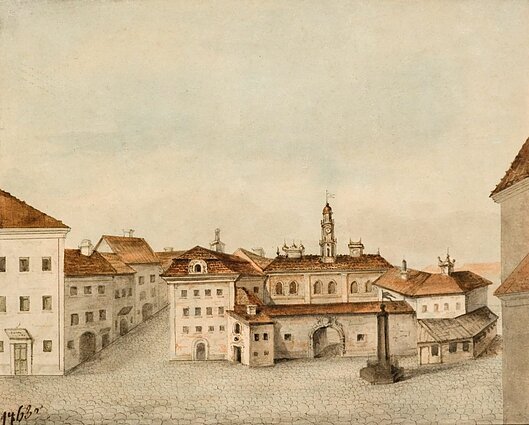
The first documented execution, however, comes much later: in 1580 the city executioner beheaded Grzegorz Ościk, a magnate turned traitor, in the Town Hall Square.
It was in the same square that the executioner burned dozens of books deemed heretical on April 14, 1581, just before Easter. Teodor Narbutt, who lived two hundred years later and left the most detailed account of the event, might not be the most reliable source, yet he says that on that day, early in the morning, several carts carrying firewood, bunches of straws, and books, arrived to the square.
The executioner, assisted by Dominican monks, dumped the firewood and straws into a pit before topping it with the books. Then a priest gave a speech and, after a Dominican exorcist handed him the torch, the executioner Ignacy performed ceremonies and set the books ablaze. Thick clouds of smoke kept rising to the skies for the remainder of the day.
Ignacy, Andrzej, and their colleagues
If the account is truthful, it gives us the name of the first documented executioner in Vilnius – Ignacy. Historical sources mention other executioners who worked in Vilnius in the 16th, 17th, and 18th centuries. They are Andrzej Wroblewski (1657–1671), Johann Rosovien (1675–1677), Paul Lipknecht (1677–1678), Adam Estermann (1679–1692), Nicholaus (1693–1712), Friedrich (1712–1737), Martin (1750?–1752), Schmidt (1752–?), and Mesterhazi (?–1797).
Mesterhazi might have been the last full-time executioner in Vilnius. Most likely a German, he appeared on many occasions in the books of municipal expenses for the year 1797. Mesterhazi died at the end of 1797 and the magistracy of Vilnius paid for his funeral. Ostensibly, the city did not hire another executioner after him.
Mesterhazi was apparently too frail to work during his last years, therefore Vilnius hired an executioner from Grodno to perform his duties from January 14 to February 5, 1797, and from April 19 to May 6 that same year.
None of the known executioners were local. Usually, Germans from Königsberg or Poles from Kraków filled the position. Most of them lived in Subocz Street.
The costly affair of hiring an executioner
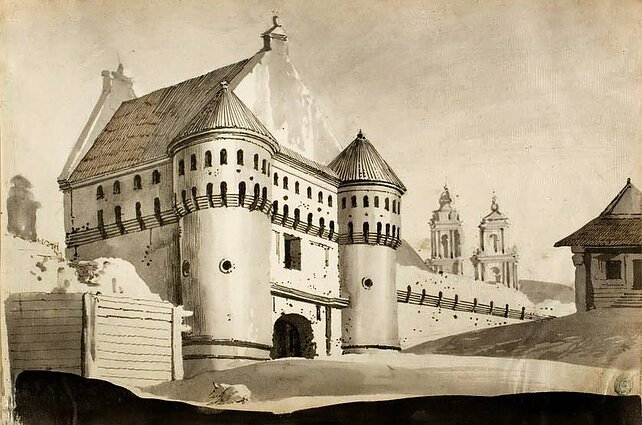
Smaller town of the Grand Duchy often could not afford to hire a full-time executioner, therefore they often invited one from places like Vilnius. At times, the city would also borrow them from elsewhere, including Lida (in 1678 and 1679), Kaunas (1679 and 1692), Kėdainiai (1693), and Königsberg (1737).
The executioner was a municipal officer, his important functions included torturing suspects in important cases under supervision of court officials. Torture, aimed at extracting a confession, was forbidden against public officials, pregnant women, and children under 14.
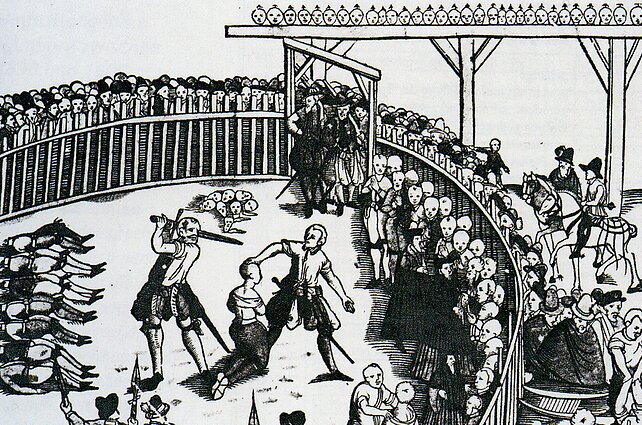
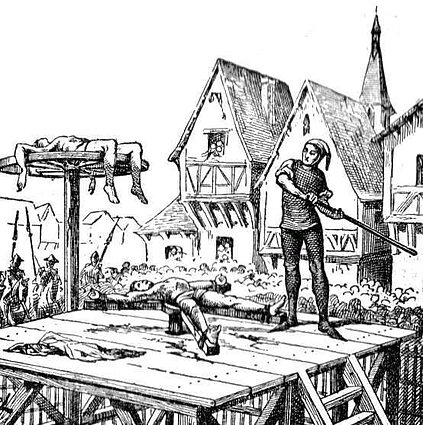
Understandably, the executioner was in charge of carrying out court sentences, from the mildest ones (like expelling from the city) to capital punishments by hanging, beheading, quartering, burning, drowning, burying alive, etc.
For each sentence, the executioner received a fixed payment set by the municipal government. The executioner was also required to remove faeces and dead animals from the streets and take them out of the city, catch stray dogs, and supervise the city prison. To carry out most of these tasks, however, he would hire assistants.
Heaps of gold and public disdain
In the mid-18th century, the executioner in Vilnius earned 300 złotys a year, a huge sum that topped the salary of a burgomaster (250 złotys) and was thrice as high as than that of a municipal assessor, who was paid 100 złotys a year. Executioners received additional money for torture, executions, a disposal of dead animals and other work.
Just as any other servants of the city, they received presents from the city on the most important Christian holidays. They were given red cloth for clothing, as the executioner of Vilnius was obliged to wear red after the German fashion. He also received cereal for sustenance.
Very few envied his position, though. Executioners were essentially social outcasts, albeit in the 16th century some lawyers started arguing that the trade was a virtuous one because it was important for the society.
Still, executioners lived in their own specific subculture, would marry each other’s daughters and widows. Ostracised by the wider society, they were often addicted to alcohol and spent their free time in brothels. Detested by the majority of citizens, they would sometimes suffer violence, like Johann Rosovien, a German who worked in Vilnius between 1675 and 1677 and was shot dead by an unknown man.
The art of torture
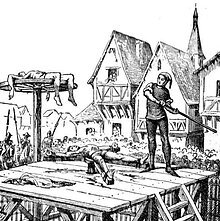
In Lithuania, not unlike in the rest of Europe, offenders would undergo cruel torture before death, which included whipping, red-hot pincers, and ear cutting. The men and women were tortured for grave offenses, primarily related to faith. Whipping at the post, known as post of disgrace, was among the lightest punishments administered for first-time petty thefts. The whipping post was decorated with the head of Themis, the goddess of justice. This is why those tied to the post were said to be “kissing the hag of the Town Hall”.
Wheeling was perhaps the most brutal punishment, which called for breaking the offender's bones before installing the disfigured body into a wheel on a high pole so that all the citizens could see the dead criminal. Other harsh sentences included impaling, quartering, and burning. The execution was usually preceded by three rounds of torture.
Executioners in Vilnius, compared to their counterparts in Western Europe where the art of torture was quite elaborate, used relatively simple tools, such as iron hooks, pincers, ropes, knives, candles, etc.
The executioner’s sword
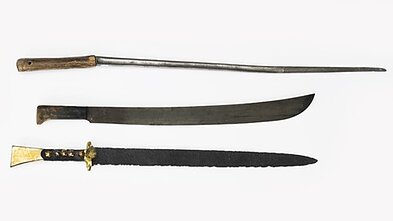
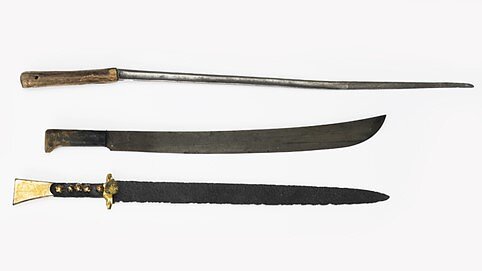
The main weapons used to carry out capital punishment were a sword and double-edged axe. The original sword, featuring a wooden handle with a copper finish, an image of Themis, and an inscription in German, was lost in the early 20th century.
Another double-edge sword, found in 1928 in Vilnius, bore two writings in German: “Whenever I raise this sword, I wish the villain life eternal” and “When I destine a sinner to die, he falls into my hands”. The sword was last seen in a Belarusian museum during the interwar period.
The story is part of the Orbis Lituaniae project by Vilnius University

Newsletter
Every Friday morning.