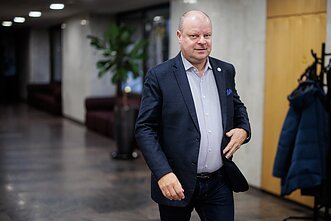

















Lithuania’s withdrawal from Beijing’s 17+1 format was prompted by underwhelming trade benefits, the country’s ambassador to China, Diana Mickevičienė, told the South China Morning Post.
“It was pure calculation,” she told the news website, dismissing a claim by the Chinese state controlled tabloid Global Times that Lithuania was picking the side of the United States in its dispute with Beijing.
“Our expectation [for joining 17+1] was to improve access to the Chinese market, and unfortunately this hasn’t happened,” Mickevičienė said. “We have had slight growth in exports to China, but imports from China are always growing much faster, so our trade balance remains negative.”
Earlier this year, Lithuania became the first country to declare it would stop participating in the 17+1 format, which was established by Beijing to promote investment and trade links with Central and Eastern European countries, 12 of which are members of the European Union.
Read more: Lithuania quits ‘divisive’ China 17+1 group

Critics say, however, that the initiative was launched to grow China’s influence in the region to the detriment of the European Union and the United States, which remains the main security guarantor in Eastern Europe.
Lithuanian Foreign Minister Gabrielius Landsbergis has previously said that the format was “divisive”, adding that the country would instead participate in EU-wide initiatives. Landsbergis also said the country would establish embassies in South Korea, Singapore, as well as an economic representation in Taiwan to limit trade “dependence” on China.
Read more: Is Eastern Europe's love affair with China coming to an end?

According to Ambassador Mickevičienė, the differences between the EU and non-EU countries in the 17+1 format had created conflicts that were “too hard to manage” for Lithuania.
The move to open a trade office in Taiwan was announced around the same time as the Lithuanian parliament voted to recognise the repressions against China’s Uighur minority as “genocide”, drawing sharp rebukes from Beijing.
Read more: Lithuanian parliament passes resolution condemning ‘Uighur genocide’ in China
According to Ambassador Mickevičienė, “we certainly hope not” to face a blowback in relations with China, adding that Lithuania respects China’s interest.
“We never thought of stopping anything [in trade] or people boycotting goods. We just want a normal, working, civilised relationship,” she told the South China Morning Post.

Newsletter
Every Friday morning.