














This coming Saturday, one of the six bands and performers will win the golden ticket to represent Lithuania at the Eurovision Song Contest in Rotterdam in May. Here they are.
Voldemars Petersons, Never Fall for You Again
Voldemars Petersons topped the first heat of Lithuania's national Eurovision selection with his lyrical song Never Fall for You Again.
Despite his Latvian-sounding name – his parents met in Jurmala and he spent his early childhood in Riga – Voldemars hails from Kaunas, Lithuania's second city.
His musical career started with a music reality show in 2005, though even before that he had been in a Christian rock band.

Voldemars has a day job at a training centre – he has yet to make a living from music – and could be spotted performing in the streets of Palanga, Lithuania's Baltic coast resort, last summer.
Voldemars says that his song about hapless love and breakup was not inspired by personal experience.
“A student at the training centre where I work heard me sing one line from the song, back when it didn't have lyrics yet. She said: this sounds like Eurovision,” he recalls.
He initially tried to develop the song as a duet, to be performed with the student, but it didn't work. Still, the student suggested that it should be about an “oppressive relationship you try to leave, but keep falling for again”.
Gebrasy, Where'd You Wanna Go?
Gebrasy is the stage name of 26-year-old Audrius Petrauskas. His song, Where'd You Wanna Go?, won the semifinal, receiving top scores from both the jury and televoters.
Gebrasy has been singing since childhood, but also started writing songs when he was around ten. In fact, he co-authored two more songs that were competing to represent Lithuania in Eurovision this year.
As to the meaning of his stage name, Audrius says there is none. “The word just popped into my head when I was 11 or 12 and I kept using Gebrasy as my username in online forums and computer games,” he says.
A few years ago, he decided to start using it on stage too, as everyone kept misspelling Audrius' real name anyway. “Before deciding to use [Gebrasy] on the stage, I looked up on the internet if it means anything in any language. It does not.”

Gebrasy's first exposure to fame came seven years ago in The X Factor. In addition to solo performances, he is part of the band Original Copy which often tours with one of Lithuania's best-known singers, Jazzu.
Gebrasy wrote Where'd You Wanna Go? with his regular collaborator, composer Faustas Venckus.
“The song is a story of hapless love [...]. The two heroes love one another, but realise that there's no future, the feeling will fade away,” he says.
The lyrics compare the love story to a car crash and contain lines like “hands gripping the wheel, as you told me how you feel, eyes staring through glass, we're running out of gas”.
“No, the song is not about anything that happened to me,” Gebrasy insists. “I don't even have a driving license.”

Titas and Benas, No
Titas and Benas, the cousin duo from Panevėžys, made a splash a year ago on Lithuania's X Factor.
Still at school, they are among the youngest contestants in the competition, though they claim to be long-time fans of Eurovision.
“Watching Eurovision is a tradition, we usually do it with our parents,” they tell LRT.lt.

Their song, No, is a lyrical rendition of a painful love story – something of a pattern this year – and is aiming straight at the audience's romantic bone.
“When we sing, we want to feel the song. That, it seems, is what wins people over,” they say.
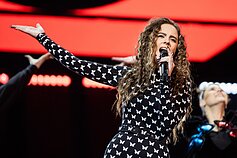
Evita Cololo, Be Paslapčių
Nineteen-year-old Evita Cololo launched her career by winning a TV music competition, Lithuania's Voice, last year, though she says she's been serious about music since 13.
“I've been fascinated by the stage since childhood, I like interacting with the public, I like the atmosphere, the attention, I like to play and sing from my heart,” says Evita.
Moreover, she comes from a family of performers, her father being a famous comedian.

Evita is the only contestant in the final to perform a song in Lithuanian, one that she herself co-wrote.
“No secrets, come closer, bitter truth is better than lies,” runs the chorus of Be Paslapčių.
“I write in Lithuanian, because it is a very beautiful language – words boost the musical emotion,” she says. “Our language is lyrical, musical, rhythmic. I want to prove this, first, to its speakers and then to Europe.”

Martyna, Thank You Very Much
Martyna Jezepčikaitė hails from the southern town of Alytus, where the 18-year-old is in the final year of school.
Like many of her competitors, Martyna used The X Factor as a career springboard and was the runner-up in 2019.
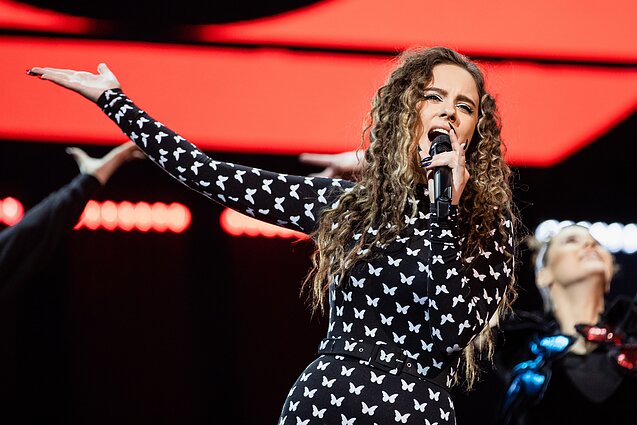
Martyna's entry, Thank You Very Much, is “a song for strong women”, she says, quoting the Israeli 2018 winner, Toy by Netta Brazilai, as her favourite Eurovision performance.
“Better alone, I guess that you don't even know that I'm so over you, 'cause I'm too good for you,” runs the chorus of the song written for Martyna by German producers.

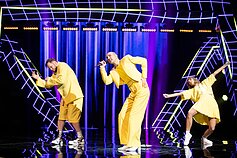
The Roop, Discoteque
Eurovision fans are already familiar with The Roop, the band that won Lithuania's national competition in 2020, but was prevented from performing on the big stage due to force majeure we're all only too familiar with.
As a compensation of sorts, The Roop got a ticket to advance straight to Lithuania's national final this year. But even though their new song, Discotheque, has not yet been subjected to the jury's and televoters' judgement, The Roop are among the favourites to go to Rotterdam.
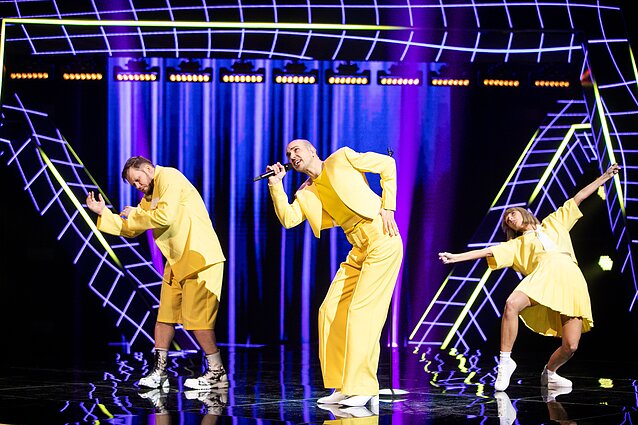
Discoteque, an 80s-inspired tune complete with a stylish music video, is about inner liberation and dance, says the band.
The song talks about “inner liberation”, according to lead singer Vaidotas Valiukevičius. “We often say that we are free and we live in a free world. But most of the restrictions are inside us. With this song, therefore, we want to stir people's inner selves that are too self-critical, too afraid to look weird.”