
















Lithuania's police register only a handful of hate crimes every year. But the real scale of the problem is much bigger – the society lacks awareness, and despite running training programmes, the police often choose not to investigate, according to experts.
What can Lithuania learn from Sweden and Ireland in tackling hate crimes? The National Human Rights Forum raised this question in its discussion Response to Hate: Examples of Good Practice.
The Lithuanian society does not recognise the scale of hate crimes, according to Goda Jurevičiūtė, project manager at Human Rights Monitoring Institute. Various groups still choose not to report such offences for fear of negative reactions, she said.
According to Jurevičiūtė, even when people report hate attacks, police often decide not to start an investigation, while in violent crime cases, the hate aspect is often ignored.
Another problem is police prejudices against various minority groups.
“[Prejudice] is a huge problem. But it is recognised, and we talk about it. This is important,” Jurevičiūtė said.
Over the last several years, police officers have received training for dealing with hate crime, according to Jurevičiūtė, and considerable progress has been made. For example, there are now guidelines on how to detect hate crime.
Moreover, police officers are actively engaging with minority communities, said Agnė Greblikaitė, the head of Kaunas Community Officers’ Activity Department.
Read more: Liverpool rallies behind Lithuanian family after hate crime attack
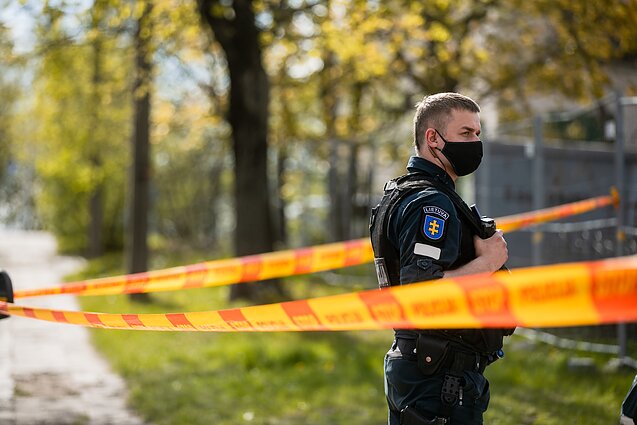
According to her, officers try to communicate with communities, introduce themselves to them, and explain what help is available. The police also ensure community safety during their religious celebrations and commemorations, Greblikaitė said.
But some issues remain unsolved, because of general prejudices against some groups of people, according to Vilius Velička of Lithuanian Police School.
“We need to talk and educate the public about it. Not only training, but also education is important for officers. [...] We need to work with human rights NGOs and representatives of vulnerable communities,” Velička said.
Sweden’s special units
In the discussion, Sweden's experience was presented as an example to follow. Since 2007, a special Hate Crime Unit has been operating within the Swedish police. Its aim is to increase people’s trust in police and to encourage them to report hate crimes. The unit also works towards improving police understanding and enabling officers to identify hate crimes.
“We are strengthening national and LGBT minorities’ trust in police. We are cooperating with those groups,” said Göran Stanton, an inspector at Sweden’s Hate Crime Unit and founder of the Swedish LGBT Police Association.
Moreover, Sweden increased punishment for hate crimes in its Criminal Code, Stanton said.
“If the main motive of the crime is a person's race, religious beliefs, sexual orientation, gender identity or gender expression, these are considered aggravating circumstances,” Stanton explained.

According to the police representative, Sweden is now an example of good practice in tackling hate crime because, in 2000–2007, the country’s government made this issue their priority.
“Special investigators of hate crimes were appointed to national LGBT groups and police units. We also organised conferences with the LGBT community and established cooperation with Jewish and Muslim communities,” Stanton said.
But according to him, in recent years, the Swedish government no longer considers hate crimes to be a priority. As the national policy no longer dealt with the issue, educational programmes disappeared and only a few officers responsible for hate crimes remained.
Ireland’s fight against racism
In Ireland, the focus is on the fight against racism. The Irish Network Against Racism (INAR) unites 125 organisations that work even with the smallest ethnic minorities in the country.
According to INAR’s head Shane O’Curry, the network helps to analyse information and brings together various organisations for joint campaigns.
“It is very important to understand that racism takes place not only within the context of hate crimes but also in institutions. [...] It is necessary to ensure that the authorities respond appropriately to hate crimes so that victim assistance and institutional response are inseparable,” O’Curry said.

INAR was founded in 2014. In the same year, it received 350 offence reports, 122 of which were about racism. At the same time, the Irish police registered 43 hate crimes involving racism. It means that the police had no guidelines on identifying and investigating hate crimes, INAR’s head said.
In 2013, INAR also founded the iReport.ie platform that collects information on racist attacks.
“It is a platform where people tell their stories. We wanted their voices to be heard. Such a platform allowed majority communities to become allies of minority communities. These goals have been successfully achieved,” O’Curry explained.
In 2019, the platform received 530 reports on racist incidents. According to O’Curry, iReprt.ie passes the collected information on to the Irish government, NGOs, media, and other institutions.
“In seven years, we registered around 3,000 cases. […] During this time, we have noticed a change in communication with national authorities and police. They are committed to the fight against hate crime, and we see significant progress on crime legislation,” INAR’s head said.
According to O’Curry, seven years ago, Ireland was in a similar situation as Lithuania is now. Back then, it was hard to be heard, he said. But INAR has built trust and became the prime institution that the media approach for reports on hate crimes.
Read more: Lithuania's Russians torn between two countries: 'I need to prove that I belong here'

Newsletter
Every Friday morning.