











On Thursday, Svetlana Tikhanovskaya, the main leader of the Belarusian opposition, called on Lithuania to impose sanctions on Belaruskali, a state-owned fertiliser manufacturer and a source of hard currency for Alexander Lukashenko’s regime.
“We raised the question [with Lithuanian politicians] of increasing the cost of delivery [and] transit,” Tikhanovskaya told BNS. “To put some conditions – if you fire people, then we will raise the price or we will just cut this transit.”
The multi-billion company is estimated to employ 16,000 people and is one of the largest fertiliser producers in the world. Most of Belaruskali’s exports go via Klaipėda and make up a significant share of profits of the Lithuanian port and state-owned railways company.
Lithuanian authorities have previously said that Belarusian freight, including Belaruskali produce, amounts to around a third of all cargo going via the port.
Read more: Belarusian company to increase exports via Klaipėda port amidst politicians' concerns
Later on Thursday, Lithuanian Economy Minister-designate Aušrinė Armonaitė said the government should consider placing sanctions on the company.
The leader of the liberal Freedom Party said potential short-term economic losses should not outweigh human rights considerations, adding that economic pressure could contribute to bringing down Alexander Lukashenko.

Read more: Will Lithuanian businesses suffer from unrest in Belarus?
“This could have negative consequences for the Lithuanian economy, but it could have positive consequences as far as the end of the Belarusian regime goes,” said Armonaitė.
“I believe this is an issue to be considered,” she said, adding that “I can't comment on a specific model right now.”
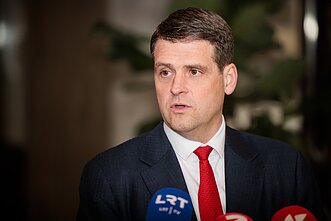
Lithuanian Foreign Minister-designate Gabrielius Landsbergis said, however, that the country cannot introduce unilateral economic sanctions, since this is a prerogative of the European Union.
“The EU is currently discussing a third package of sanctions, which includes possible sanctions against people and businesses financing those close to the regime,” the leader of the conservative Homeland Union–Lithuanian Christian Democrats (TS-LKD) told BNS.
Read more: New EU sanctions on Belarus coming, Lithuania among initiators – minister
Tikhanovskaya: Belaruskali ‘is very powerful in Belarus’
Tikhanovskaya said she asked Lithuanian officials to review transit conditions for Belaruskali if the Minsk government carries on with repressions against its employees.
“Belaruskali is one of the state enterprises that is like a purse of Lukashenko. It's very powerful in Belarus. Their workers are being fired because of their civil position,” she said.

The opposition has repeatedly called on the thousands of Belaruskali workers to strike, potentially hitting the regime’s income. However, Belarus’ security forces responded by detaining strike leaders and coercing others to continue working.
Earlier in December, Norway's Yara, one of world leading fertiliser companies, said it might restrict purchases from Belaruskali in response to repressions.
“We contacted Yara and they just put forward conditions – if you fire workers, we'll stop buying your products,” said Tikhanovskaya.
“It is much better than just to stop buying products: do this or that and that and we will continue to work with you,” she added. “But they continued to fire workers and now we understand that these economic sanctions have to be hardened towards Belaruskali to fulfill all those conditions.”
Lithuanian president: sanctions 'require additional discussion'
“We'd look [at the issue] in the future, but at the moment, it would require additional discussion,” commented Asta Skaisgirytė, the chief foreign policy adviser of Lithuanian President Gitanas Nausėda.
She noted that sanctions against businesses were applied on an EU scale, adding that it was also important to look at whether the measure could have a negative impact on the Belarusian people.
“On the one hand, if a company works for the regime, it could be sanctioned,” she told RT RADIO. “On the other hand, one always looks at whether this is going to harm ordinary people.
Read more: Lithuanian hardline on Belarus cracks with China’s investment push

“For example, if the company employs a lot of people, and Belaruskali probably employs several tens of thousands, [sanctions] might affect the well-being of these ordinary people, workers.”
“When it comes to sanctions, we wouldn't want to overdo things when they affect the civil society that we want to have the best relationship with and which we support,” she added.
Klaipėda port: sanctions should target individuals
"Economically, this would have a very negative impact on the port", the port's CEO, Algis Latakas, told BNS. "If applied, sanctions should target individuals, not business sectors or companies."
Klaipėda handled 14.1 million tons of Belarusian shipments last year, including around 12 million tons of Belaruskali produce, accounting for 30.5 percent of the port's total cargo traffic.
Belaruskali also holds a 30 percent stake in Birių Krovinių Terminalas (Bulk Cargo Terminal, BKT) in the Klaipėda port. The majority share is owned by Lithuanian businessman Igor Udovickij.
Read more: Belarusian investments in Lithuania come with strings attached, Seimas security committee warns

Newsletter
Every Friday morning.