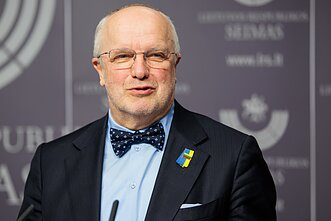

















While the second wave of the coronavirus pandemic weighed hard on some businesses, a young Russian-speaking entrepreneur from Lithuania's Šalčininkai says his startup managed to grow and attract investment.
Evgeny Polonis, a 28-year-old businessman, hails from Šalčininkai, a predominantly Russian and Polish-speaking town in southeastern Lithuania. He completed a management degree at Vilnius University, and then studied advertising and marketing, before embarking on his own business.
“We have created a platform that helps cargo owners to have all the information related to transportation in one place. That is, our solution covers the entire process of communication, which begins with pricing enquiries and ends with the preparation and signing off on all documents after unloading the cargo. All this can be done on our platform, in your account,” Polonis tells LRT Novosti.
He created his startup three years ago, but it truly took off in spring 2019.
The company now has clients in Lithuania, the other Baltic countries, Poland, and Eastern Europe. Everything went well until March 2020, when almost the whole world closed due to the coronavirus pandemic.
“We do not have annual license agreements, our clients buy monthly subscriptions to our system. Under the new conditions, many manufacturing companies did not know what to expect,” he says.

“Those clients who used our services continued to work with us, I'd say that we did not suffer any losses there. But other potential clients who were about to sign up suspended the whole process, because no one knew how serious it would be.”
As Polonis' business operates in the field of international transportation and logistics, border closures spelled considerable uncertainty. “No one then knew when movement would be restored.”
“So the result of the first wave of the coronavirus for us was this: we did not suffer financial losses, but new sales stopped for a month and a half,” says Polonis.
Clients got used to working from home
According to him, the challenge for many businesses was how to organise work from home – it took people about a month to understand that leaving office did not mean that they should stop making any decisions.
“If earlier three logistics managers worked in the same office, now everyone is sitting in their different apartments, and that's when solutions like ours, when you can see all the information on one screen, can be beneficial,” says Polonis.
And so sales started picking up again about six weeks into the quarantine. “Everyone got used to working from home, everyone realised that it was not fatal, and everyone began to think how to solve issues.”

At the beginning of the year, his company employed six people and the management decided not to fire anyone, but to wait out the pandemic.
“Our field is IT, we are not a restaurant business where there was zero turnover at that time. We continued to receive money from the clients we already had, only the growth of the company stopped for about two months. If you compare it with other business sectors, I think that IT suffered the least,” Polonis says.
By the start of the summer, his company's clients could be divided into two camps – those that were hit hard by the pandemic and those that were not or actually gained from it.
“We were not tied to any one sector, we can work with everyone. If we take such areas as packaging, pharmaceuticals or plastics, those companies received a lot of orders, this situation was good for them, they started to grow. And we decided to work with them,” he says.
This year, his startup got its second investment injection in 12 months. In January, investors put forward 120,000 euros and now they increased funding by another 450,000 euros. The company will use the investments to further expand in Poland and Western Europe.
“We have now 10 employees. And the number of clients has tripled. Among them are companies such as Narbutas, Continental, Dominari,” says Polonis.

Sorting out winners and losers
“One of the success factors was that we quickly realised who were the losers in this situation and who were the winners. First, this applies to countries, and second, it applies to industries. Some industries have suffered greatly, while others have benefited. And we simply shifted our focus to those industries that were going through good times,” Polonis shares.
However, he is cautious when it comes to expectations for next year.
“Guessing what 2021 will be like is looking for a needle in a haystack,” he says.
“But I think that the [teleconferencing] tools that have come into our daily lives will stay with us for a long time.”
In his opinion, with the emergence of new IT solutions and digitalisation, companies can reallocate their resources and employees who previously simply clicked on the “send” or “copy to Excel” buttons can now perform more efficient work.
“Speaking on a national scale, I really hope that we will understand how serious this is and we will follow the rules that must be observed and this will lead to a positive result,” Polonis says.

Newsletter
Every Friday morning.