










A beach set up by Vilnius municipality in Lukiškės square has ignited a moral panic among the country’s politicians. They claim that frivolous festivities are unsuitable in the square, since anti-Tsarist uprising leaders were executed there.
Historians, however, say the exact location of the execution has not been determined, while the lingering effects of the Lenin’s statue that used to stand in the square, as well as Soviet repressions and politisation of memory, cannot be ignored. LRT FACTS investigates.
The so-called January Uprising of 1863–1864, in which Poles and Lithuanians rebelled against the Russian Empire, was violently crushed by the Tsar's forces. Some of the rebel leaders were executed by hanging somewhere around present-day Lukiškės Square in Vilnius.
Some politicians quoted this fact when criticising the mayor of Vilnius after the city built a temporary beach on the square.
“Uprising participants were executed in that square, and many other things [took place] that prohibit what Vilnius municipality did,” Ramūnas Karbauskis, the leader of the ruling Lithuanian Farmers and Greens Union, told reporters last week.
The Lithuanian parliament passed an urgent law this week, saying “the square’s present use [...] does not befit its historical and urbanistic significance and risks degrading the nation’s historical memory”.
On Wednesday, Karbauskis compared the beach to a circus that was later installed on the square by the Tsarist authorities – according to him, to belittle the 1863–1864 uprising participants.

Sites of executions unknown
However, historians have previously said that the exact locations of the executions are not known, even though there is now a memorial commemorating the uprising on the side of the square.
Until the mid-nineteenth century, the site was located outside the city and looked completely different.
“For a long time, there used to be a marketplace here, [and the square] looked completely different than today and occupied a different plot of land,” said Darius Staliūnas from the state-funded Lithuanian Institute of History told LRT.lt.
“The sites of the executions could have been in the centre of this square, but also anywhere else on this plot,” which “used to stretch all the way to Tauras Hill” a few hundred metres away, he added.
Gedimino Avenue, today one of the main streets of central Vilnius adjoining Lukiškių Square, was not built until much later.
The Tsarist government did install a circus here, but it was not done to mock the executed Lithuanian rebels, according to Staliūnas.
“The Russian officials that worked in Vilnius at the time may have not even known that there were death sentences passed in this square,” he said.
“The square wasn’t some sort of site for national pilgrimage or a place for commemoration,” added Staliūnas. There was no reason why a circus could have “insulted someone’s national feelings or belittle someone”.

Statue of Lenin
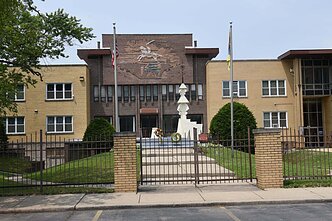
Lukas Rekevičius, the head of Lithuania’s Chamber of Architects, said the gallows could have stood not in the present-day square, but on the site of a nearby building that used to house KGB headquarters and is now a museum and a court.
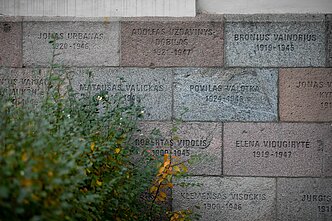
According to Rekevičius, there already is a place of commemoration near the building: a monument for Lithuania's anti-Soviet resistance fighters and facade stones with their names.
Meanwhile, the square has been left for the city and its residents to enjoy, he added.
In fact, the first time that Lukiškių Square was turned into a solemn place of reverence was when the Soviet authorities erected a statue of Lenin in the middle.
“The understanding of the square [as a site of commemoration] has been dictated to us by Lenin and we’re still attached to it,” he told LRT.lt.
The statue of the Soviet leader created “a symmetrical and central understanding of the square”, indicating that the object at the centre is important, said Rekevičius.
It’s time to move away from the decisions “left behind by Lenin [statue]” and the Soviets, he added.
“The square was ideologically charged during the Soviet” occupation, as it adjoined several institutions of government and repression, including the KGB headquarters, according to Rekevičius.
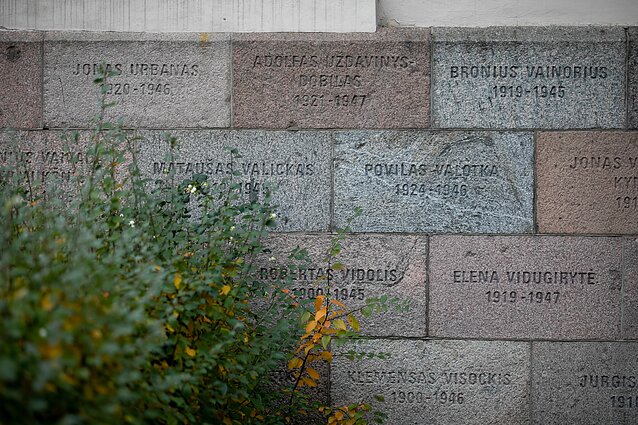
With the memory of the executed 1863 rebels and “resistance members killed after the [Second World] War”, the historical meaning of the square was both “painful and explosive”.
This pain is somewhat “escalated in a disingenuous way” because of the upcoming elections and social tensions in the country, he added.
Staliūnas from the Institute of History also believes that the square is being exploited for politics.
“The politicians’ concern for commemorating the 1863 uprising participants is not genuine, it surfaces only during certain political moments, like during last year's reburial ceremony,” said Staliūnas.
“It seems that it’s similar today,” he added. “For the current political elite it’s [convenient] that the uprising was anti-Russian, therefore, no one wants to understand why and what cause the rebels fought for.”
“The ideals of the uprising participants would be somewhat foreign to the political elite today,” he added.
Manipulation. Lithuania’s parliament has adopted a law regulating activities in Lukiškės Square, quoting its historical significance. Meanwhile historians say the exact locations of the executions are unknown, the square looked differently in the 19th century, and the politicians have been capitalising on historical memory.