











Belarusian leader Alexander Lukashenko once said the country was not ready for a woman president – mockingly referring to Lithuania’s former president Dalia Grybauskaitė who "came, smiled, sat a bit and went away". As Belarus gears up for August 9 election, Lukashenko is keen to preserve his grip. RFE/RL reports from Minsk.
Belarusian President Alexander Lukashenko has openly warned that there will be no "Maidan" following mass rallies in Minsk and other towns and cities supporting potential opposition presidential candidates.
Lukashenko used the word Maidan, which became a symbol of pro-European anti-government protests after the Maidan Square in Kyiv, Ukraine, which became the epicentre of the revolution in 2014 that toppled Russia-friendly Ukrainian President Viktor Yanukovych.
Read more: Inside Belarus. People defy Belarusian authorities to resist Covid-19 pandemic
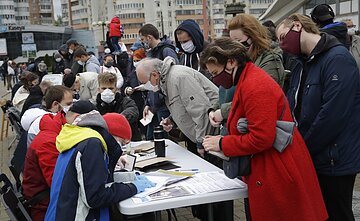
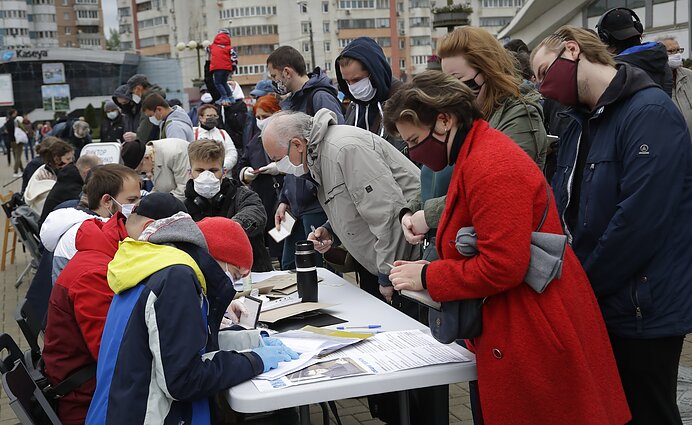
The Belarusian leader said during a June 1 meeting with the chief of the Belarusian KGB, Valery Vakulchyk, that the rallies a day earlier to collect signatures to register independent and opposition presidential candidates were organised by foreign forces, calling the demonstrations "winds blown from different sides to our Belarusian land".
"We absolutely know the goals of those wind-blowers. They want to organise a little Maidan before or during the presidential poll. [...] I want at this meeting to warn you and all those who hear me now, all those ‘maidanised’ ones. There will be no Maidans in Belarus," Lukashenko said.
In his usual flamboyant style, Lukashenko hinted that the rallies pose a threat to Belarusian sovereignty and independence, which must be "defended by the army, the KGB, and all the people".
Read more: Lukashenko is lying to Lithuania and the West – opinion
"We are not going to muzzle anyone. There are places in Minsk and other cities allocated for public discussions. I think there are six such places in Minsk," Lukashenko said, referring to six places in the city designated as areas where public discussions may take place. "Our thing is to control that, so that nothing could go over the top. There are six sites in Minsk, so go and debate there. But the KGB and police must, by all means, secure law and order."
"People can go there and discuss issues. If they want to do that in the kitchen, please do so," Lukashenko added, "So that they did not create problems for others."
People were waiting for 3-4 hours to sign in support of alternative presidential candidates. Up to 10,000 people participated in Minsk rally, thousands protested Brest, Viciebsk, Homiel. At least half-million watched live stream at @svaboda (@RFERL). It's unprecedented. pic.twitter.com/eaODuD0tse
— Franak Viačorka (@franakviacorka) May 31, 2020
Human Rights Watch (HRW) warned earlier this month that authorities in Belarus have intensified their crackdown on protesters, opposition bloggers, journalists, and other government critics with a "new wave of arbitrary arrests" ahead of the election scheduled for August 9.
More than 1,000 demonstrators joined together in Minsk on May 24 to oppose another term for Lukashenka in one of the biggest protests of the year in the country of around 9 million.
Read more: Lithuanian and Belarusian leaders hold first call in a decade
Critics of Lukashenka say his government has shown little tolerance for dissent and independent media.
He has ruled the country since 1994 and is currently serving his fifth presidential term. Belarus abolished presidential term limits in 2004.
The country has been the target of US and EU sanctions over its poor rights record and lack of fair elections, but Belarus and the West have recently sought to mend ties to reduce Russia’s influence in the country.
This story originally appeared on Radio Free Europe/Radio Liberty, and was edited by LRT English for brevity.

Newsletter
Every Friday morning.