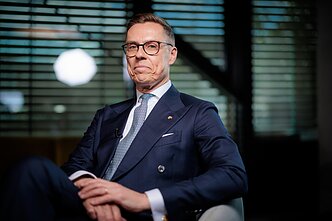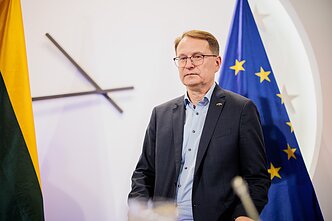



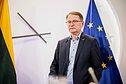



One year into Gitanas Nausėda's presidency, his record divides opinion: a unifying leader who is above petty partisan disputes or someone who looks good on TV and can be ignored by the ruling parties?
“Lithuania deserves to have a welfare state where everyone is doing well and the rich do not have to fence themselves off from the poor,” Nausėda said last May after winning the presidency.
Read more: Lithuanian president defends his 'style', calls for different political culture
Welfare state was the president's key campaign promise and is, consequently, the biggest disappointment, says political scientist Saulius Spurga of Mykolas Romeris University.
“I think that, besides talk, we haven't moved forward much. [Nausėda] hasn't developed the concept, it's not clear what is meant by welfare state and what are the stages of building it,” Spurga says.
A goal so ambitious is difficult to achieve on one's own and Nausėda may be lacking political support. Not backed by any major party – political independence was another selling point of his campaign – the president has had a complicated relationship with the ruling parties.

While markedly less confrontational with the governing coalition and the prime minister than his predecessor Dalia Grybauskaitė, Nausėda's boldest step yet was demanding the resignation of Transport Minister Jaroslav Narkevič – to no avail.
“The president declared no confidence in the minister, but he remains a minister and continues in the post. It's a defeat for the president, a blow to his authority,” Spurga says.
Critics have criticised Nausėda for failing to stand up to Prime Minister Saulius Skvernelis and Ramūnas Karbauskis, the leader of the Farmers and Greens Union which dominates Lithuania's ruling coalition.
Read more: One year in office: Lithuanians want more leadership from new president
Meanwhile the president has responded that it is simply his different style of politics that observers are not used to.
“I am not someone who escalates the situation where there is no need for that,” he said. “True, I may not agree with Mr Skvernelis or Mr Karbauskis on some issues, they may disagree with some of my ideas, but that must not undermine the general atmosphere in which we seek and find solutions.”

Ruling party leader Karbauskis has also refrained from criticising the president directly, but has lashed out at Nausėda's advisers, saying they misinform the president or misrepresent his positions.
Political analyst Kęstutis Girnius of Vilnius University says Nausėda should work more closely with the opposition.
“We have the ruling majority that is happy to ignore the president, not to do what he's asking them to do, since they have enough votes and can do without the president,” he says. “Though that may contravene his neutrality, I think he should seek closer relations with the opposition in order to push through at least some of his proposals.”
Jūratė Novagrockienė, a political scientist at the Military Academy of Lithuania, describes the current balance of political power as "cohabitation", a situation in semi-presidential systems when the presidency and the premiership are held by opposing parties.

“The prime minister and the ruling party dominate and the president is there like a cohabitant,” Novagrockienė says. “He is tall and handsome and serves the representational function very well. You can't say he's weak, it's just his situation.”
By backing down in his first year, Nausėda has encouraged the ruling coalition to disregard him, she says.
On the other hand, a president who is dignified and not trigger-happy is what voters wanted, says political scientist Mažvydas Jastramskis of Vilnius University.
“The people of Lithuania elected a man they wanted to see in the office: someone non-partisan, politically neutral,” he says. “But this means that he does not have a strong programme and one shouldn't expect from him assertive action in domestic politics.”
Moreover, it would be unfair to say that Nausėda has not achieved anything, according to Jastramskis. He successfully vetoed a law on lowering the electoral threshold and refused to allow the government to regulate prices during the coronavirus pandemic.

He has been criticised for taking the backseat during the Covid-19 crisis, but healthcare is not the area that is normally in the president's hands, he adds.
“We regard the president as a political leader who does not necessarily take political action or give concrete proposals, but is visible in the public as an encouraging, unifying presence,” he says, a function somewhat neglected by his predecessor.
However, Novagrockienė disagrees, quoting Nausėda's reluctance to move to the president's official residence as yet another sign that he does not mean business.
“Above all, he should be a state leader. [...] As long as he he is only involved in his family matters – as that is the impression one gets – he won't become one,” she says.
Nausėda himself says, one year after his election, everyone has yet to fully understand his ambition to change the political culture in Lithuania.
“If I succeed during my term to make the majority of people understand what my team and I are doing, then I will have achieved my key goal,” he said last week.

Newsletter
Every Friday morning.