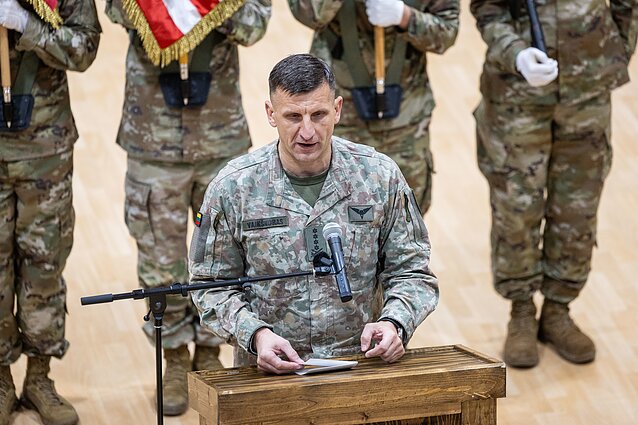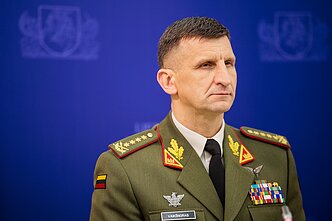














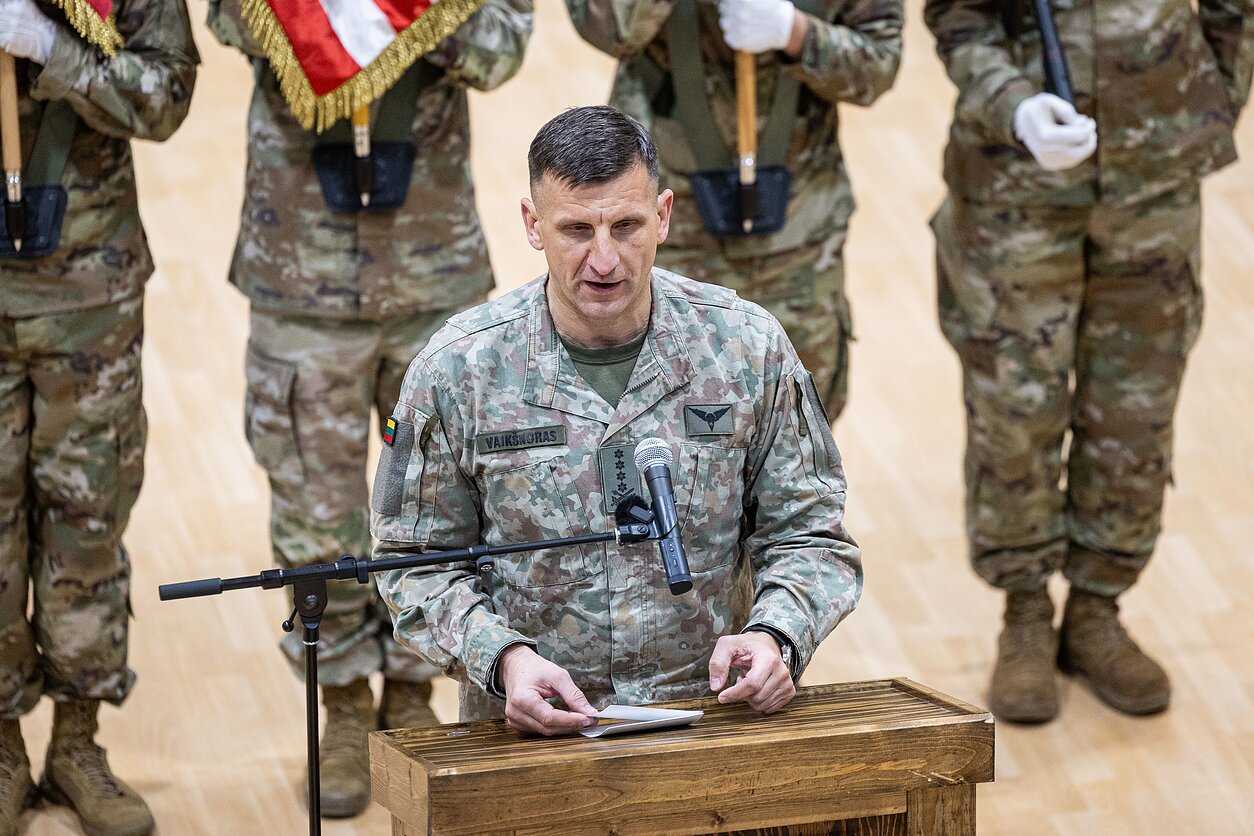
The deployment of two US rotational battalions in Lithuania was officially completed on Monday. “I think the entire Lithuanian nation breathed a sigh of relief,” Lithuanian Armed Forces Chief General Raimundas Vaikšnoras told LRT in an interview.
General, did you breathe a sigh of relief when the American flag was raised again at the Pabradė base?
Yes. And I would say I was not the only one. I think the entire Lithuanian nation breathed a sigh of relief. You will remember how much anticipation there was and how the deadlines kept getting pushed back: first to midsummer, then to the end of summer, and finally to the beginning of autumn.
By early autumn, we more or less knew the date. It was clear because certain things, which I do not want to discuss now, indicated that we were on the right track and heading in the right direction. Perhaps, for operational security reasons, this was not communicated very clearly or precisely.
Today is the big day: the Americans, the rotational forces, have returned to Pabradė, and we will begin training together.
For nine months? These are still rotational battalions. Do you have any indications or news suggesting that this arrangement will continue?
We believe this will not be a one-off rotation and that it will continue, but we will see how things develop over time. What matters to us now is having them here.
We have provided accommodation and good training conditions. The Lithuanian Armed Forces' Land Force is taking them under its wing and integrating them into its overall military training cycle. I think we have plenty of things we can work on together. The time will come, and we will find out.
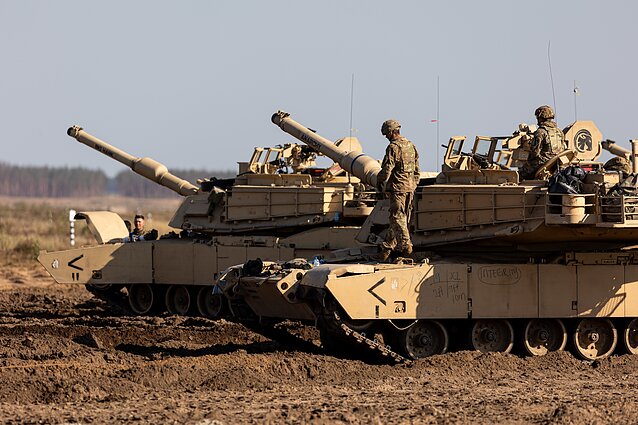
The previous rotation involved an armoured and artillery battalion, while this time it is an engineering battalion. Is this what Lithuania asked for, or are we simply making do with what the Americans have offered?
The engineers who have replaced the artillery troops bring a different level of capability, allowing other units to train alongside them. We have worked quite extensively with the artillery troops, gained a good understanding of their capabilities and what they can do, and learned how to exchange expertise.
Now we have the engineers – another new level. Other units can train alongside them, building various fortifications. By the way, I saw today that they had brought some heavy, highly sophisticated equipment. We would also like to acquire similar equipment.
I would say this is a very good preparation process, helping us understand exactly what we need and how to use this kind of equipment and machinery on the battlefield.
Despite political statements that Vladimir Putin is demanding the withdrawal of military bases from what he calls the new NATO member states, Lithuania is seeking a permanent US military base. Politicians have already signalled that Lithuania would even cover the costs of such a project. How prepared are the armed forces if such a political decision is made?
This is ultimately a political decision, and various criteria will probably be assessed. Of course, Lithuania has done a great deal of groundwork and demonstrated to our allies that we are a reliable partner.
This applies to the amount of money we allocate to defence, the infrastructure we provide, training and accommodation facilities, as well as the share of the costs we cover to make it cheaper for American taxpayers to maintain rotational forces here.
I think this is a good model for everyone else, particularly when discussing how to keep American troops on the European continent in general. I would say that Europe is still one of the wealthiest continents, and we can afford to pay for our own security. That would be both fair and honourable.
As for the Lithuanian Armed Forces, we have effectively handed over Pabradė and the infrastructure built there – the barracks and training grounds – to the Americans for almost two years now.
Of course, another factor that needs to be considered – and this will ultimately be a political decision – is that if it is eventually decided that we will have permanent military bases here, families may start moving in as well. We would then have to think about other things: kindergartens, schools and additional infrastructure.
All these challenges are natural developments, similar to those involved in bringing the German brigade to Lithuania. The advantage is that Pabradė is not far from Vilnius, a city with an international school and international kindergartens, as we already have a foreign community here. I think the logistical costs could actually be very low.

Another priority for both politicians and the armed forces is air defence. [...] Can we say that the Lithuanian Armed Forces can now detect more objects, but neutralising them remains a problem?
It was only last year that we seriously began considering what capabilities might be needed. Procurement processes are under way, certain contracts have been signed, and we are waiting for the equipment to arrive and be integrated into our systems.
Radars are a simpler matter. As you mentioned, we are covering some of the gaps and blind spots that previously existed. With relatively modern radars, we now have a much clearer picture.
Detection is taking place, but we also need to understand that, in peacetime, there is another requirement: before neutralising a target, we need to identify it visually. Visual identification is difficult, particularly at night or when objects are obscured by clouds.
Radar data may indicate that an object is very likely to be a particular type of target. Of course, there are other criteria, such as sound, speed and so on.
However, we know there are quite a few airports in the surrounding area. Particularly in summer and early autumn, light and ultralight aircraft are flying around, and they are not necessarily equipped with transponders, as these were not mandatory.
We are now looking at how to improve these processes in cooperation with air navigation services.
The specific incident – [the drone that entered Lithuania earlier this month] – showed that identification is already, I would say, at around 10 out of 10. The procedures also worked perfectly – another 10 out of 10. The only thing left was neutralisation.
Unfortunately, until we have our own capabilities, this will remain an issue that still needs to be addressed.

Newsletter
Every Friday morning.