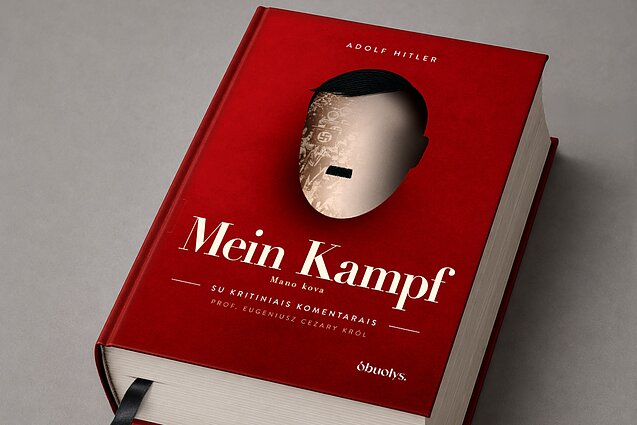

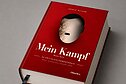











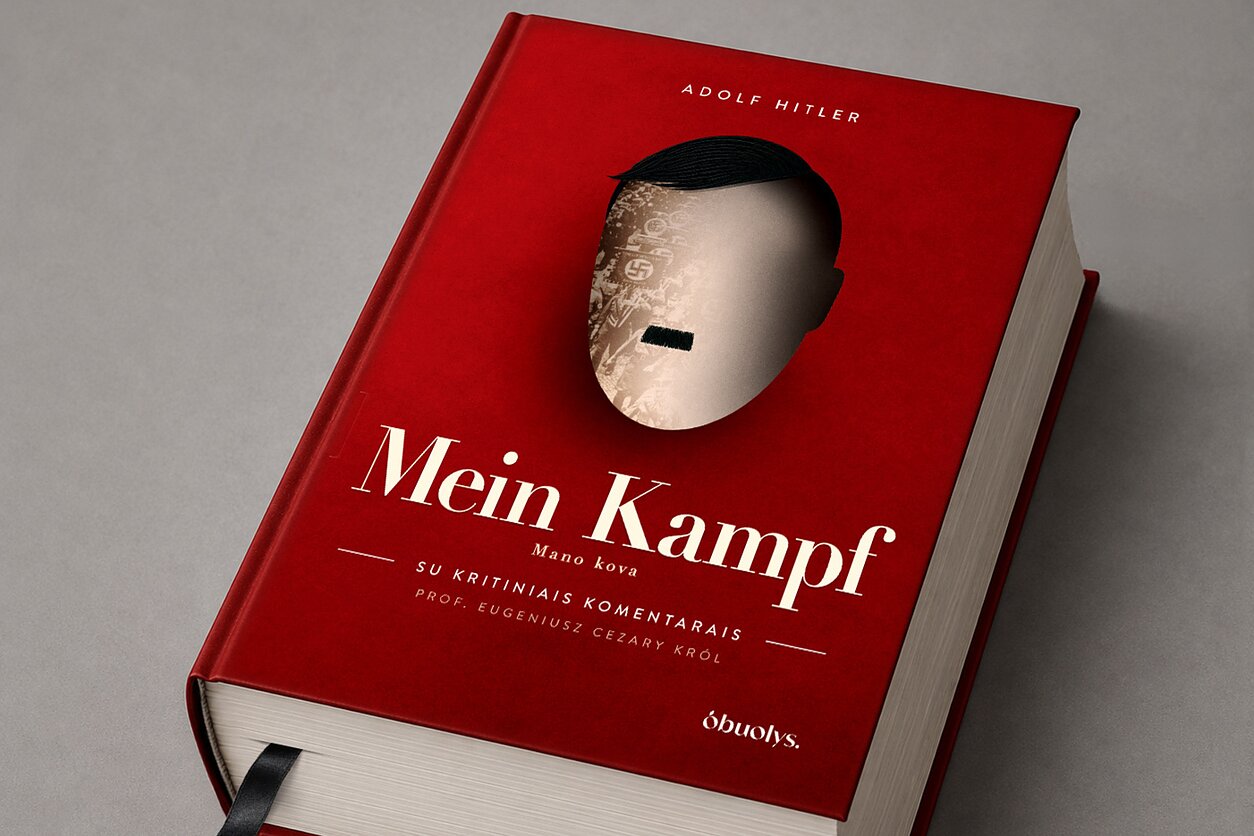
Plans by Obuolys publisher to release a critical edition of Adolf Hitler’s Mein Kampf in Lithuanian has sparked heated debate. While the publisher says the book should serve as a lesson for future generations, some experts question whether now is the right time for such a publication to appear in Lithuania.
In a statement to the media issued on Thursday, Obuolys said Hitler’s 800-page book would be accompanied by more than 1,500 footnotes, comments and explanations.
These were prepared by Polish historian and political scientist Eugeniusz Cezary Król, while the translation was done by Jolita Navickienė. The foreword was written by Arūnas Bubnys, acting head of the state-run Genocide and Resistance Research Centre of Lithuania.
“Mein Kampf should be read as a historical warning, showing the consequences that an ideology of hatred and the rejection of democracy can have,” Bubnys writes in the foreword.
Król, who prepared the critical commentary, has spent more than five decades researching 20th-Century German history, National Socialism and political propaganda, the publisher said. His critical edition of the book was published in Poland in 2021.
Obuolys also says the book, due to be released in late December, is intended to serve as a lesson for future generations.
Culture Minister Lukas Alsys is sceptical about the publisher’s plans.
“If you asked me personally whether this is the right time to publish this book in Lithuania, I would say probably not. Perhaps we should refrain from publishing such controversial books, even with critical commentary,” the minister told the BNS news agency last week.
“But since it is being published with critical commentary, the academic community should assess it once it comes out: whether the comments and insights provided alongside the text reflect the historical context of today and how we view events from the past,” Alsys said.
The minister said that although critical analysis contributes to historical scholarship, it was important not to overlook the fact that the book was produced by the Nazi regime.
“Nevertheless, this is probably also an element of scholarship and history that requires fresh and critical assessment. We do the same in Lithuania, for example, with all books and works of art published during the Soviet period: we examine them critically,” he explained.

An attempt to profit?
Historian and ethics teacher Dr Algis Bitautas told LRT.lt that he had reviewed the 65 pages of the book available on the Obuolys website, including the introductory texts by Bubnys and Król.
“Some questions arise because there is no reasoned explanation of why the decision was made to publish this book now. Nor is there any explanation of why the Polish edition was chosen. Was it financially more convenient for the publisher, or did they acquire the rights to that edition?
“Since the book will undoubtedly attract a range of reactions, I would have preferred the 2016 German two-volume edition published by the Institute of Contemporary History, with its genuinely professional commentary. [...] In that edition, two-thirds of the pages consist of commentary, while only one-third contain Hitler’s own text,” Bitautas said.
“It is obviously difficult to check everything at this stage. But one colleague pointed out that the Lithuanian edition will differ from the Polish one in the number of comments, too – there will be fewer of them. [...] So far, this information has not been provided either on the back cover of the book or in Bubnys’s text, including the Lithuanian foreword,” he added.
Bitautas also questioned why a commercial publisher was preparing a book of this nature.
He pointed out that the book listed for publication on the website of the Martynas Mažvydas National Library of Lithuania does not mention Hitler’s name, even though both the author’s name and portrait appear on the cover.
“We can only speculate, because the publisher has a rather poor reputation in the book industry, partly due to its previous translations. Is this an attempt and a desire to make a profit, or even to provoke? We can see how much public attention it has already attracted, even though the book itself has not yet been published.
“If the intention was to produce a genuinely scholarly edition, it should unquestionably have been carefully prepared and approved by scholars from either the Lithuanian Institute of History or the Genocide and Resistance Research Centre of Lithuania, rather than being a commercial undertaking,” Bitautas said.
A gift to Kremlin propaganda?
Philosopher Gintautas Mažeikis has also criticised the publisher’s decision. He said that, while Russia continues its war against Ukraine, the Kremlin’s propaganda machine could exploit the publication of the book in Lithuania.
“Could Vladimir Putin and his aggressive propagandist ideologues have been given a better gift than the publication of this book in Lithuania now?” Mažeikis wrote on Facebook.
He said that even the “correct and critical” commentary by Król would not help.
“Russian propaganda will not comment on Król’s or Bubnys’s texts. It will use the fact that the book has been published as supposed ‘proof’ of Nazification. I do not support publishing this book now,” Mažeikis said.
He stressed that the critical edition had been published in Poland in 2021, before Russia launched its full-scale invasion of Ukraine.
The philosopher also questioned the purpose of the publication, arguing that academics could read the book in other languages, while the general public might not be interested in its scholarly commentary.
Mažeikis said the publisher’s decision could also require an explanation from Lithuania’s Foreign Ministry.
Responding to the philosopher’s criticism that the Kremlin’s propaganda could exploit the book’s publication, the publisher said it disagreed with his argument.
“The Kremlin’s propaganda does not need facts. It finds ‘Nazis’ in Lithuania, Ukraine and Poland, regardless of what our publishing house publishes. [...] If we tailored our cultural and academic decisions to what the Kremlin might distort, we would be giving it the right to decide what Lithuanians are allowed to read,” the publisher said in a response sent to the ELTA news agency.
Obuolys stressed that critical editions of Mein Kampf had already been published in Germany, Poland and other European countries.
“Anyone looking for Nazi ideas will find this book the worst possible choice. Adolf Hitler’s main arguments are explained and refuted in the historian’s commentary,” the publisher said.
Bubnys: an important historical warning
According to Daiva Latinienė, head of publishing projects at Obuolys, the decision to release the book this year was linked to the centenary of the publication of the second volume of Mein Kampf.
“This text has existed in various forms and on various platforms throughout this time. It has never disappeared. It is freely available online. You can even buy all sorts of versions of it in online bookshops. We did not specifically choose this particular time for its publication.
“But the aim is to make the text available not as bare propaganda, but as a scholarly edition explaining manipulative propaganda, the history itself, all the conspiracy theories and so on. The debate about timing is strange, because it is interesting to ask when would be the right time,” Latinienė told LRT RADIO.
She said the book was intended primarily for an academic audience, including students, lecturers and historians, as well as people interested in the emergence and development of propaganda.
Meanwhile, when asked why he had agreed to write the foreword, Bubnys said that, as a historian, he had been interested for several decades in the history of the Second World War, the Nazi occupation and the Holocaust in Lithuania.
“Despite the criticism that this is the wrong moment and that it will serve Putin’s interests, I believe it is actually the right time, because this is an important historical warning showing the consequences of an ideology of hatred, the rejection of democracy and the cult of a leader.
“All these characteristics are typical of present-day Russia. Some authoritarian tendencies can even be seen in America under Donald Trump’s presidency. I do not think this edition should be dismissed as entirely inappropriate for the current moment,” he stressed.

Criticism from the Israeli embassy
Gercas Žakas, head of the Kaunas Jewish Community, said he strongly opposed the publication of Mein Kampf.
“I think there are more important things to publish. [...] Hitler’s ideas initially seemed harmless even to those in his inner circle. And look what came of it,” he said.
The Israeli Embassy in Lithuania has expressed outrage over Obuolys’s plans. The diplomatic mission is urging the publisher to reconsider its decision, which it says insults the memory of Holocaust victims.
“The Embassy of Israel in Lithuania expresses its deep shock and dismay at the intention to publish and distribute a Lithuanian translation of Adolf Hitler’s Mein Kampf – the toxic manifesto that laid the ideological foundation for the systematic annihilation of millions of people, including approximately 95% of Lithuanian Jewry,” the embassy said in a Facebook post last week.
Amid rising antisemitism, Holocaust distortion and extremism around the world, the question of making such a publication available to the general public must be addressed, the embassy said.
“We recognise the importance of academic and historical research, but there is a fundamental difference between controlled scholarly research and the commercial distribution of a hate-filled manifesto on bookshop shelves. For Lithuania’s Jews, who still bear the deep scars of the Holocaust, this book is not merely a theoretical historical artefact – it is a particularly potent symbol of genocidal hatred,” the embassy said.
The diplomatic mission urged the publisher and other stakeholders to demonstrate historical sensitivity and social responsibility and reconsider a decision which, it said, undermined the shared commitment to fighting antisemitism and intolerance.
Asked whether the publisher had consulted the Lithuanian Jewish Community before deciding to release the book, Obuolys did not give a direct answer.
However, it noted that the publication had been prepared in cooperation with Holocaust historian Bubnys, who had overseen the historical accuracy of the translation.
“The book is dedicated to the memory of those who suffered under the criminal regime and is intended as a lesson for future generations. [...] Remembering the victims also means understanding what led to their deaths. This cannot be disrespectful to the victims – on the contrary, it is a way of remembering them and ensuring that this never happens again,” the publisher said.
Obuolys plans to invite the Lithuanian Jewish Community and Holocaust researchers to the book launch, which will be attended by Król.

Law provides an exemption
Article 524 of Lithuania’s Code of Administrative Offences prohibits the distribution or display of Nazi symbols. Violators face fines of up to €700, while heads of legal entities can be fined up to €1,200.
However, the Communication Department of the Lithuanian Police told the BNS news agency that the law also provides for an exemption.
No liability applies for the distribution of Nazi symbols when this is done for the purposes of museum activities, public information about historical and current events or totalitarian and authoritarian regimes, education, science, art, collecting, or the trade in antiques and second-hand goods.
Bitautas pointed out that the publisher had failed to communicate sufficiently about the legal aspects of the issue.
This means that Hitler’s book is also covered by the exemption.
Publishers’ association expresses concern
On Friday, the Lithuanian Publishers Association set out its position in a Facebook post.
“At a time of rising antisemitism and hate speech, it is particularly important to assess the consequences of commercially distributing such a publication.
“We recognise the importance of historical and academic research, but support the concerns voiced in society about the need to demonstrate sensitivity, wisdom and responsibility. We also support calls for the publisher to reconsider its decision to translate and distribute this book,” the association said.
The critical edition is planned for publication in a print run of 1,000 copies. The publisher has not disclosed how many advance orders it has received.
The Nazi dictator wrote the first volume of the book while serving a sentence at Landsberg Prison following the failed Munich Putsch of 1923. The volume was published in 1925, with the second following in 1926.
The ideas set out in the book later became the foundation of Nazi Germany’s policies: racial hierarchy and antisemitism, the destruction of democracy, the principle of an infallible leader, territorial expansion and the pursuit of Lebensraum – “living space” – in Eastern Europe.

Newsletter
Every Friday morning.