

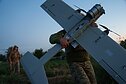














Lithuania’s Chief of Defence Raimundas Vaikšnoras has warned that military radar systems could again mistake drones for flocks of birds, saying the armed forces must rely on visual identification before deciding whether to engage suspicious flying objects.
Vaikšnoras also revealed that Lithuanian forces nearly opened fire on an ultralight aircraft last spring after it appeared in the country’s airspace.
“Let’s be realistic, this is physics, and we will probably mistake one for the other again, perhaps more than once,” Vaikšnoras told LRT RADIO on Tuesday, referring to the possibility of confusing drones with birds.
He said the military needed reliable means of visual identification, including cameras or scrambling fighter jets. The latter, he said, was currently the most flexible and straightforward way to quickly reach different parts of Lithuania and establish whether an unidentified object was a flock of birds or a human-controlled aircraft.

“There were several incidents that perhaps were not widely discussed. Last spring, we were almost at the point of having our finger on the trigger, but it turned out to be an ultralight aircraft that had somehow entered our airspace,” Vaikšnoras said.
He added that the military had since improved its procedures in cooperation with air navigation authorities, including measures to quickly close restricted airspace in specific areas to prevent similar incidents or potentially catastrophic consequences.
Vaikšnoras said firing a fighter jet’s missile at a drone entering Lithuanian airspace was currently the most effective and fastest way to destroy it.
However, he stressed that Lithuania could not afford to protect its entire territory with an impenetrable air defence system.
“People and our citizens need to understand that we could not cover the entire territory of Lithuania with an iron dome, and we will probably not be able to do so in the near future, because it would cost billions,” he said.
He also emphasised that peacetime rules of engagement require visual confirmation before a target can be destroyed.
The military must establish that an unidentified object is not a civilian aircraft or another vehicle operated by someone who has accidentally entered restricted airspace, such as an ultralight plane, hot air balloon or paraglider.
Otherwise, an attempt to eliminate what appears to be a threat could itself result in a catastrophe, Vaikšnoras said.
An air alert was declared in parts of Lithuania on the night of November 11 after a drone entered the country’s airspace from Belarus. NATO fighter jets identified the object but failed to shoot it down.
NATO’s Baltic air policing mission operates from bases in Lithuania and Estonia.

Newsletter
Every Friday morning.