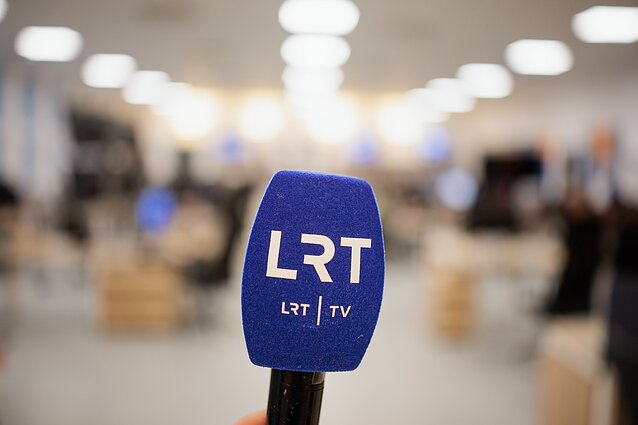














Lithuania’s parliament adopted watered-down changes to LRT on Tuesday following widescale protests attracting tens of thousands of people.
“We have a law, which was supported by a majority. The use of public funds by LRT will be more effective,” Parliament Speaker Juozas Olekas told lawmakers.
The protest organisers, including Association of Professional Journalists (ŽPA), as well as the LRT staff protest committee, welcomed the softened changes, saying that demonstrations had an effect in stifling plans to take control of the public broadcaster.
What changes were adopted?
A parliamentary working group was formed following initial protests in December last year, which expanded the scope of the proposals beyond the initial plans to change how the director general was elected and dismissed.
Some of the most contentious proposals included editorial oversight and contractual agreements with the government, but were later dropped.
WHAT HAS BEEN DECIDED
- The supervisory LRT Council will be expanded from 12 to 15 members. Newly included NGOs will gain the right to delegate additional members, but the majority of the Council will still be delegated by politicians.
- The term of office for council members will be shortened from six to four years, with a newly introduced two-term limit. Reputation and competence requirements will be tightened.
- The LRT Council will have the right to hold open or sector ballots when voting to choose the next director general. An office will be established to handle the administrative activities of the Council.
- The same person may serve as head of LRT for no more than two consecutive terms and can be dismissed more easily, including if they fail to meet requirements or commit a serious violation.
- The new provisions will apply to the current head of LRT, meaning the current director general can also be fired more easily.
- A five-member LRT management board will be established.
- LRT’s mission has been enshrined in law: to ensure the public's right to be informed, strengthen democracy, citizenship, culture and language, and combat disinformation based on the principles of pluralism, impartiality and human rights.
- Editorial decisions will be based on new editorial policy guidelines, which will be approved by the chief editors of the radio, TV, and digital departments.
Despite calls by the LRT staff and media watchdogs to depoliticise the supervisory council, it will now include more civil society reps but will remain dominated by political delegates.
The parliament and the president will nominate eight out of 15 members, which means the broadcaster's independence will lack “a solid institutional foundation”, Reporters Without Borders (RSF) said in a statement on Monday.
The changes will also apply immediately, meaning the law could be used to unseat the current director general, the RSF said.
The Venice Commission and the RSF called for these amendments to be scrapped for the law to be in line with the European Media Freedom Act (EMFA), which requires public broadcasters governance to be able to resist political interference.
The LRT director general, Monika Garbačiauskaitė-Budrienė, said the administrative changes, including the new management board, “will cost taxpayers an additional €300,000 a year, while making decision-making more cumbersome and slower”.
“LRT’s institutional independence has been weakened, and its management has been completely over-bureaucratised,” she said in a post on Facebook on Tuesday, adding that she hoped the opponents would appeal to the Constitution Court.
Why are there changes to the public broadcaster?
Politicians first announced last year they planned to make it easier to unseat the director general, saying it was done in response to a financial audit that found shortcomings.
The audit recommended administrative changes, but did not call for stricter editorial or management control.
Further reading
Critics said the lawmakers were trying to unseat the director amid long-standing claims that LRT’ was more critical of the Social Democrat-led government and the country's president, who took an active role in forming the ruling coalition.
However, an earlier political neutrality audit of LRT found no shortcomings. The decision itself to launch such a probe was criticised as encouraging self-censorship and political oversight of editorial decisions.
How big was the opposition?
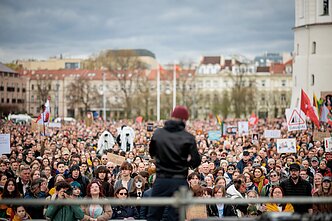
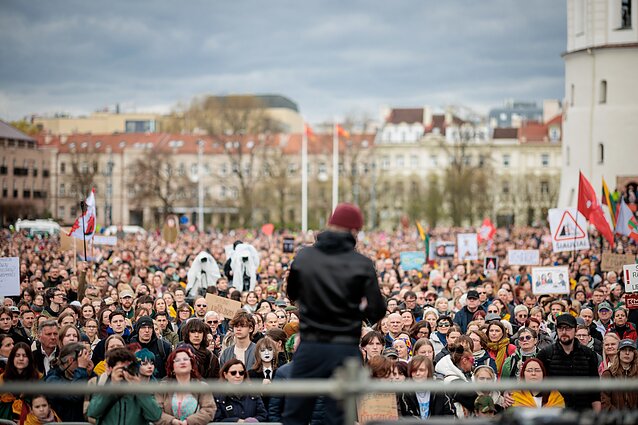
The protests started last December and lasted until April this year, subsequently attracting between 10,000 and 30,000 people at larger rallies, according to police and media estimates. Over 143,000 people also signed a petition, making it the most popular online petition to date.
Many of those who rallied in the streets said the changes were part of broader anti-democratic reforms pushed by the populists in the Social Democrat-led government.
The European Parliament also adopted a resolution criticising the bill in April 2026, with domestic and international bodies, including members of the European Broadcasting Union (EBU), calling for changes to be scrapped.

Newsletter
Every Friday morning.