














Lithuanians may soon be able to pay for food, medicine, and fuel during emergencies without an internet connection, the central bank says, as it seeks alternatives to current payment systems.
The solution would require citizens to update their bank cards. Lithuania’s central bank is also exploring national payment systems to reduce reliance on international cards like Visa and Mastercard, though commercial banks are sceptical and critical of another proposal: legally requiring more ATMs and bank branches.
In Vilnius, the city centre along Gedimino Avenue, once lined with ATMs, now has only four. In the rest of the country, the situation is even worse. Residents say that the network of ATMs and bank branches is insufficient, especially in suburban and rural areas.
“People still need and want cash,” said one local.

Residents note that authorities should consider how people could shop without cash in case of power outages, as happened recently in Spain.
The central bank has been considering offline payments since 2024, prompted by concerns over the war in Ukraine. Citizens would not need to take any action other than receiving a new bank card once their current Visa or Mastercard expires.
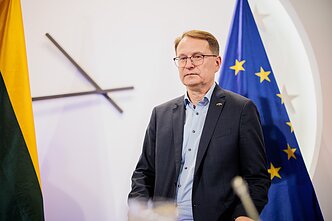
“You could buy essential items for a week – specifically food, medicine, and fuel – up to a set amount,” said Gediminas Šimkus, head of the Bank of Lithuania.
Eivilė Čipkutė, head of the Lithuanian Banks Association, said the new cards already include the necessary technology. “These same cards would be used for payments. They are just slightly newer generation cards. People already get them when their current card expires,” she said.

Currently, Lithuania relies on American Visa and Mastercard networks. Many European countries are developing national payment systems to ensure alternatives exist; Poland and Sweden already have theirs. Lithuania aims to launch its system by 2030.
“Such systems in Europe today are not just backups for emergencies; they are used daily, both in physical stores and online,” said Evaldas Ruzgys, a board member of the Bank of Lithuania.
Commercial banks, however, suggest a broader European solution would be preferable, given that citizens can already pay globally through cards, phones, smartwatches, rings, and various apps.

The central bank also wants more ATMs and bank branch access in regional areas. Proposed legislation would require commercial banks to install ATMs, and branches could be either permanent or mobile, operating at least once a week.
Čipkutė noted that last year, 60% of residents did not visit a bank branch at all. While an additional 100 ATMs were installed under a 2022 agreement with the central bank, over one-third remain largely unused. The Bank of Lithuania estimates that up to 50 more ATMs may be added.

Newsletter
Every Friday morning.